Virtual Visuals add to Authentic Engagement

The difference between participating in a cyber educational event via a webinar and one via a virtual world  is dramatic.  When I first started to explore the use of virtual worlds to determine potential use in education I asked, “why not just use an online meeting software package? A webinar allows voice, is in real-time, allows sharing and collaborating, includes chat and sidebar conversations as well as the benefits of not having to waste time in travel and logistics of a F-t-F event”.  The use of an avatar and mechanics of having to find the right outfit for her to wear, to have her transport, walk and sit in a virtual auditorium seemed a little silly.

Avatars attending a building Class at NCI on SL. Snoopy was a classmate.

Having participated in both types of events I can now say that, for me, the Virtual World experience is much more connected.  Even a ‘talking head’ presentation with a Powerpoint is more active in the 3D virtual world than participating in a 2D webinar.  I have observed that in a 3D environment the audience seems more likely to ask questions and provide commentary which adds to the information and addresses adult learning principles.  The chat texts I have saved from regular ISTE sessions are much longer and more interesting than the ones I have from Elluminate and Meeting-Place sessions I have attended.  They are also less formal, more natural.

When I attend a “flat” webinar I have a tendency to multi-task, to have the webinar on in the background while I do some other work at my desk.  Conversely, when sitting in an audience of avatars there is a feeling of presence.  I look around and see who else is there, I may chat with someone I know, introduce myself to someone I don’t know and contribute to the conversation in local chat for everyone’s benefit or chat privately on the issues being discussed.  I rarely do other work and concentrate on the topic at hand.   I am more engaged.

Virtual events that incorporate instructional strategies such as grouping participants, taking “field trips”, and interacting with content in the environment are even more engaging and push participants to participate.

A class getting ready to go on a field trip

The use of the virtual world medium is still evolving and it seems the majority of decision makers have yet to be convinced of potential educational merits.   I was not convinced until I had mastered some basic avatar communication and mobility skills and had participated several times in sessions that were of particular interest with skilled presenters.  I have paid more attention to the cartoons in virtual worlds than to an unattached voice and a whiteboard on my computer desktop.

Gallery

Can a Paracosm in a Virtual World Contribute to Creativity?

This gallery contains 6 photos.

According to a recent Newsweek article, The Creativity crisis, the Creativity Quotient (CQ) among American children has been dropping steadily since 1990.   This drop in CQ correlates with the exclusive focus on the teaching of standards and the preponderance of television … Continue reading

NASA STEM Challenge for Grades 9-12 InWorld

A competition from NASA provides a challenge for High school students, in 2 phases. In phase 1 students have an opportunity to work cooperatively, in teams of three-to-five students, as engineers and scientists to solve real-world problems related to the James Webb Space Telescope. Final solutions from this first phase of the challenge are due on Dec. 15, 2010.

Teams who complete Phase 1 are then paired with participating college engineering students for Phase 2, the InWorld phase of the challenge. Each InWorld team will refine designs and create 3-D models of the Webb telescope.

For more information about the challenge, visit http://www.nasarealworldinworld.org/.

Virtual Worlds Via the iPhone

Movement controls inworld on an iPhone

Accessing virtual worlds via the iPhone with Pocketmetaverse is possible but there are limitations. Yes, I do have the new iPhone 4 and yes I have downloaded an array of apps to test out my new toy. I have found that I can enter the virtual worlds of both Second Life and Reaction Grid, chat locally and in IM mode, teleport and be teleported, see what friends are online and view profiles, search for people and places, look through inventory, listen to media and even move my avatar, no flying.

the inworld view on an iPhone

The experience is somewhat outer-body, however. On the iPhone you cannot see the action, you cannot even see your avatar beyond a yellow dot among the green dots. A friend told me I was like a zombie, there but not there, not knowing when I was bumped and not being able to interact beyond chat. This access relegates the experience to a web social networking one.

The application is available on the iPad, I have not seen that one in action. If it is possible to view the visuals in the 3D worlds there could be some educational potential to interact in and to consume the virtual world, without that view the virtual world becomes a flat one.

Culture and Foreign Language, Virtually

Learning of foreign languages can be somewhat of a challenge in the United States, partially due to proximity to countries where another language is spoken, yet global perspectives are essential and better  addressed through a multi-lingual  and multi-cultural citizenry.  “According to the American Council on the Teaching of Foreign Languages, a higher percentage of students are studying a foreign language than at any time in history.”  The Case for Foreign language Classes Education Week ( July 12, 2010).  Students need to become prepared to conduct business and compete in a global economy, our competitors across the globe are addressing it.

Foreign language instruction is an area that can be handled effectively through virtual environment experiences.  Foreign language teachers will tell you that practice in the native tongue with native speakers is a “best practice”.  In real life it often includes field trips, at the very least to a local restaurant or community,  students from affluent homes may participate in a trip abroad.

In a virtual environment, students can be placed in a variety of social situations, with native speakers, to practice newly acquired linguistic skills. There are instant translators available in virtual worlds that can translate written text to a limited degree, and/or students may turn on voice and actually practice speaking with individuals from another country.   Environments can be constructed to elicit the practice of particular vocabulary such as sporting, arts, cultural, or social events.  Students (through avatars) engaged in conversation and interaction will naturally acquire cultural lessons as well.

ESOL students could use the environment similarly.  A characteristic that encourages language practice for the second language learner is the ‘security’ of the avatar.  Students learning a foreign language may express a reluctance to speak, for fear of being made fun of.  An avatar representation offers some shielding from potential or perceived ridicule.

A virtual setting may very well be the most ‘natural’ setting we can provide, at a reasonable cost, for foreign language instruction.

Visual Arts in The Virtual World

The virtual world is of course a visual art in and of itself, but there is potential to provide learning experiences in a virtual setting that would otherwise be impossible in the real world.  In my experience, the world of visual arts can be brought to students to consume in 4 ways.

First the traditional way of walking around a museum and looking at the art.  One of the most extensive museums in the virtual world that I have seen is the Dresden Museum on Second Life (Dresden Gallery 120,128,26), which houses 750 masterpieces of European art.  An avatar can walk around the museum  and see the famous art, clicking on it to get information as it is desired. This method of learning about the art mimics a strategy used in the real world.

An avatar floats down Rumsey's Map Museum tower

The second method takes the display and viewing of works to a different level, literally.  Here an avatar can view a large collection of artwork in a “museum”  that can be traversed only in a virtual setting.  A wonderful example of this is the Rumsey Map Museum on Second Life ( Rumsey Maps 2 (193,201,715)).  The avatar visiting this museum  can fly through a tower to view the extensive map collection, stopping to click on any of interest to get additional information.

The third method of  learning about art in a virtual setting involves becoming a part of the art.  Art Box (Klaw 5,21,46) on Second Life has selected pieces of artwork with human subjects.

An avatar becomes a part of a famous piece of art in Art Box.

Participants are provided an opportunity to choose a painting and then click on a poseball to become the subject in the art.  The owners offer props and costumes for some of the art work.  Laguna Beach California has a real life, annual art show reminiscent of this strategy of enjoying art.  Actors dress and pose while backdrops and lighting are used to duplicate a painting in real life.   In the virtual setting the participant gets to make the art selection and become a part of it.  Certainly more immersive than just looking at it.

Sitting in Van Gogh's room. The builder created an elongated room to ensure groups of visitors had a correct view.

Finally, an avatar can visit a location and be completely immersed in the art.  In the case of Arles (168,23,29) on Second Life.  This amazing sim allows avatars to walk around Vincent Van Gogh’s paintings as they may have been seen by the artist.  The paintings are a 3D form and allow complete interaction.  An avatar can climb one of the famous yellow haystacks, sit in a cafe and enjoy the “starry night”, or even sit in Van Gogh’s bedroom.

The many museums in the virtual environment  each have policies regarding the use of the images they display.  It is best to experience them by visiting the location.

The places described here are not available to students under 18 years of age, but the methods may be used to create art locations in the Opensim grids so that students may interact with art and thus learn about it.  Better yet, students may become the producers and create these environments with art work in the public domain or even their own art work.

Collaboration is a 21st Century Skill

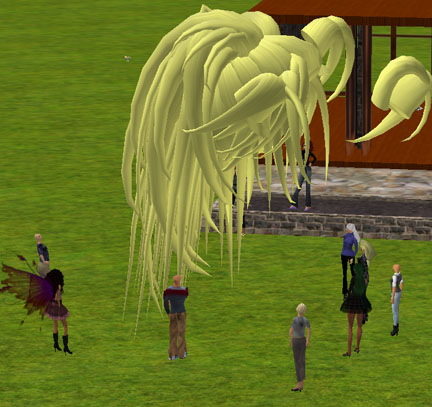
Avatars collaborating on making hair

Employers complain that the incoming workforce lacks what is needed.  Are we preparing our students appropriately for their future?   Tony Wagner in his book, The Global Achievement Gap discusses what he calls the 7 survival skills for the 21st century.  According to him these skills are:

  1. Problem-solving and critical thinking;
  2. Collaboration across networks and leading by influence;
  3. Agility and adaptability;
  4. Initiative and entrepreneurship;
  5. Effective written and oral communication;
  6. Accessing and analyzing information; and
  7. Curiosity and imagination.

These are the kinds of things we discuss in our annual reviews with supervisors and we know these skills make us more productive and useful to the organization.

Most of these 7 skills are supported with project-based  participant production in a virtual environment.  Student production in virtual environments involves building, scripting and researching to develop content.  This type of activity lends itself to a collaborative atmosphere and the ‘network’ across which students collaborate can extend across the globe. (Collaborative building in Second Life – Palo Alto Research Center). Problem solving takes place while planning and again while producing.  Limitations must be considered and decisions about the best solution take place for effective results.  Students must use mathematics and communication skills as they work together to complete their intended product.  They may need to do some research and analyze information as they progress in their building.  Discovery can take place and a plan may change or students may need to adapt a plan and influence colleagues toward a different approach.  Of course, curiosity and imagination are always at play as students build what defies common perceptions and sometimes the laws of physics.  It is the process that is most important here, what the students have to do to achieve their goal – not the final product.

VW Learning Curve

Teaching and helping someone makes the teacher a better teacher – (perhaps a case for peer mentoring).  Helping others to participate in a Virtual World requires patience, thorough comfort with and knowledge of the virtual environment, and practice.  My advice to anyone seeking to encourage colleagues to use a virtual environment for education is to first become something of an expert and practice giving assistance to others whenever an opportunity arises,  it will make you a better instructor.  Good teachers know the answers and how to best instruct partly because they have heard the same questions so many times and they have had to explain to many students with a variety of learning styles and requirements.  There is a learning curve in using virtual worlds.  When individuals become frustrated they often want to quit, give-up.  To keep the frustration at bay the teacher/helper needs the solutions in the adequate amount at the correct time in the appropriate modality for the learner.  Adopting the use of virtual environments in education is going to take time.