Virtual Worlds as Part of a Transmedia Literacy Experience

Transmedia Storytelling is a strategy that uses current and emerging technologies along with traditional strategies to enable the participant to become immersed in a story to increase engagement and understanding.  Henry Jenkins, Professor of Communications, Journalism, Cinematic Arts, and Education at the University of Southern California, explains that “In transmedia, elements of a story are dispersed systematically across multiple media platforms, each making their own unique contribution to the whole.” It is a strategy that is used in the world of marketing and entertainment, still lagging in the education sector.

Telling stories across multiple platforms and formats addresses multiple learning modalities, encourages participation and motivates participants.  Stories are used to teach a wide variety of concepts at all levels of education.  A virtual world with a sim designed to draw students into a “game”  could potentially result in a high level of learning of a literary work, historical event, or scientific phenomenon.  The compelling attributes of transmedia storytelling are the capacity to engage participants and the capacity to promote creativity among the participants.  Engagement is crucial to meaningful learning and creativity is identified as a 21st Century skill necessary to solve problems and be competitive in a global environment.  As we look into school reform and teacher preparation for 21st Century schools it may be beneficial to ensure that teachers have some knowledge and skills in the the use of Transmedia storytelling.

Teaching and Learning Options in the Virtual World

The virtual environment offers students alternative ways of learning concepts.  Educators understand that differentiating instruction is important and that we should not limit ourselves to telling and explaining.  The information in a lecture or demonstration is magnified when students are given an opportunity to actively engage in an activity that provides a way for students to practice, apply or even play with the new content.  A community college professor demonstrates a virtual world activity designed to follow a lecture and provide  students a chance to “build a molecule” in virtual space.

3 Days (53 hours) of Virtual Education Sharing

The VWBPE (Virtual World Best Practices in Education) Conference will be held in Second Life and other grids on March 17-19.  The Conference offers:

  • Theoretical and research presentations
  • Content-based describing the use of VW for teaching and learning
  • Workshops  offering technical guidance
  • Tours of virtual spaces used for education
  • Panel and roundtable discussions
  • Tools for both newcomers and experienced virtual world users
  • Game and simulation demonstrations
  • Poster presentations
  • Machinima screening and competition

Experienced virtual world participants will have the opportunity to learn and share with a global community of educators. This is also an opportunity for experienced users to introduce more reticent colleagues  to an environment that offers an alternative format for teaching and learning.

Telling isn’t Teaching… in any World

A lecture hall filled with students and an instructor lecturing about a topic he/she knows very well does not guarantee learning is taking place, neither in real life nor in the virtual world.  Good teaching requires that the students do something in order to meet the objectives of the lesson.  Student engagement can range from taking notes and asking questions to discussing and working on an assignment that requires using information and skills. The level of engagement correlates with the learning that takes place.  The video below is one created by students at Elisabeth Morrow School in Englewood NJ.  Students undoubtedly learned more than the significance of Apollo as they interacted, on various levels, to create the video.  Additional work from middle school students at this school is posted on their wiki.

Some videos illustrating the concept of changing our teaching paradigm are Ken Robinson’s Changing Education Paradigms and  Dr Tae’s Building A New Culture of Teaching And Learning .   They are not short videos but definitely worth a watch…. and a share.  The men in these two videos describe eloquently how teaching needs to change in order to impact student learning, I suggest teaching in the virtual world should have a level of engagement similar to what they advocate.

Educators who have ventured into the virtual world have some innovation and sense of adventure to begin with – just by their presence.  Instruction in the virtual world must mirror that innovation by changing the paradigm, making sure that students (whatever their age) do more than “just sit there”.  Getting students to move into groups and perform activities in the real world requires classroom management skills, and an impact on space, time, and sound that could be disruptive if not handled with expertise.  The virtual world has these elements but   it is easier to move and alter the space, it takes less time, and sound can always be mitigated with individual headphones and microphones.  The part that takes some effort is ensuring a student focus. At the lowest level of engagement, the instructor should ask students/participants for feedback and then address the questions.  For more intense interaction and more learning the instructor can:

  • provide students with instructions to complete a task, either as individuals or in a group
  • have students present findings or completed tasks to the group
  • have students develop video clips and/or pictures of concepts to be shared on a common site

In either world,  the person doing the communicating is the person doing the learning.

Gallery

Build a Virtual Biome to Master Science Standards

This gallery contains 5 photos.

Environments in virtual worlds can be realistic or fantastical, each has benefits for students both as visitors and as creators.  National and state educational standards require that students can identify, describe and understand the differences in both land and water-related … Continue reading

Gallery

Virtual Learning Communities Flourish

This gallery contains 4 photos.

Learning communities (LC) are active in the virtual environment,  consisting of like-minded individuals who have a  common interest and get together regularly over long periods of time  to both share and gain knowledge and skills.  Many of the learning communities … Continue reading

Constructivist Learning, Virtual Worlds and Future Work Skills

Teachers know that differentiating instruction is most effective and that the more involved in the learning a student is, the more that student will learn.  Thus knowledge/concept retention from lecture is significantly less than from group discussion and actual practice by doing.  As educators we also know that when an individual “teaches” or provides instruction to another they learn it better themselves.  Using gaming in a constructivist teaching environment has merit. The theory of constructivist learning comes from the philosophy that people can understand only what they have personally constructed.  The nature of constructivism:

  • is interdisciplinary with the emphasis on the learner rather than the teacher
  • requires that the learner interacts with the environment and gains understanding
  • ensures the student making meaningful connections
  • requires problem solving
  • requires personal involvement
  • is based on the application of concepts to be learned

Constructivist teachers structure learning experiences that foster the creation of meaning,  building lessons around big ideas to foster learning.  Virtual worlds used in a way that students can build, collaborate, solve problems, and teach others certainly are aligned with the tenets of constructivist teaching.

According to Gartner information, the  World of Work in 10 Years will require a similar set of skills:

  • Work Swarms -problem solving with less structured  situations
  • Weak links – work with people you don’t know or barely know
  • Working With the Collective informal groups of people, outside the direct control of the organization
  • Spontaneous Work new opportunities and creating new designs and models.
  • Simulation and Experimentation active engagement with simulated environments
  • Hyperconnectedness – existing within networks of networks, unable to completely control any of them.
  • Virtual workplace – meetings occurring across time zones and organizations  increasingly happen 24 / 7

The alignment between  constructivist learning and skills for the future make teaching in a virtual world an obvious option.

Grid Hopping: One Av / Multiple Grids

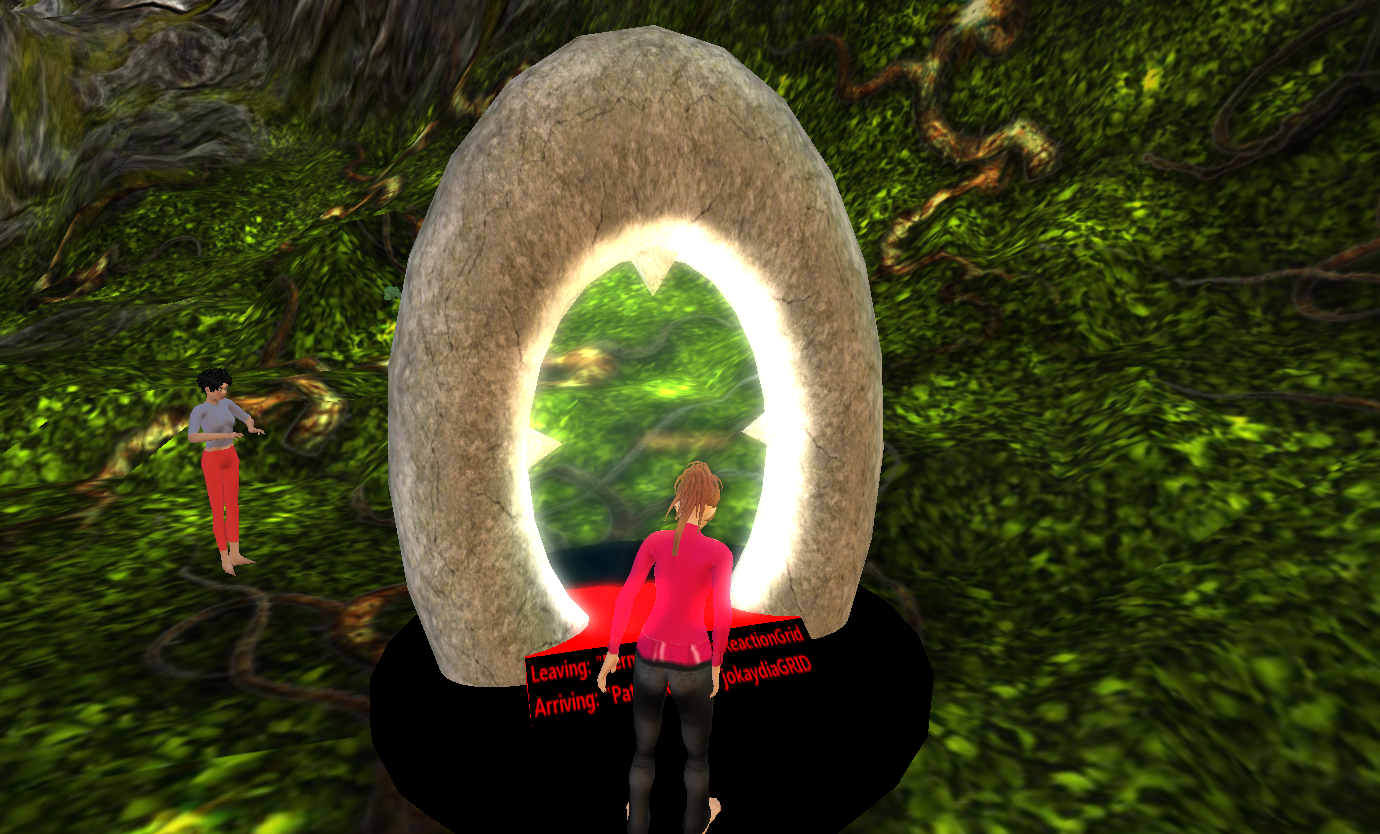
I joined an international group of “Gridizens” a couple of nights ago to experience a hypergrid.  Our Avatars teleported from one grid to another.  In this case we teleported from Reaction Grid to Jokaydia.  The technical aspects are explained on the Opensim wiki. Hopping from one grid to another – hypergridding –  is like linking from one website to another.  We do that everyday on the 2D web without really thinking too much about it, and many create those links in wikis, blogs, and in social networking and bookmarking pages.  A virtual world is a little more complicated because you have an agent or avatar that is entering the grid.  Typically, the user needs to register in each of the worlds and use a different avatar or agent, so the benefit of the hypergrid is that it allows you to use the same avatar in each of these worlds.

Entering the Hypergrid portal on Reaction Grid.

Implications for education and collaboration are significant.  Imagine being able to do extend what is now done in a flat environment like Facebook,  Google Docs, or Diigo in a 3D environment.  A single sign-on, a single username and password,  a single inventory repository simplifies entering the Virtual Universe and visiting the worlds within it.

On Jokaydia Grid with a member of the Jokaydia Grid - the tags indicate the Grid of origin for the visiting Avatars

VW – What’s the Point? Would a score help?

I have been in a cloud – in a trough of disillusionment.  As I encourage colleagues and superiors of the potential in using VW for teaching and learning – and actually get some to register and spend some (limited) time in a virtual world, I get the questions “So what is the point?”  or  “Ok I kinda get it – but is this the best way to…?”  Both are valid questions and questions like these require a thoughtful response.  Some people get it right away, others need guidance, support and demonstrations.  Many need proof – yes metrics.  A hunch is great, a description of happy children makes for good feelings but nothing works like data.

Rubrics are an effective way to capture observations and quantify what participants accomplish and the way in which they do so.  A simple rubric design may look something like this:

Communication Collaboration Problem Solving Use of Information Points
Objective: Participants will work together in teams of … to …..
Participant has minimal communication with other participants Participant works alone Participant has no unique contribution Participant includes only known information 1Points

each

Participant uses voice to effectively communicate with peers Participant demonstrates ability to work with 1 to 2 individuals primarily as a follower Participant participates in solving problems in a unique way Participant contributes to information by completing some research 2points

each

Participant uses both text and voice to collaborate with peers Participant collaborates with peers as a follower as well as a leader Participant provides unique contributions to solve problems Participant contributes with both known and newly researched information 3points

each

Participants would benefit knowing how well they are doing and the objective in the use of the environment needed to succeed. Success depends on the process. So points are awarded when students

  • work with others to accomplish a task
  • communicate effectively
  • locate and use information effectively

Evidence vs Adult Intervention

Remember the clubhouse in the woods you built with your friends.  It was your clubhouse.  You and your friends thought of it, planned it, gathered materials, constructed it, fought about it, fought in it, plotted in it, pretended to be super-heros or knights in it, and then probably tore it down because it seemed like a good idea and it was yours to tear down.  Remember the playhouse that the little girl down the street had.  Her father built it for her.  It was a beauty; A door with hinges and a door knob, heart-shaped shutters, flower-boxes, shingles, matching curtains and furnishings.  She had a birthday party and everyone got to go into it but you couldn’t “mess it up”. Nobody really played there much, it collected spiderwebs.  It sat forever – a monument to adult intervention.

As I listened to the ISTE Speaker Series on SL Tuesday night, Knowclue’s message was most profound.  She said she is a stickler on students building and making their own environment in SL Teen Grid and now on Reaction Grid where she provides instruction.  I sat in the audience and asked “what evidence do you have of student achievement?”  My thoughts were focused on what so many educators are thinking about:  test scores, numbers, Adequate Yearly Progress, achievement data, standards.  Of course these are important quantifiable data points and so is the remarkable build that her students created.

A student build in a virtual world - minimal adult intervention.

The evidence is that children built a community based on a unit of study.  The student Build required the use of communication, collaboration and problem solving (those 21st Century Skills).  It required the use of mathematics and integration of an artistic sensibility.  The students had to read/research and take notes, write, and compute.  Knowclue has a clue and she also has evidence.  The student product is the evidence.  The students will be tested in the standards at the end of the year and those scores too will be reviewed – together they form the picture of evidence.  My hunch is the students who build will demonstrate more learning gains than the students who have it built for them,  look to the evidence.