Gallery

Living Literature in Virtual Worlds

This gallery contains 7 photos.

The use of Virtual Worlds to explore and enhance the literary experience is a useful activity for pre-reading, ongoing as a specific piece is read, and/or  as reinforcement after the reading is complete.    The value of a virtual world in … Continue reading

As The Virtual World Evolves

Many virtual worlds require the downloading of a particular viewer to access the virtual world and to interact with it.  Some require nothing but the web, a browser and a current operating system.  Jibe is one of those worlds which I was able to visit recently.
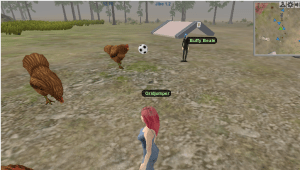
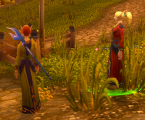
Walking amongst giant chickens in JIbe. They clucked and pecked but I survived.

The look  is similar to OpenSim or Second Life and the feel is like these worlds in MouseView, kind of takes getting used to.  Creating in the environment seems less laborious than the virtual worlds  I typically visit.  The creation/building tool, available as a free add-on, is reminiscent of what you see in a typical graphics program.

A flat terrain in JIbe is "brushed" with hills.

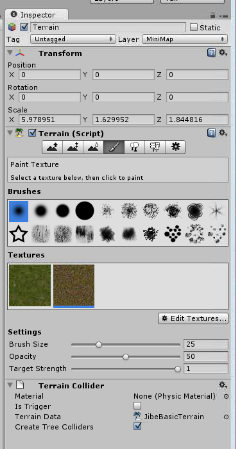
Changing the terrain is as simple as painting with a digital brush. Adding a field of ferns was a s simple as dipping the brush into the “fern” paint and then brushing the terrain in with ferns.

Ferns "painted" into the terrain do not require individual placement.

I  got the feeling that the creation and building within this web-base world was simpler than in the virtual worlds requiring a special browser.  The interaction was not as smooth or easy for me.  It seemed a little unstable but impressive that any of it could be done on the web on my Macbook Pro in Safari.  Perhaps the potential lies in the limitations and lack of complexity.

The Jibe Tools.

The registration was simple (name and password),  avatar selections are reasonable and there is an asset store with objects for free and for purchase.  The items can be imported into Jibe and placed, moved, and rotated as desired to complete the environment.

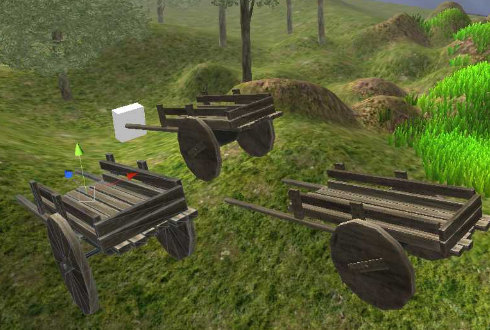
A Cart from the asset store is duplicated and added to the environment.

The simplified interaction and limited choices in this web-based world reminded me  of the new “basic” browser in Second Life.  Both types of virtual worlds are changing, maybe to accommodate an audience maybe to make a profit, maybe because people have a natural inclination to improve and change what they have.  For whatever reason, the end user will ultimately benefit.

Gallery

Genetic Study via Virtual Pets and Plants

This gallery contains 5 photos.

Can the virtual world SL breedable pets such as  Meeroos and breedable plants such as Sibotanicals provide some opportunities to learn about biological and botanical genetics?  The breedables are an amusing addition to the virtual setting, as the scripting progresses, the concepts of DNA and … Continue reading

Geography Standards via Terraforming and Virtual Mapping

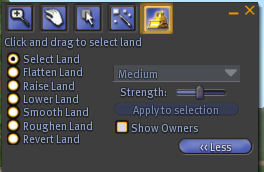
Forming continents, islands, mountains, valleys and rivers works with mashed potatoes, beach sand, mud in the back yard and pixels in the virtual world.  Terraforming physical landform characteristics including  mountains, valleys, rivers, oceans, lakes and beaches is as easy as a click with a mouse on the correct tool and then sliding or moving the mouse in a circular motion to raise, lower, flatten, roughen and smooth the land.

The terraforming tool options are basic and easy to understand

The size of the area as well as the strength of the tool is adjusted as desired.  A little practice in an empty “sandbox” is typically enough to get the “feel” for pressure and size attributes.  Adding Flora and fauna to the newly formed topography is an opportunity to learn about climate, elevations and ecosystems.

A map view of a sim on Reaction Grid

Geography standards include various elements of map reading.   Reading the maps in a virtual world and being able to zoom in provides not only the opportunity for recognizing the use of a legend, direction, location and distance, but also the ability to see  influences of hydrology and physical characteristics of a place.

Middle School Students Build A Virtual World

The students in “Norma Underwood’s” class in an Arizona public school are building and scripting in a 3D environment, sculpting in Rokuro, collaborating on projects, and communicating with their peers and interested visitors.  I had the opportunity to visit Norma’s  virtual class space on Reaction Grid,  never having to leave my home state over 2000 miles away.  What a treat  to see 12 and 13 year olds assembling, communicating and cooperating in a medium that many are completely unaware of.

The class is an art class, lucky for these students they have a teacher who acknowledges and has taken the time to learn an art medium for the future.  The young architects and 3D artisans have used floor-plans to build 3D homes, decorated them and added items like video games and chess sets. Learning objectives  focus primarily  on standards in the area of art and mathematics. Additionally, Norma is incorporating 21st Century objectives like collaboration, communication and problem solving.  These are not as easily tested in the traditional assessments required by the state but obvious in the products the students have created and obvious as well when you watch them engaged in their work.

The 1st Question 10 April 2011

My appearance on The First Question was an experience welcomed in order to better understand Virtual World possibilities for teaching and learning.  It was fun…but I do have to admit I was a little nervous, it was a “publicly broadcast” show.  Once I got over the very real feeling of “how do I look, how do I sound” I played my role and enjoyed the moment.  Implications for education are obvious.  Of course there is the game scenario with factual questions, a common strategy for quizzing and reinforcing curricular knowledge.  But more subtle was the actual experience that students could benefit from.  Essentially all the behaviors employed to make the show work; public speaking, taking part in a studio show with a live audience, following a set of rules, preparing, listening, being a cordial loser, being on time, following direction, collaborating and communicating effectively.  All skills and behaviors helpful in any workplace.  The one that really stands out is public speaking.  In all of our standardized testing of reading , writing , math and science – we never really assess public speaking.  Not that I advocate yet another test, but providing instruction and practice in this necessary skill is clearly lacking.  Just take a listen to some public figures, company chiefs, spokespeople and even some news reporters.  We often hear inadequate articulation of ideas, distracting verbal tics, and poor grammar.  So maybe a fun virtual TV show giving students a chance to play different roles, articulate ideas, converse with each other and instructors would provide some valuable practice in the language art we take for granted, speaking.

Vodpod videos no longer available.

Virtual Worlds as Part of a Transmedia Literacy Experience

Transmedia Storytelling is a strategy that uses current and emerging technologies along with traditional strategies to enable the participant to become immersed in a story to increase engagement and understanding.  Henry Jenkins, Professor of Communications, Journalism, Cinematic Arts, and Education at the University of Southern California, explains that “In transmedia, elements of a story are dispersed systematically across multiple media platforms, each making their own unique contribution to the whole.” It is a strategy that is used in the world of marketing and entertainment, still lagging in the education sector.

Telling stories across multiple platforms and formats addresses multiple learning modalities, encourages participation and motivates participants.  Stories are used to teach a wide variety of concepts at all levels of education.  A virtual world with a sim designed to draw students into a “game”  could potentially result in a high level of learning of a literary work, historical event, or scientific phenomenon.  The compelling attributes of transmedia storytelling are the capacity to engage participants and the capacity to promote creativity among the participants.  Engagement is crucial to meaningful learning and creativity is identified as a 21st Century skill necessary to solve problems and be competitive in a global environment.  As we look into school reform and teacher preparation for 21st Century schools it may be beneficial to ensure that teachers have some knowledge and skills in the the use of Transmedia storytelling.

Teaching and Learning Options in the Virtual World

The virtual environment offers students alternative ways of learning concepts.  Educators understand that differentiating instruction is important and that we should not limit ourselves to telling and explaining.  The information in a lecture or demonstration is magnified when students are given an opportunity to actively engage in an activity that provides a way for students to practice, apply or even play with the new content.  A community college professor demonstrates a virtual world activity designed to follow a lecture and provide  students a chance to “build a molecule” in virtual space.

Immersive Story Telling

Vodpod videos no longer available.