Virtual Literature Circles

Facilitating a literature circle takes skill and even the most practiced practitioners sometimes have challenges in encouraging the reticent to speak up.  In her article “The Virtual Circle” Stacy Kitsis describes how she used blogging to support student participation and thoughtful reflection. This English teacher describes a number of positive observations including increases in engagement and interaction, completion of homework, and active reading.  Ms. Kitsis described how the more reticent students chose to use pseudonyms for their blogs and were ‘not shy’ with their entries.

The success described could be taken a step further by conducting the literature circles in an immersive environment.  Positive aspects achieved in blogging could be even more enhanced as students use their avatars to reflect and discuss the selected literature.  The discussions could take place in voice or in text, the latter offers an archival benefit.

Evidence vs Adult Intervention

Remember the clubhouse in the woods you built with your friends.  It was your clubhouse.  You and your friends thought of it, planned it, gathered materials, constructed it, fought about it, fought in it, plotted in it, pretended to be super-heros or knights in it, and then probably tore it down because it seemed like a good idea and it was yours to tear down.  Remember the playhouse that the little girl down the street had.  Her father built it for her.  It was a beauty; A door with hinges and a door knob, heart-shaped shutters, flower-boxes, shingles, matching curtains and furnishings.  She had a birthday party and everyone got to go into it but you couldn’t “mess it up”. Nobody really played there much, it collected spiderwebs.  It sat forever – a monument to adult intervention.

As I listened to the ISTE Speaker Series on SL Tuesday night, Knowclue’s message was most profound.  She said she is a stickler on students building and making their own environment in SL Teen Grid and now on Reaction Grid where she provides instruction.  I sat in the audience and asked “what evidence do you have of student achievement?”  My thoughts were focused on what so many educators are thinking about:  test scores, numbers, Adequate Yearly Progress, achievement data, standards.  Of course these are important quantifiable data points and so is the remarkable build that her students created.

A student build in a virtual world - minimal adult intervention.

The evidence is that children built a community based on a unit of study.  The student Build required the use of communication, collaboration and problem solving (those 21st Century Skills).  It required the use of mathematics and integration of an artistic sensibility.  The students had to read/research and take notes, write, and compute.  Knowclue has a clue and she also has evidence.  The student product is the evidence.  The students will be tested in the standards at the end of the year and those scores too will be reviewed – together they form the picture of evidence.  My hunch is the students who build will demonstrate more learning gains than the students who have it built for them,  look to the evidence.

Advisory Panel to Offer Obama Ideas for Advancing STEM Education

Advisory Panel to Offer Obama Ideas for Advancing STEM Education.

Gallery

Machinima in Education

Creating films for learning is not new in K-12 education nor has the strategy  been limited to magnet programs or exclusive schools that offer high-level technology classes and/or broadcasting.  Teachers have used filmmaking  as a way to help students learn … Continue reading

Social Learning in Immersive Environments

Much is discussed on the topic of Social Networking and the potential use of this technology in education.   Research indicates that individuals benefit from a social approach to learning.  L. Rendell et al. states that “Social learning (learning through observation or interactionwith other individuals) is widespread in nature and is centralto the remarkable success of humanity…” .  Immersive environments have gained acceptance in post-secondary education for the past several  years. VLearning: Is The Future Of Online Education A 3D Virtual Classroom? describes several studies that determined a positive correlation between the increased interaction among classmates and instructors in virtual classrooms and involvement in the course work and comprehension of material.  It states, “… this to be particularly true for students who have a difficult time engaging in face-to-face discussions, but who will ask questions freely and contribute to live debates in a virtual classroom.”

In their book The New Social Learning Bingham and Connor devote a chapter to the topic of social learning in immersive environments, describing the successful uses in multiple corporate training programs.  Social learning involves interaction, engagement and mutual exchange and benefit to participants.

The research on the  successful use of immersive environments in professional development and post-secondary education are certainly reason to consider exploring these strategies in the K-12 sector.

Beyond Powerpoint: 2D to 3D in Virtual Worlds

In an in-world presentation, Lesley Scopes aka Light Sequent presented ‘Learning Archetypes as tools of Cybergogy: A structure for eTeaching in Second Life to VWBPE 2010.  The presentation was worth watching  for the information that was presented, but of particular interest was the presentation method.  Lesley used 3D world tools to present rather than bringing the more frequently used 2D tool (PowerPoint) into the 3D world.  This made the presentation more engaging than presentations I typically attend.   The 3D models brought a unique physicality to the presentation that served to interest the audience.

A 3D representation is used to make a point

The presentation took advantage of tools not available in a 2D platform and perhaps demonstrates the evolution of 2D to 3D much like the evolution of overheads to PowerPoint was a few years ago.  Using the tools available in virtual worlds requires that the presenter have some skills in the area of building.  Light Sequent explained that the 3D items could contain scripts for additional interaction between audience and information 3D graphic. At the very least the presenter should be able to place the correct 3D object in front of the audience at the appropriate time but the actual building of the objects could be built by someone adept at building.

I look forward to using this method of presentation in the future, though I’ll need to label objects carefully so I don’t accidentally place a shoe or a silly gadget in front of my audience.

Gallery

The Value of Play

This gallery contains 4 photos.

Play connects us to others, fosters creativity, helps with social skills, motivates and increases cognitive growth, according to Vygotsky’s research on play.    We like to play and we learn from playing, so playing in a virtual setting seems to be logical enhancement … Continue reading

Teaching Math in The Virtual World

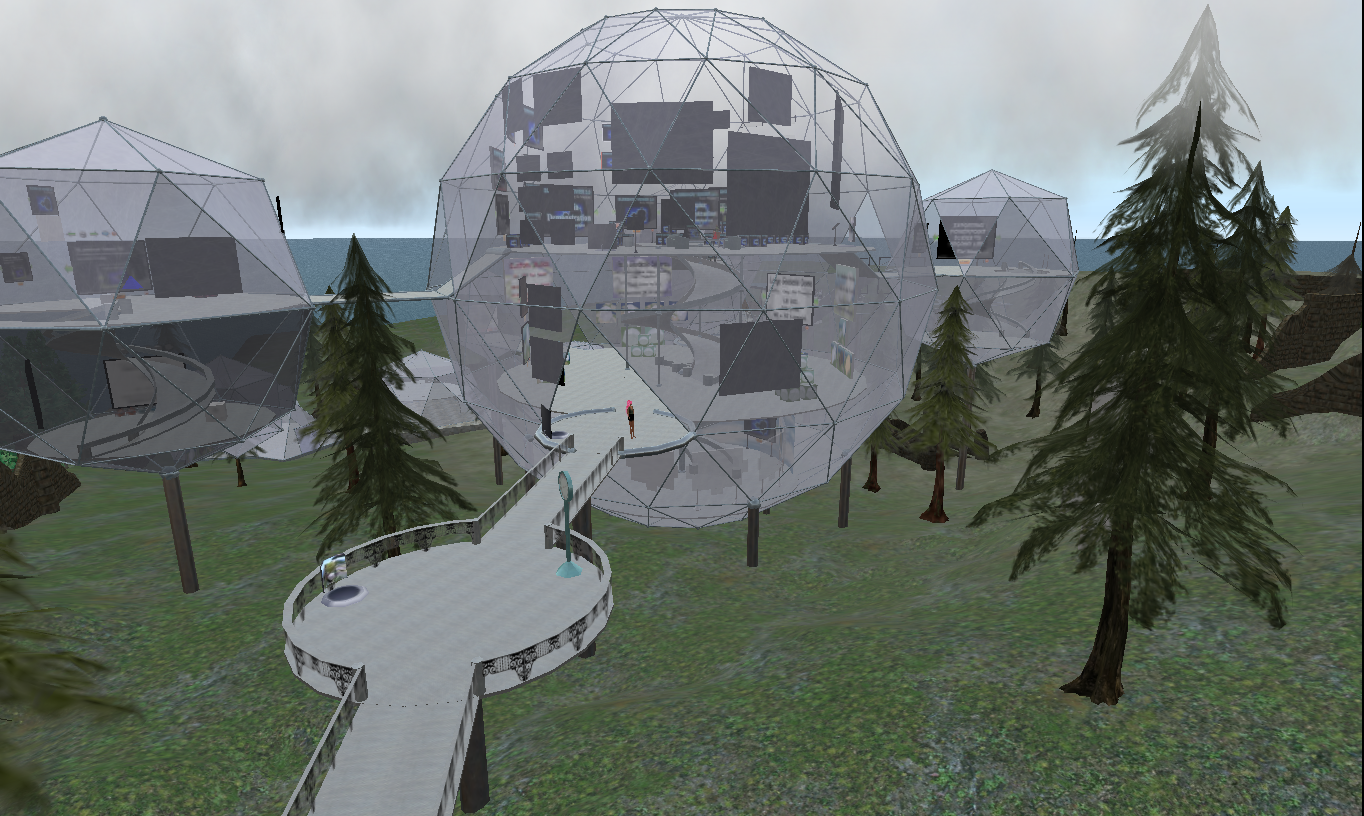
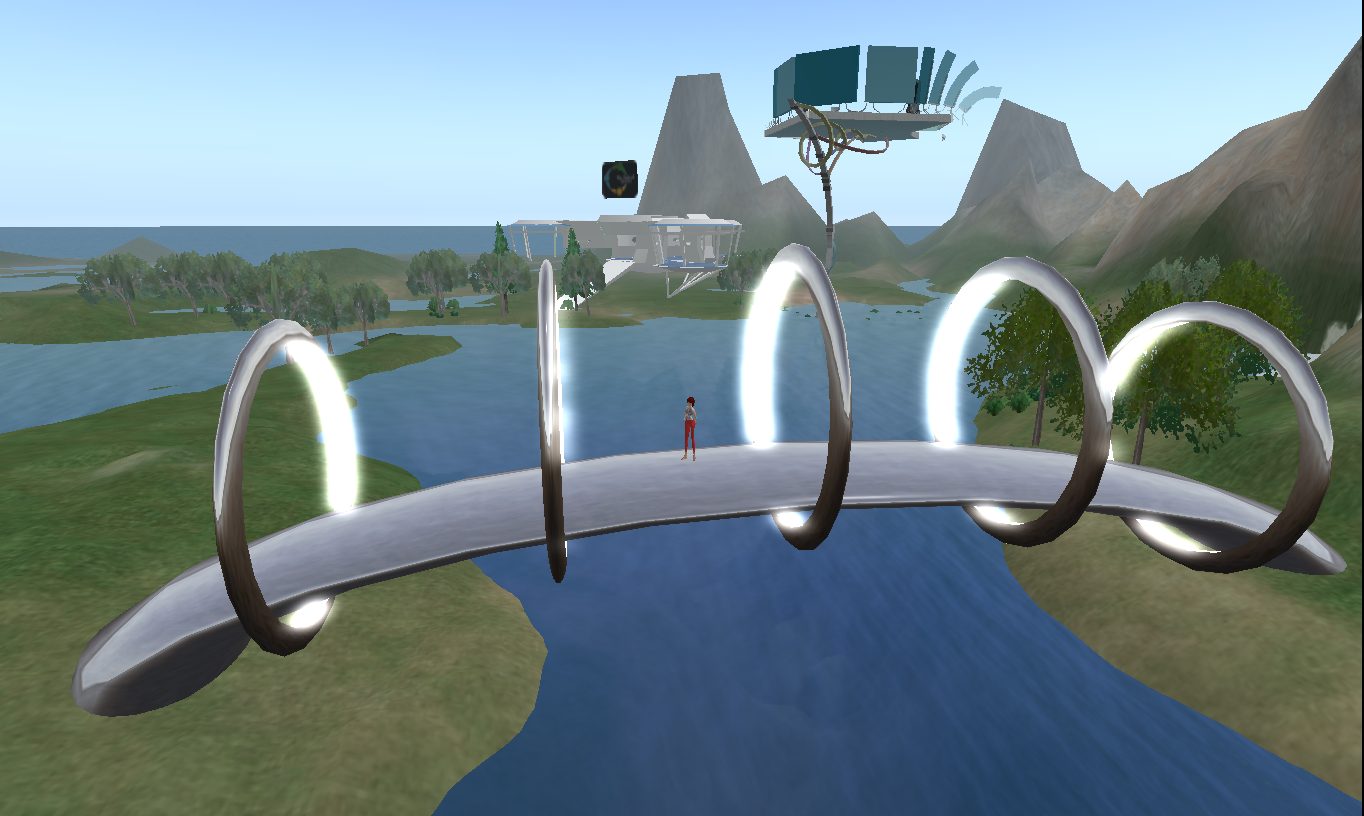
Mathematics may be one of the most obvious ways to use a virtual world for teaching and learning, particularly when students are in the building capacity.  Students can practice applying   mathematical concepts, while being creative and having fun.  Geometry comes alive as an avatar creates and moves 3D shapes around to construct a real or imagined structure, graphical representations are concrete rather than theoretical.

A geodesic structure in SL

A bridge in Reaction Grid

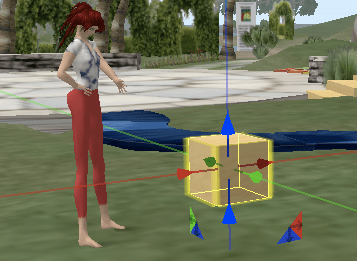
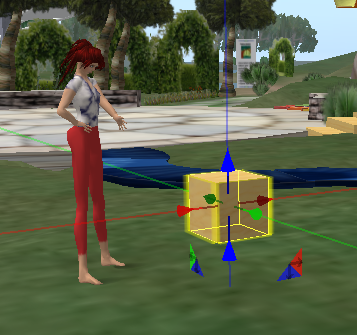
The tools in the virtual world are simple enough that even elementary school children can use them.   Learning to use these tools may even provide some preliminary knowledge and skills for future use of  more complex engineering CAD tools. Once the students create the shapes (which takes seconds) the 3D polygons can be moved about, enlarged or reduced in size, stacked, linked, rotated, twisted, tapered, even suspended in the air at the click of a mouse.  Students can adjust shapes and angles to fit ‘building blocks’ more precisely, they have the use of coordinates and measuring tools to support their building and learning.  The most important part is the process, not the final product, though the final product may contribute to discussion regarding the feasibility of the structures in real  life.  The process of building and solving the problems of fitting virtual shapes together to construct a planned structure is what makes students think and apply the mathematical concepts.

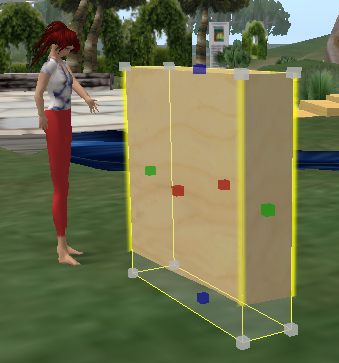
'Building' a block

Adjusting dimensions of the cube.

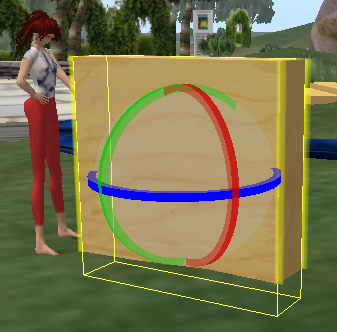
Rotating the adjusted cube.

Here an avatar creates a cube and then transforms it to a thinner taller rectangular shape, then rotates it to get it in the correct position.

The syllabus of an educational technology class at Boise State is an example of prospective teachers being provided an opportunity to learn  the skills necessary to use this medium for future instruction in K-12 classrooms.  There are multiple examples of K-12 teachers providing ‘building’ opportunities on the SL Teen Grid and on Reaction Grid  to their students. As these students apply mathematical concepts and address required standards they also practice some 21st Century skills such as innovation, collaboration and problem solving.


Virtual Visuals add to Authentic Engagement

The difference between participating in a cyber educational event via a webinar and one via a virtual world  is dramatic.  When I first started to explore the use of virtual worlds to determine potential use in education I asked, “why not just use an online meeting software package? A webinar allows voice, is in real-time, allows sharing and collaborating, includes chat and sidebar conversations as well as the benefits of not having to waste time in travel and logistics of a F-t-F event”.  The use of an avatar and mechanics of having to find the right outfit for her to wear, to have her transport, walk and sit in a virtual auditorium seemed a little silly.

Avatars attending a building Class at NCI on SL. Snoopy was a classmate.

Having participated in both types of events I can now say that, for me, the Virtual World experience is much more connected.  Even a ‘talking head’ presentation with a Powerpoint is more active in the 3D virtual world than participating in a 2D webinar.  I have observed that in a 3D environment the audience seems more likely to ask questions and provide commentary which adds to the information and addresses adult learning principles.  The chat texts I have saved from regular ISTE sessions are much longer and more interesting than the ones I have from Elluminate and Meeting-Place sessions I have attended.  They are also less formal, more natural.

When I attend a “flat” webinar I have a tendency to multi-task, to have the webinar on in the background while I do some other work at my desk.  Conversely, when sitting in an audience of avatars there is a feeling of presence.  I look around and see who else is there, I may chat with someone I know, introduce myself to someone I don’t know and contribute to the conversation in local chat for everyone’s benefit or chat privately on the issues being discussed.  I rarely do other work and concentrate on the topic at hand.   I am more engaged.

Virtual events that incorporate instructional strategies such as grouping participants, taking “field trips”, and interacting with content in the environment are even more engaging and push participants to participate.

A class getting ready to go on a field trip

The use of the virtual world medium is still evolving and it seems the majority of decision makers have yet to be convinced of potential educational merits.   I was not convinced until I had mastered some basic avatar communication and mobility skills and had participated several times in sessions that were of particular interest with skilled presenters.  I have paid more attention to the cartoons in virtual worlds than to an unattached voice and a whiteboard on my computer desktop.

Visual Arts in The Virtual World

The virtual world is of course a visual art in and of itself, but there is potential to provide learning experiences in a virtual setting that would otherwise be impossible in the real world.  In my experience, the world of visual arts can be brought to students to consume in 4 ways.

First the traditional way of walking around a museum and looking at the art.  One of the most extensive museums in the virtual world that I have seen is the Dresden Museum on Second Life (Dresden Gallery 120,128,26), which houses 750 masterpieces of European art.  An avatar can walk around the museum  and see the famous art, clicking on it to get information as it is desired. This method of learning about the art mimics a strategy used in the real world.

An avatar floats down Rumsey's Map Museum tower

The second method takes the display and viewing of works to a different level, literally.  Here an avatar can view a large collection of artwork in a “museum”  that can be traversed only in a virtual setting.  A wonderful example of this is the Rumsey Map Museum on Second Life ( Rumsey Maps 2 (193,201,715)).  The avatar visiting this museum  can fly through a tower to view the extensive map collection, stopping to click on any of interest to get additional information.

The third method of  learning about art in a virtual setting involves becoming a part of the art.  Art Box (Klaw 5,21,46) on Second Life has selected pieces of artwork with human subjects.

An avatar becomes a part of a famous piece of art in Art Box.

Participants are provided an opportunity to choose a painting and then click on a poseball to become the subject in the art.  The owners offer props and costumes for some of the art work.  Laguna Beach California has a real life, annual art show reminiscent of this strategy of enjoying art.  Actors dress and pose while backdrops and lighting are used to duplicate a painting in real life.   In the virtual setting the participant gets to make the art selection and become a part of it.  Certainly more immersive than just looking at it.

Sitting in Van Gogh's room. The builder created an elongated room to ensure groups of visitors had a correct view.

Finally, an avatar can visit a location and be completely immersed in the art.  In the case of Arles (168,23,29) on Second Life.  This amazing sim allows avatars to walk around Vincent Van Gogh’s paintings as they may have been seen by the artist.  The paintings are a 3D form and allow complete interaction.  An avatar can climb one of the famous yellow haystacks, sit in a cafe and enjoy the “starry night”, or even sit in Van Gogh’s bedroom.

The many museums in the virtual environment  each have policies regarding the use of the images they display.  It is best to experience them by visiting the location.

The places described here are not available to students under 18 years of age, but the methods may be used to create art locations in the Opensim grids so that students may interact with art and thus learn about it.  Better yet, students may become the producers and create these environments with art work in the public domain or even their own art work.