Teaching Math in The Virtual World

Mathematics may be one of the most obvious ways to use a virtual world for teaching and learning, particularly when students are in the building capacity.  Students can practice applying   mathematical concepts, while being creative and having fun.  Geometry comes alive as an avatar creates and moves 3D shapes around to construct a real or imagined structure, graphical representations are concrete rather than theoretical.
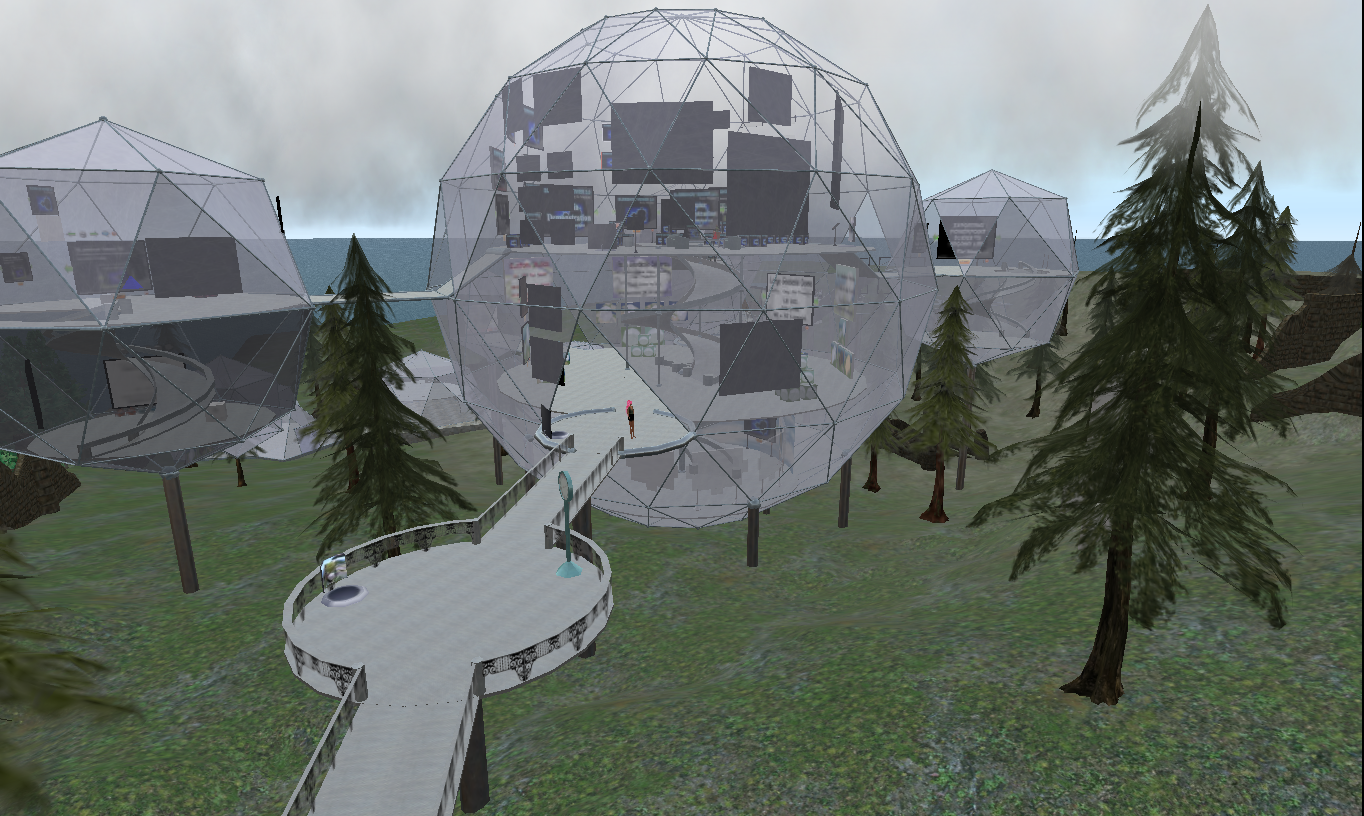
A geodesic structure in SL
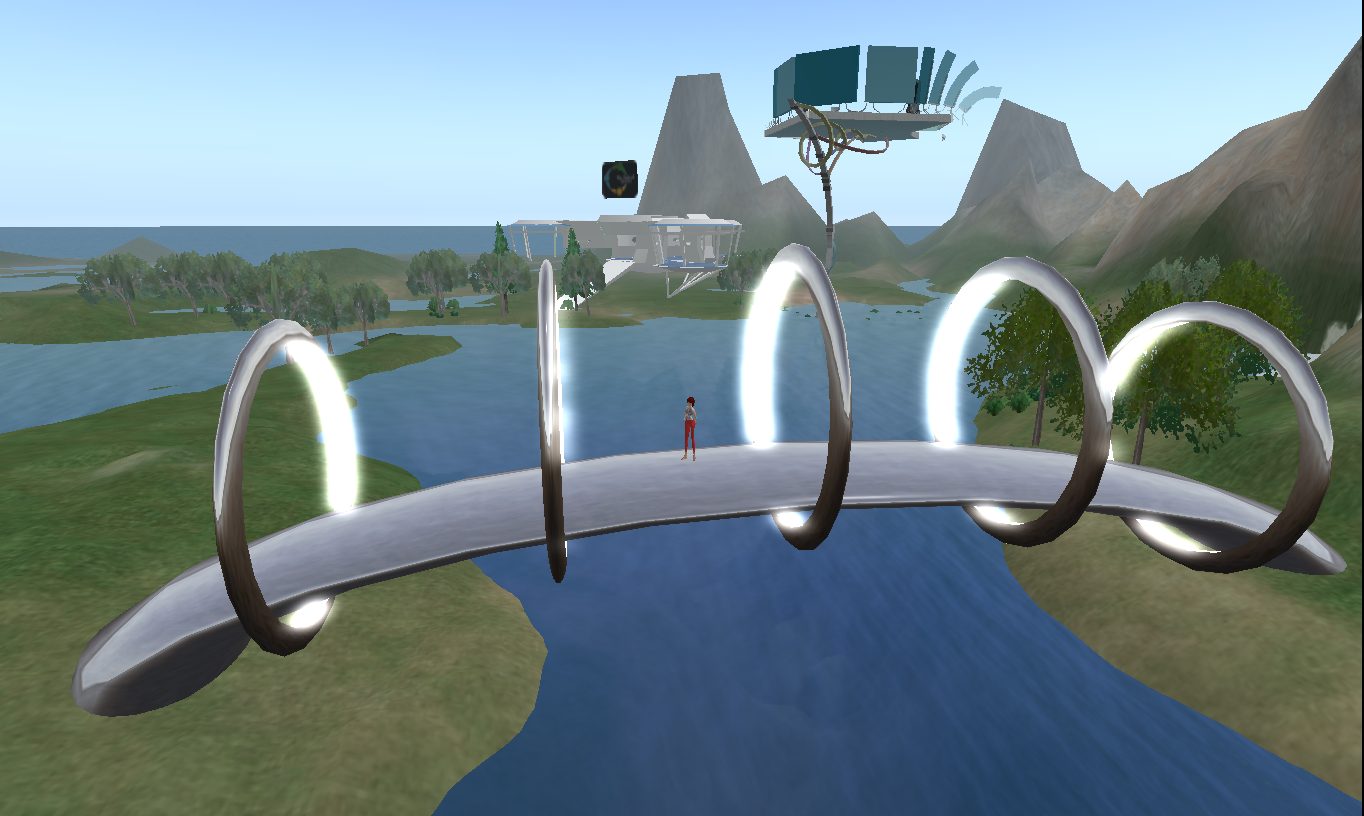
A bridge in Reaction Grid

The tools in the virtual world are simple enough that even elementary school children can use them.   Learning to use these tools may even provide some preliminary knowledge and skills for future use of  more complex engineering CAD tools. Once the students create the shapes (which takes seconds) the 3D polygons can be moved about, enlarged or reduced in size, stacked, linked, rotated, twisted, tapered, even suspended in the air at the click of a mouse.  Students can adjust shapes and angles to fit ‘building blocks’ more precisely, they have the use of coordinates and measuring tools to support their building and learning.  The most important part is the process, not the final product, though the final product may contribute to discussion regarding the feasibility of the structures in real  life.  The process of building and solving the problems of fitting virtual shapes together to construct a planned structure is what makes students think and apply the mathematical concepts.
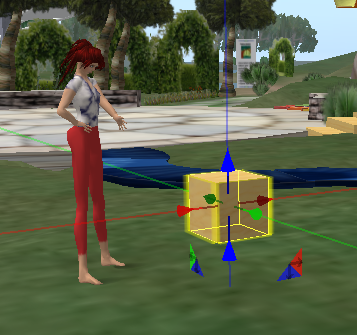
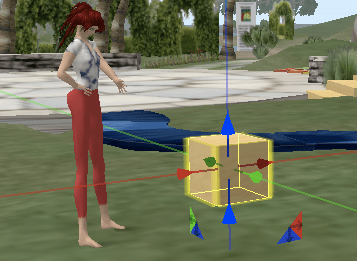
'Building' a block
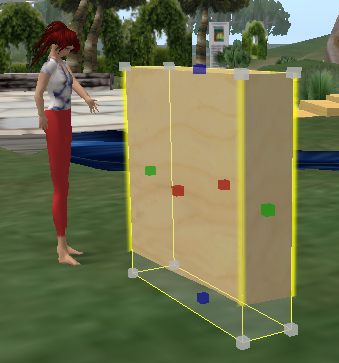
Adjusting dimensions of the cube.
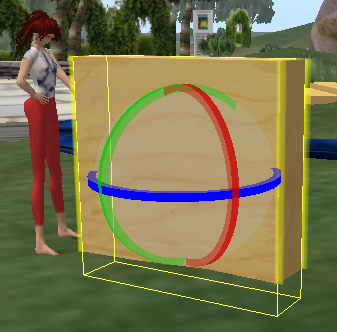
Rotating the adjusted cube.

Here an avatar creates a cube and then transforms it to a thinner taller rectangular shape, then rotates it to get it in the correct position.

The syllabus of an educational technology class at Boise State is an example of prospective teachers being provided an opportunity to learn  the skills necessary to use this medium for future instruction in K-12 classrooms.  There are multiple examples of K-12 teachers providing ‘building’ opportunities on the SL Teen Grid and on Reaction Grid  to their students. As these students apply mathematical concepts and address required standards they also practice some 21st Century skills such as innovation, collaboration and problem solving.


Gallery

Can a Paracosm in a Virtual World Contribute to Creativity?

This gallery contains 6 photos.

According to a recent Newsweek article, The Creativity crisis, the Creativity Quotient (CQ) among American children has been dropping steadily since 1990.   This drop in CQ correlates with the exclusive focus on the teaching of standards and the preponderance of television … Continue reading

Visual Arts in The Virtual World

The virtual world is of course a visual art in and of itself, but there is potential to provide learning experiences in a virtual setting that would otherwise be impossible in the real world.  In my experience, the world of visual arts can be brought to students to consume in 4 ways.

First the traditional way of walking around a museum and looking at the art.  One of the most extensive museums in the virtual world that I have seen is the Dresden Museum on Second Life (Dresden Gallery 120,128,26), which houses 750 masterpieces of European art.  An avatar can walk around the museum  and see the famous art, clicking on it to get information as it is desired. This method of learning about the art mimics a strategy used in the real world.

An avatar floats down Rumsey's Map Museum tower

The second method takes the display and viewing of works to a different level, literally.  Here an avatar can view a large collection of artwork in a “museum”  that can be traversed only in a virtual setting.  A wonderful example of this is the Rumsey Map Museum on Second Life ( Rumsey Maps 2 (193,201,715)).  The avatar visiting this museum  can fly through a tower to view the extensive map collection, stopping to click on any of interest to get additional information.

The third method of  learning about art in a virtual setting involves becoming a part of the art.  Art Box (Klaw 5,21,46) on Second Life has selected pieces of artwork with human subjects.

An avatar becomes a part of a famous piece of art in Art Box.

Participants are provided an opportunity to choose a painting and then click on a poseball to become the subject in the art.  The owners offer props and costumes for some of the art work.  Laguna Beach California has a real life, annual art show reminiscent of this strategy of enjoying art.  Actors dress and pose while backdrops and lighting are used to duplicate a painting in real life.   In the virtual setting the participant gets to make the art selection and become a part of it.  Certainly more immersive than just looking at it.

Sitting in Van Gogh's room. The builder created an elongated room to ensure groups of visitors had a correct view.

Finally, an avatar can visit a location and be completely immersed in the art.  In the case of Arles (168,23,29) on Second Life.  This amazing sim allows avatars to walk around Vincent Van Gogh’s paintings as they may have been seen by the artist.  The paintings are a 3D form and allow complete interaction.  An avatar can climb one of the famous yellow haystacks, sit in a cafe and enjoy the “starry night”, or even sit in Van Gogh’s bedroom.

The many museums in the virtual environment  each have policies regarding the use of the images they display.  It is best to experience them by visiting the location.

The places described here are not available to students under 18 years of age, but the methods may be used to create art locations in the Opensim grids so that students may interact with art and thus learn about it.  Better yet, students may become the producers and create these environments with art work in the public domain or even their own art work.

Pixel Performances

How can performing in a virtual setting help aspiring musicians? Performing in a virtual setting includes characteristics of a

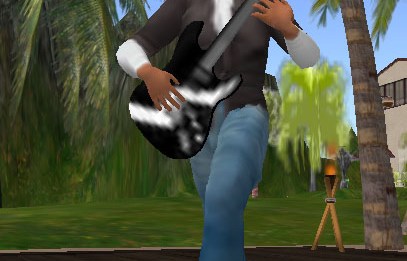
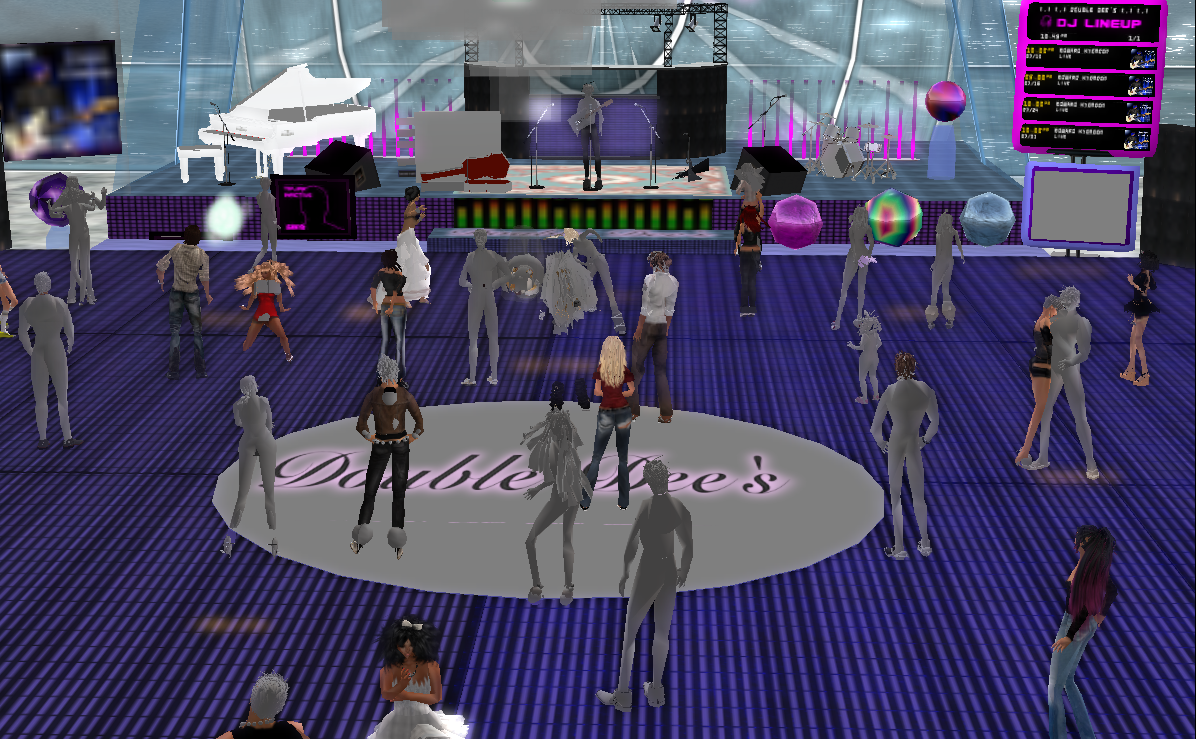
A "live" musical performance in the virtual world

real life performance as well as some unique qualities available only in a virtual world. A musician on Second Life told me it was more like being in a sound studio, missing are the auditory and visual cues that a real audience provides. In a virtual environment, you must ‘read’ your audience through chat. Setting up equipment so that you can see the computer screen while you perform allows a performer to be able to read the chat and thus respond to audience cues. Typically the audience will respond with applause and commentary, the commentary does not disrupt the performance and is typically a conversation about the performance (the lyrics, historical references, personal reflections). Another unique trait of entertaining an audience of avatars is that you can see all their names and additional ID tags providing the performer with a supply of information for personal interaction with the audience.

Technical aspects of performing online require some hardware setup as well as software to enable audio streaming. A basic requirement is a high quality microphone and a quality sound card. Some software is available online for free and some have an associated cost. Setting up to a streaming server and entering IP addresses are part of the setup. Then of course the performing avatar must develop their stage presence including attire, hair, appropriate instruments and animations. The ability to create supernatural effects to enhance a performance brings an additional magic to a virtual show that could be cost prohibitive or simply impossible in the real world.

A student who is interested in performance as a future career may be able to learn a great deal by performing in a virtual setting. There are the technical and studio aspects as well as the “live” aspects. The virtual stage can provide a feeling of “being there” without some of the barriers of physicality and on stage jitters that often accompany new performers. In a recent LA Times article, Thriving Music Scene, a musician who regularly performs inworld, and makes money doing so, states that “…the interactive experience that the virtual platform provides can actually surpass that of traditional live gigs.” Perhaps this venue can provide a “training stage” to help prepare future performers, something for our performing arts instructors/schools to consider.

Engagement and Immersion

On May 20 Iggyo wrote about Princeton’s abandoning Second Life “…replicating a campus and setting up lecture halls make little sense in a world where we can fly and where a lecture can be streamed to the flat Web. Virtual worlds are places for simulations and immersion, not recapitulation and passivity.”

It is interesting that so many universities “rebuild” their campuses on Second Life, the administration buildings, the student socializing areas and the classrooms.  When I ask, why? the response I get is something like “people need a frame of reference”.  Indeed, many of the builders I have met on SL do build structures they are familiar with or have at least visited.  The environments are true to the geography even with the flora and fauna – with an occasional fantasy figure thrown in ( a mermaid in Maine, or a Loch Ness Monster in Scotland) maybe not so true to scale, so some interpretive expression is taking place.   They take great pains to find just the right textures so the build is true to the real place.  Perhaps it is an evolutionary process – we build first what we are familiar with, we copy, replicate, duplicate, imitate.  We do what we have always done  but in a different place, in this case a virtual place.

The next step will be to do things differently and the virtual environment does encourage doing things differently.  Why talk at students about what happens when you mix certain chemicals instead of letting them do it safely and inexpensively?  Why lecture to students about a period in history instead of giving them the opportunity to experience it?  Why show pictures of an artist’s work instead of having students immerse themselves in that work?  Why describe how geometric forms fit together in building structures instead of providing opportunities for students to experiment with these structures?

Active engagement is something we say we strive for in classrooms yet we continue to tell, lecture, demonstrate, talk-at and describe.  We know that the ones doing the talking and the ones doing the doing are the ones doing the learning – perhaps the virtual environment can help to move us in that direction.  It does not make sense to gather students in a virtual room and talk at them – we have had mixed results doing it in the real world with this Talk-at-you strategy.  As Iggyo said “...Virtual worlds are places for simulations and immersion.”  Active learning produces better results in any world so perhaps taking advantage of the VW capabilities will provide what we have been unable to provide in the real world.