
Creating films for learning is not new in K-12 education nor has the strategy been limited to magnet programs or exclusive schools that offer high-level technology classes and/or broadcasting. Teachers have used filmmaking as a way to help students learn … Continue reading
Category Teaching Strategies
Federal Virtual Worlds Challenge
An open challenge to create the most innovative and interactive solutions in virtual environments.
- $25,000 in prizes
- Focus on AI
- Open to everyone
- Submission due date Dec 6 2010
Share this:

Social Learning in Immersive Environments
Much is discussed on the topic of Social Networking and the potential use of this technology in education. Research indicates that individuals benefit from a social approach to learning. L. Rendell et al. states that “Social learning (learning through observation or interactionwith other individuals) is widespread in nature and is centralto the remarkable success of humanity…” . Immersive environments have gained acceptance in post-secondary education for the past several years. VLearning: Is The Future Of Online Education A 3D Virtual Classroom? describes several studies that determined a positive correlation between the increased interaction among classmates and instructors in virtual classrooms and involvement in the course work and comprehension of material. It states, “… this to be particularly true for students who have a difficult time engaging in face-to-face discussions, but who will ask questions freely and contribute to live debates in a virtual classroom.”
In their book The New Social Learning Bingham and Connor devote a chapter to the topic of social learning in immersive environments, describing the successful uses in multiple corporate training programs. Social learning involves interaction, engagement and mutual exchange and benefit to participants.
The research on the successful use of immersive environments in professional development and post-secondary education are certainly reason to consider exploring these strategies in the K-12 sector.
Share this:
The End of the Virtual World.
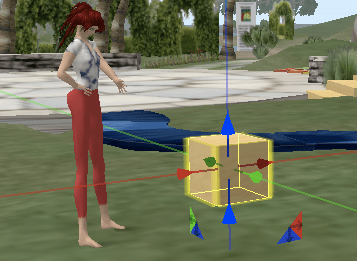
Teaching Math in The Virtual World
Mathematics may be one of the most obvious ways to use a virtual world for teaching and learning, particularly when students are in the building capacity. Students can practice applying mathematical concepts, while being creative and having fun. Geometry comes alive as an avatar creates and moves 3D shapes around to construct a real or imagined structure, graphical representations are concrete rather than theoretical.
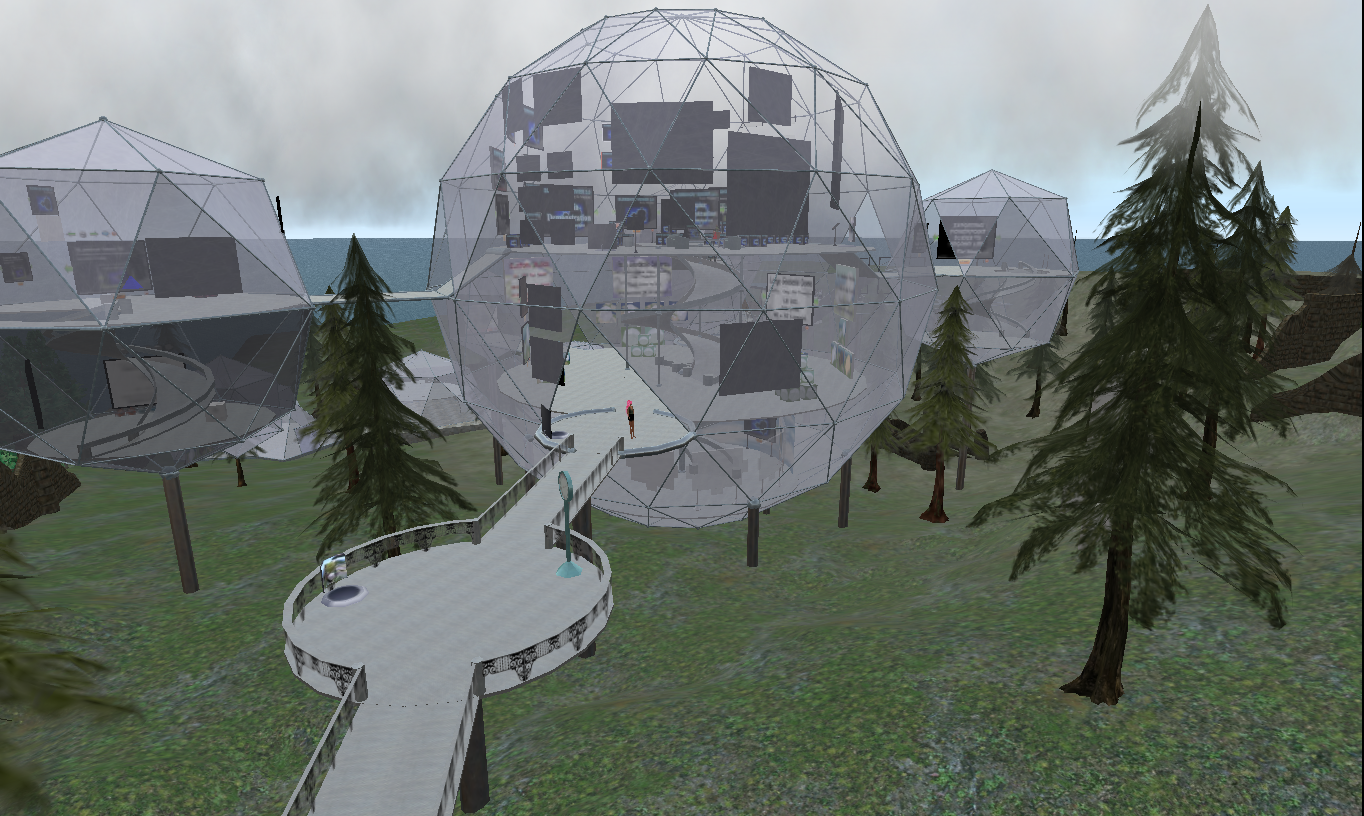
A geodesic structure in SL
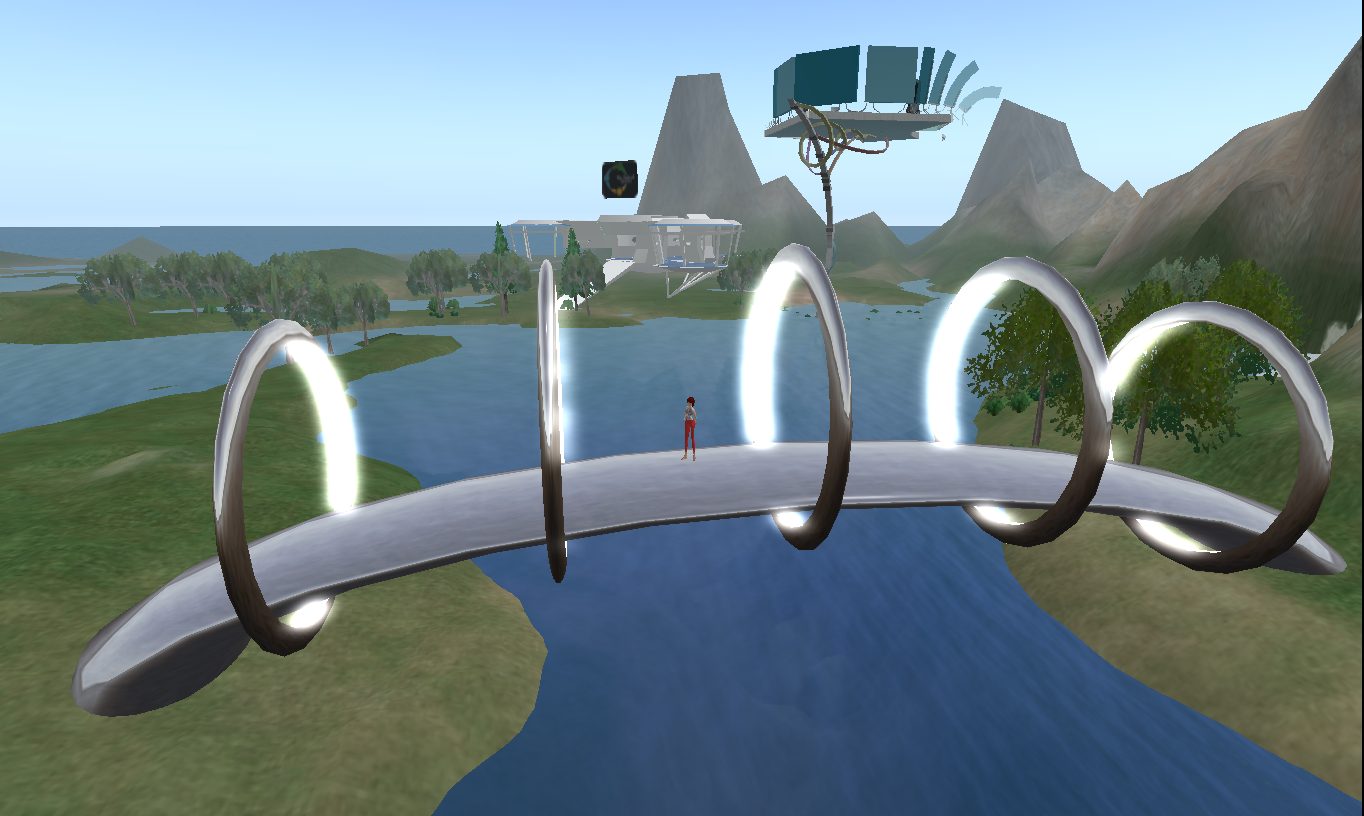
A bridge in Reaction Grid
The tools in the virtual world are simple enough that even elementary school children can use them. Learning to use these tools may even provide some preliminary knowledge and skills for future use of more complex engineering CAD tools. Once the students create the shapes (which takes seconds) the 3D polygons can be moved about, enlarged or reduced in size, stacked, linked, rotated, twisted, tapered, even suspended in the air at the click of a mouse. Students can adjust shapes and angles to fit ‘building blocks’ more precisely, they have the use of coordinates and measuring tools to support their building and learning. The most important part is the process, not the final product, though the final product may contribute to discussion regarding the feasibility of the structures in real life. The process of building and solving the problems of fitting virtual shapes together to construct a planned structure is what makes students think and apply the mathematical concepts.
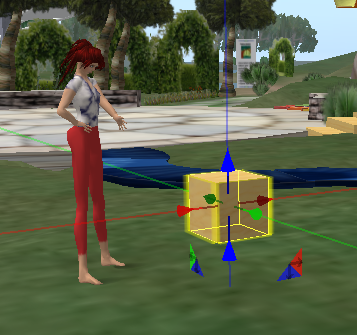
'Building' a block
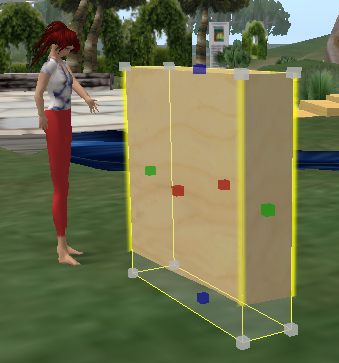
Adjusting dimensions of the cube.
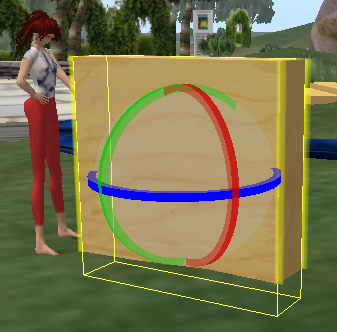
Rotating the adjusted cube.
Here an avatar creates a cube and then transforms it to a thinner taller rectangular shape, then rotates it to get it in the correct position.
The syllabus of an educational technology class at Boise State is an example of prospective teachers being provided an opportunity to learn the skills necessary to use this medium for future instruction in K-12 classrooms. There are multiple examples of K-12 teachers providing ‘building’ opportunities on the SL Teen Grid and on Reaction Grid to their students. As these students apply mathematical concepts and address required standards they also practice some 21st Century skills such as innovation, collaboration and problem solving.
Share this:

Can a Paracosm in a Virtual World Contribute to Creativity?

This gallery contains 6 photos.
According to a recent Newsweek article, The Creativity crisis, the Creativity Quotient (CQ) among American children has been dropping steadily since 1990. This drop in CQ correlates with the exclusive focus on the teaching of standards and the preponderance of television … Continue reading

Visual Arts in The Virtual World
The virtual world is of course a visual art in and of itself, but there is potential to provide learning experiences in a virtual setting that would otherwise be impossible in the real world. In my experience, the world of visual arts can be brought to students to consume in 4 ways.
First the traditional way of walking around a museum and looking at the art. One of the most extensive museums in the virtual world that I have seen is the Dresden Museum on Second Life (Dresden Gallery 120,128,26), which houses 750 masterpieces of European art. An avatar can walk around the museum and see the famous art, clicking on it to get information as it is desired. This method of learning about the art mimics a strategy used in the real world.

An avatar floats down Rumsey's Map Museum tower
The second method takes the display and viewing of works to a different level, literally. Here an avatar can view a large collection of artwork in a “museum” that can be traversed only in a virtual setting. A wonderful example of this is the Rumsey Map Museum on Second Life ( Rumsey Maps 2 (193,201,715)). The avatar visiting this museum can fly through a tower to view the extensive map collection, stopping to click on any of interest to get additional information.
The third method of learning about art in a virtual setting involves becoming a part of the art. Art Box (Klaw 5,21,46) on Second Life has selected pieces of artwork with human subjects.

An avatar becomes a part of a famous piece of art in Art Box.
Participants are provided an opportunity to choose a painting and then click on a poseball to become the subject in the art. The owners offer props and costumes for some of the art work. Laguna Beach California has a real life, annual art show reminiscent of this strategy of enjoying art. Actors dress and pose while backdrops and lighting are used to duplicate a painting in real life. In the virtual setting the participant gets to make the art selection and become a part of it. Certainly more immersive than just looking at it.

Sitting in Van Gogh's room. The builder created an elongated room to ensure groups of visitors had a correct view.
Finally, an avatar can visit a location and be completely immersed in the art. In the case of Arles (168,23,29) on Second Life. This amazing sim allows avatars to walk around Vincent Van Gogh’s paintings as they may have been seen by the artist. The paintings are a 3D form and allow complete interaction. An avatar can climb one of the famous yellow haystacks, sit in a cafe and enjoy the “starry night”, or even sit in Van Gogh’s bedroom.
The many museums in the virtual environment each have policies regarding the use of the images they display. It is best to experience them by visiting the location.
The places described here are not available to students under 18 years of age, but the methods may be used to create art locations in the Opensim grids so that students may interact with art and thus learn about it. Better yet, students may become the producers and create these environments with art work in the public domain or even their own art work.
Share this:

Consumer and Producer

This gallery contains 3 photos.
Frequent questions regarding Virtual environments in education are “So what does a student do in a virtual world? How/what does a student learn?”. What students can do falls into two categories, they can consume content and they can produce content. … Continue reading
 Gridjumper's Blog