Vodpod videos no longer available.
1st collector for Immersive Story Telling
Follow my videos on vodpod

Vodpod videos no longer available.
1st collector for Immersive Story Telling
Follow my videos on vodpod

The Virtual World Best Practices in Education Conference began on March 17 with over 200 attendees either on one of the 20 sims, watching on treet tv, and/or following on Twitter.

Botgirl Questi and her alter ego presenting the Keynote Address.
Botgirl Questi and her alter ego delivered the keynote address discussing identity, multiple personality capability and the use of virtual identity for positive change. The session was recorded and can be viewed at Treet TV.
Following the keynote, educators from around the world transported their avatars to multiple venues and grids to learn more about the use of virtual spaces for education. Two more days of expert presentations are scheduled.
A variety of social events including multiple person bicycle rides and music and dancing at an Irish pub are available all 3 days.
The builds, a collaborative effort of many hours, are elaborate and imaginative creations in a Steampunk theme. All 20 sims will be dropping into the pixel sea at the end of the month so teleport over to http://slurl.com/secondlife/VWBPE%20Central%202/3/19/42 and fly around while it is still there. Take some photos, capture some video and sit in on a session or two. You may just learn something.

The VWBPE Conference has a number of events to support machinima endeavors for both novice users and experts. The sessions are being held at different locations on the VWBPE 20 sims built in a Steampunk motif, just for this event.
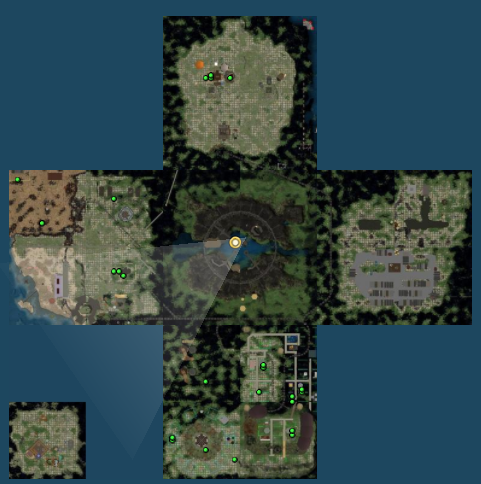
20 Sim site on SL built specifically for the event 3/17-3/19.
March 17, 2011
March 18, 2011

East - Location of Screening of the VWBPE Machinima entries (popcorn is included)March 18, 2011
March 19, 2011

The VWBPE (Virtual World Best Practices in Education) Conference will be held in Second Life and other grids on March 17-19. The Conference offers:
Experienced virtual world participants will have the opportunity to learn and share with a global community of educators. This is also an opportunity for experienced users to introduce more reticent colleagues to an environment that offers an alternative format for teaching and learning.
The Internet is a text-rich environment, smart phone technology and social networking facilitate the use of text, in a virtual world instruction can be provided in either text or voice mode and each has pros and cons. Shambles Guru provides a useful video describing the setup of voice in Second Life using Viewer 2.
Text allows you to think about what you are communicating, seeing the written word allows for some processing and editing prior to clicking the send button. Text can also be saved and referred to at a later time, always beneficial. Text is the preferred method to communicate when language translation is required and the appropriate communication with hearing impaired students. The downside of text is that it is difficult to simultaneously demonstrate while communicating in text. Another potential drawback is “text speak” and typos. Though typically understood there is potential for misunderstanding and it develops a habit of ignoring typos and using abbreviations. A class participant must be able to read and follow instructions in text. This has potential for problems depending on the audience and individual capabilities. Responding to individual questions in IM texting can be confusing (not seeing the message, having too many message boxes open, blocking view of the screen due to message boxes).
Voice allows an instructor to deliver a message the way that an instructor delivers in a real life classroom setting, a clarification is immediate and intonation is clear. The lack of visual cues requires an instructor to use other methods to engage students and to ensure the message was delivered. Ideally the students are also using voice so that 2-way communication can take place. This requires an etiquette system of watching the screen for who is speaking, listening to the spoken text and speaking at a specific pause, so as not to interrupt the speaker. It requires that the communicators listen more carefully than they may do in a real life classroom. The teacher must also be watchful of students as they are performing particular tasks in the virtual setting. The teacher needs to continuously move the camera around and watch students to ensure that students are performing tasks as directed, providing appropriate verbal direction as needed.
The ideal strategy is to use both text and voice. This addresses various learning styles and takes advantage of the pros of each method, minimizing the cons. This can be done is several ways. The instructor can:
Teachers should practice the strategies in order to become comfortable and adept at using them, ultimately selecting which is most appropriate.

This gallery contains 1 photo.
Teaching as a “performing art” has validity. In the book with that title Seymour Sarason compares teacher preparation to performer preparation, describing that a teacher must practice, be articulate, know the curriculum (script) and engage the audience. We all remember … Continue reading
A lecture hall filled with students and an instructor lecturing about a topic he/she knows very well does not guarantee learning is taking place, neither in real life nor in the virtual world. Good teaching requires that the students do something in order to meet the objectives of the lesson. Student engagement can range from taking notes and asking questions to discussing and working on an assignment that requires using information and skills. The level of engagement correlates with the learning that takes place. The video below is one created by students at Elisabeth Morrow School in Englewood NJ. Students undoubtedly learned more than the significance of Apollo as they interacted, on various levels, to create the video. Additional work from middle school students at this school is posted on their wiki.
Some videos illustrating the concept of changing our teaching paradigm are Ken Robinson’s Changing Education Paradigms and Dr Tae’s Building A New Culture of Teaching And Learning . They are not short videos but definitely worth a watch…. and a share. The men in these two videos describe eloquently how teaching needs to change in order to impact student learning, I suggest teaching in the virtual world should have a level of engagement similar to what they advocate.
Educators who have ventured into the virtual world have some innovation and sense of adventure to begin with – just by their presence. Instruction in the virtual world must mirror that innovation by changing the paradigm, making sure that students (whatever their age) do more than “just sit there”. Getting students to move into groups and perform activities in the real world requires classroom management skills, and an impact on space, time, and sound that could be disruptive if not handled with expertise. The virtual world has these elements but it is easier to move and alter the space, it takes less time, and sound can always be mitigated with individual headphones and microphones. The part that takes some effort is ensuring a student focus. At the lowest level of engagement, the instructor should ask students/participants for feedback and then address the questions. For more intense interaction and more learning the instructor can:
In either world, the person doing the communicating is the person doing the learning.

This gallery contains 4 photos.
Learning communities (LC) are active in the virtual environment, consisting of like-minded individuals who have a common interest and get together regularly over long periods of time to both share and gain knowledge and skills. Many of the learning communities … Continue reading

This gallery contains 3 photos.
When asked to describe virtual worlds to my colleagues I struggle in giving an adequate definition. There is a game quality in virtual worlds, and we know that game based learning is motivating and effective. I run into newcomers “inworld” … Continue reading
This gallery contains 1 photo.
Assessment is a necessary part of teaching and learning. Although standardized testing is a piece of the evaluation picture, other evaluation strategies add to the data and provide a more comprehensive view of the success of teaching and learning. … Continue reading
 Gridjumper's Blog