Gallery

Can a Paracosm in a Virtual World Contribute to Creativity?

This gallery contains 6 photos.

According to a recent Newsweek article, The Creativity crisis, the Creativity Quotient (CQ) among American children has been dropping steadily since 1990.   This drop in CQ correlates with the exclusive focus on the teaching of standards and the preponderance of television … Continue reading

NASA STEM Challenge for Grades 9-12 InWorld

A competition from NASA provides a challenge for High school students, in 2 phases. In phase 1 students have an opportunity to work cooperatively, in teams of three-to-five students, as engineers and scientists to solve real-world problems related to the James Webb Space Telescope. Final solutions from this first phase of the challenge are due on Dec. 15, 2010.

Teams who complete Phase 1 are then paired with participating college engineering students for Phase 2, the InWorld phase of the challenge. Each InWorld team will refine designs and create 3-D models of the Webb telescope.

For more information about the challenge, visit http://www.nasarealworldinworld.org/.

Visual Arts in The Virtual World

The virtual world is of course a visual art in and of itself, but there is potential to provide learning experiences in a virtual setting that would otherwise be impossible in the real world.  In my experience, the world of visual arts can be brought to students to consume in 4 ways.

First the traditional way of walking around a museum and looking at the art.  One of the most extensive museums in the virtual world that I have seen is the Dresden Museum on Second Life (Dresden Gallery 120,128,26), which houses 750 masterpieces of European art.  An avatar can walk around the museum  and see the famous art, clicking on it to get information as it is desired. This method of learning about the art mimics a strategy used in the real world.

An avatar floats down Rumsey's Map Museum tower

The second method takes the display and viewing of works to a different level, literally.  Here an avatar can view a large collection of artwork in a “museum”  that can be traversed only in a virtual setting.  A wonderful example of this is the Rumsey Map Museum on Second Life ( Rumsey Maps 2 (193,201,715)).  The avatar visiting this museum  can fly through a tower to view the extensive map collection, stopping to click on any of interest to get additional information.

The third method of  learning about art in a virtual setting involves becoming a part of the art.  Art Box (Klaw 5,21,46) on Second Life has selected pieces of artwork with human subjects.

An avatar becomes a part of a famous piece of art in Art Box.

Participants are provided an opportunity to choose a painting and then click on a poseball to become the subject in the art.  The owners offer props and costumes for some of the art work.  Laguna Beach California has a real life, annual art show reminiscent of this strategy of enjoying art.  Actors dress and pose while backdrops and lighting are used to duplicate a painting in real life.   In the virtual setting the participant gets to make the art selection and become a part of it.  Certainly more immersive than just looking at it.

Sitting in Van Gogh's room. The builder created an elongated room to ensure groups of visitors had a correct view.

Finally, an avatar can visit a location and be completely immersed in the art.  In the case of Arles (168,23,29) on Second Life.  This amazing sim allows avatars to walk around Vincent Van Gogh’s paintings as they may have been seen by the artist.  The paintings are a 3D form and allow complete interaction.  An avatar can climb one of the famous yellow haystacks, sit in a cafe and enjoy the “starry night”, or even sit in Van Gogh’s bedroom.

The many museums in the virtual environment  each have policies regarding the use of the images they display.  It is best to experience them by visiting the location.

The places described here are not available to students under 18 years of age, but the methods may be used to create art locations in the Opensim grids so that students may interact with art and thus learn about it.  Better yet, students may become the producers and create these environments with art work in the public domain or even their own art work.

Collaboration is a 21st Century Skill

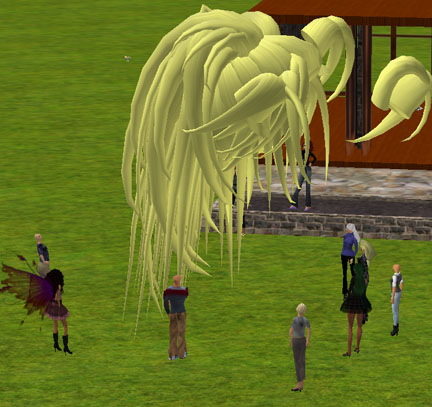
Avatars collaborating on making hair

Employers complain that the incoming workforce lacks what is needed.  Are we preparing our students appropriately for their future?   Tony Wagner in his book, The Global Achievement Gap discusses what he calls the 7 survival skills for the 21st century.  According to him these skills are:

  1. Problem-solving and critical thinking;
  2. Collaboration across networks and leading by influence;
  3. Agility and adaptability;
  4. Initiative and entrepreneurship;
  5. Effective written and oral communication;
  6. Accessing and analyzing information; and
  7. Curiosity and imagination.

These are the kinds of things we discuss in our annual reviews with supervisors and we know these skills make us more productive and useful to the organization.

Most of these 7 skills are supported with project-based  participant production in a virtual environment.  Student production in virtual environments involves building, scripting and researching to develop content.  This type of activity lends itself to a collaborative atmosphere and the ‘network’ across which students collaborate can extend across the globe. (Collaborative building in Second Life – Palo Alto Research Center). Problem solving takes place while planning and again while producing.  Limitations must be considered and decisions about the best solution take place for effective results.  Students must use mathematics and communication skills as they work together to complete their intended product.  They may need to do some research and analyze information as they progress in their building.  Discovery can take place and a plan may change or students may need to adapt a plan and influence colleagues toward a different approach.  Of course, curiosity and imagination are always at play as students build what defies common perceptions and sometimes the laws of physics.  It is the process that is most important here, what the students have to do to achieve their goal – not the final product.

Which Comes First – Problem Solving or Facts?

Perhaps they can be learned together in a more meaningful way. In a Frontline video James Paul Gee makes a case for using video games with students to teach 21st Century skills of problem solving and innovation.

We typically test students on the facts that they know but are less adept at assessing if they can use the facts to solve problems. We often attempt to ensure students know the vocabulary and facts before we give them experiences in which these words and facts are used. They are both important and require the other in order to be meaningful. You need facts to solve problems. A game or virtual environment has the quality of providing an experience in which a student can solve problems and learn facts and concepts simultaneously, they may even learn vocabulary after concepts are learned.

I watched a 7 year old playing a video game called Spore, the concepts were about evolution and biology and the game required manipulating an organism in varying stages of evolution. This little girl solved a variety of problems including avoiding predators, experimenting with mobility and communication and finding shelter and food. Among the concepts learned were the importance of a brain to a living organism, usefulness of camouflage, and the value of mobility types. She does not yet know all the vocabulary associated with these concepts but the frame of reference allows for a meaningful learning of facts and vocabulary. When told the word “predator” and “camouflage” in relation to the images on the screen that she had played with, it made perfect sense and the words were then used in conversation. Interestingly, none of this took place in a school classroom.

James Paul Gee describes games as being best for “preparation for future learning”, to give a foundation and background for learning that will take place later in another mode. What are the implications for children with limited experiences? Could a virtual environment provide that preparation for future learning effectively enough?

Black and White or Shades of Grey

In the WSJ article on June 5, 2010 Does The Internet Make You Smarter or Dumber?, Clay Shirkey author of Cognitive Surplus: Creativity and Generosity in a Connected Age and Nicholas Carr author of The Shallows: What the Internet is Doing to Our Brains describe opposing viewpoints – who is correct?  As usual, they are both right and wrong.  I happen to agree more with Shirkey’s perspective but I have to acknowledge the research described by Carr. The bottom line is that it is a revolutionary time,  the digital world has arrived and it is what we do with it that matters.  There are always negative byproducts – we can’t stop innovation because of those – we need to learn to mitigate the negative while moving ahead with new developments, we simply cannot go back to the way things were.

To apply the title to the use of Virtual Worlds – Do Virtual Worlds Make You Smarter or Dumber?  Well, again – it’s what you do with it.  Some of it will be inane and meaningless and even bizarre, there are also positive aspects like collaboration, experiential learning, engagement,  constructivism, improved communication, and motivation.  As educators we need to take advantage of innovations and learn to use them to benefit our students.  That means as educators we will need to learn to do things differently, to use these technologies to instruct, assist and guide our students.  There are examples of this being done effectively.  Those who are at the forefront have intellectual curiosity, a sense of adventure, and the realization that it is a different world than the one we were students in.

Engagement and Immersion

On May 20 Iggyo wrote about Princeton’s abandoning Second Life “…replicating a campus and setting up lecture halls make little sense in a world where we can fly and where a lecture can be streamed to the flat Web. Virtual worlds are places for simulations and immersion, not recapitulation and passivity.”

It is interesting that so many universities “rebuild” their campuses on Second Life, the administration buildings, the student socializing areas and the classrooms.  When I ask, why? the response I get is something like “people need a frame of reference”.  Indeed, many of the builders I have met on SL do build structures they are familiar with or have at least visited.  The environments are true to the geography even with the flora and fauna – with an occasional fantasy figure thrown in ( a mermaid in Maine, or a Loch Ness Monster in Scotland) maybe not so true to scale, so some interpretive expression is taking place.   They take great pains to find just the right textures so the build is true to the real place.  Perhaps it is an evolutionary process – we build first what we are familiar with, we copy, replicate, duplicate, imitate.  We do what we have always done  but in a different place, in this case a virtual place.

The next step will be to do things differently and the virtual environment does encourage doing things differently.  Why talk at students about what happens when you mix certain chemicals instead of letting them do it safely and inexpensively?  Why lecture to students about a period in history instead of giving them the opportunity to experience it?  Why show pictures of an artist’s work instead of having students immerse themselves in that work?  Why describe how geometric forms fit together in building structures instead of providing opportunities for students to experiment with these structures?

Active engagement is something we say we strive for in classrooms yet we continue to tell, lecture, demonstrate, talk-at and describe.  We know that the ones doing the talking and the ones doing the doing are the ones doing the learning – perhaps the virtual environment can help to move us in that direction.  It does not make sense to gather students in a virtual room and talk at them – we have had mixed results doing it in the real world with this Talk-at-you strategy.  As Iggyo said “...Virtual worlds are places for simulations and immersion.”  Active learning produces better results in any world so perhaps taking advantage of the VW capabilities will provide what we have been unable to provide in the real world.

Gallery

Consumer and Producer

This gallery contains 3 photos.

Frequent questions regarding Virtual environments in education are “So what does a student do in a virtual world?  How/what does a student learn?”.   What students can do falls into two categories, they can consume content and they can produce content. … Continue reading

Cultural Evolution

The sophistication of the modern world is a collective enterprise, according to Matt Ridley Humans:  Why They Triumphed – WSJ Saturday May 22. This notion validates the collaboration those in virtual worlds often make reference to.  I know that my learning has been positively impacted through the collaboration I have had with “friends” I have never met, friends who live in another time zone and in a different culture than mine.  My “experience”  is richer through my interaction with others who share my interests but not my geography.  Trade, in ancient times, caused ideas to spread and cultures to evolve – today we can trade ideas and move the evolution of culture through online  activities in virtual worlds.  What are the implications for our students?  The 21st century Pen-pal can be an avatar who works with someone from a different culture and solves problems in real-time.  Am I being overly hopeful that this would bring greater understanding between people?

Virtual Environments and Education

In virtual environments students are able to experiment with identity and develop shared values. As they use and interact with the environment and objects, observe and interact with others, student participants can experientially develop a deeper understanding of a theme, topic, period of time, or concept. Since players are offered many options and the environment responds to their choices, student-players often feel as if they are in control of their learning and, as a result, own their learning process (Herz 2001).

Some students claim that they learn more through an online game than they would have if they had only read the text (Van 2007). Additionally, scaffolded activities are likely to create a safe environment with minimal risk of failure or embarrassment (Steinkuehler 2004).  Virtual environments enable students to practice skills vital to the world of work including but not limited to collaborating, communicating, critical thinking, navigating and evaluating resources. The power of play is motivating for some students ( Squire 2005), another feature available in virtual environments.