
The virtual environment offers students alternative ways of learning concepts. Educators understand that differentiating instruction is important and that we should not limit ourselves to telling and explaining. The information in a lecture or demonstration is magnified when students are given an opportunity to actively engage in an activity that provides a way for students to practice, apply or even play with the new content. A community college professor demonstrates a virtual world activity designed to follow a lecture and provide students a chance to “build a molecule” in virtual space.
Tag Archives: communication

Immersive Story Telling
Vodpod videos no longer available.
1st collector for Immersive Story Telling
Follow my videos on vodpod
Share this:
VWBPE 2011 Machinima Finalists Announced
The First Machinima 4 Educators Appreciation Contest finalists are grouped into 3 categories with a fourth being the “People’s Choice”. VWBPE participants will be able to cast their votes for this last category during the VWBPE Conference beginning on Thursday March 17. Screening of all submitted videos will be on Friday, March 18 at 8 pm SLT on Machinima (East 1) East 1/2 http://slurl.com/secondlife/VWBPE%20East%202/56/116/32. You can see ALL the entries and cast your vote for the people’s choice on the electronic Ballot.
Best Educational Machinima
Each of the following three entries uniquely demonstrates educational media. Muinji Becomes a Man, written by Chief Mi’sel Joe is aimed at preserving and sharing the history and culture of the Miawpukek people of Conne River in Canada. SWIFT Virtual Genetics Lab is a product of University of Leicester and depicts the use of a genetics lab in the virtual world used to orient first year students in the safety and best use of the lab to prepare them for the use of the actual lab. The lab also provides opportunities for students to use the lab for what is impossible in the real world. Kansas to Cairo Projectis a blend of Machinima and traditional video and allows the viewer to become acquainted with both the real-life participants and their avatar representations in this depiction of cross-cultural collaboration between university students in Los Angeles and Cairo solving real world problems.
Best Production
Machinima production incorporates traditional as well as new digital and animation techniques in both capturing action and in the editing process. Click: Immersive & Interactive Art, written & edited by Lori Landay for University of Western Australia Imagine 3d Art & Design Challenge, zooms in and around stunning examples of virtual art that is immersive or interactive. Munji’j Becomes a Man is a beautifully crafted Machinima with traditional language and music of the Miawpukek people, English subtitles translate much of the dialogue. The build eloquently depicts the habitat, the animation and color provide a sense of being, and the voices of the young boy and his mentor are realistic and well synchronized. The skillful blend of cinema and machinima in Kansas to Cairo Project allows the viewer to see architectural students and their avatar representations in their collaborative work in a virtual world.
Best Story Line/Narrative
Each of these machinima entries had a compelling story. Muinji’j Becomes a Man is a story about a Miawpukek boy coming of age. WB Yeats – An Irish Airman Foresees His Death is a narration of the story of the Yeats poem with the same title, filmed on the flight sim, Rise of Flight with vintage war planes. Time Travelers – Episode 1 – The Time Machine is an adventure story about teenagers, a time machine, and fighting evil in the future with sequels to describe scholarship and funding opportunities for college.
Be sure to attend the screening and vote for your favorite.
Share this:
Machinima Learning at the VWBPE Conference 3/17-3/19
The VWBPE Conference has a number of events to support machinima endeavors for both novice users and experts. The sessions are being held at different locations on the VWBPE 20 sims built in a Steampunk motif, just for this event.
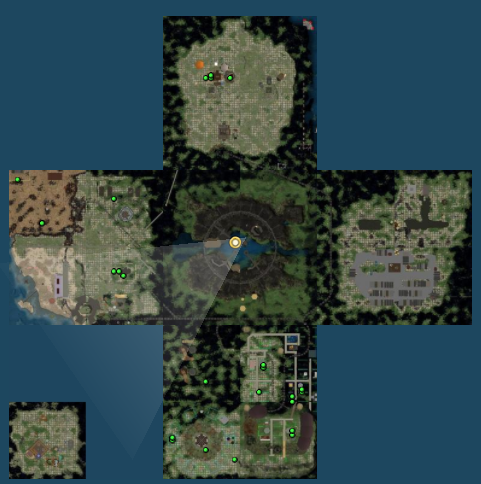
20 Sim site on SL built specifically for the event 3/17-3/19.
March 17, 2011
- 4:00 PM – 05:00 PM SLT -Machinima Featured Speakers -Decka Mah and Knowclue Kidd: Machinima through multiple lenses: Lights Camera! Learning! VWBPE Central – Central Auditorium – http://slurl.com/secondlife/VWBPE%20Central%202/3/19/42
- 5:00 PM – 06:00 PM SLT – Archivist Llewellyn, Machinima Best Practices: Preserving Virtual Worlds Through Video Documentation Building: EAST Room: East 1/2 Machinima
- 7:00 PM – 08:00 PM SLTMarlene Brooks, Cathy Wicks, Digital Storytelling Using Virtual World Technology: The Making of Machinima Building: NORTH – Room: North1
March 18, 2011

East - Location of Screening of the VWBPE Machinima entries (popcorn is included)March 18, 2011
- 2:00 – 3:00 PM SLT – The Fantastic and The Furious: Capturing Moments Through Machinima
Machinima Featured Speaker – Sonicity Fitzroy and Lowe Runo: Central – Central Auditorium http://slurl.com/secondlife/VWBPE%20Central%202/3/19/42
- 3:00 – 4:00 PM SLT- Machinima 4 Mere Mortals: Machinima Working Group – Intro. to Machinima East – EM 1/2
- 3:00 – 4:00 PM SLT How 2 Use Machinima as Part of Your Class: East 1 – East 1/2 Teen Fair
- 8:00 – 9:00 PM SLT-VWBPE Machinima Screening: East – EM 1/2
March 19, 2011
- 7:00 – 8:00 AM SLT – Firery Broome, Machinima Demystified: The Experts Share Their Secrets
Building: EAST
Share this:

3 Days (53 hours) of Virtual Education Sharing
The VWBPE (Virtual World Best Practices in Education) Conference will be held in Second Life and other grids on March 17-19. The Conference offers:
- Theoretical and research presentations
- Content-based describing the use of VW for teaching and learning
- Workshops offering technical guidance
- Tours of virtual spaces used for education
- Panel and roundtable discussions
- Tools for both newcomers and experienced virtual world users
- Game and simulation demonstrations
- Poster presentations
- Machinima screening and competition
Experienced virtual world participants will have the opportunity to learn and share with a global community of educators. This is also an opportunity for experienced users to introduce more reticent colleagues to an environment that offers an alternative format for teaching and learning.
Share this:
Teaching Strategies for Using Voice and Text in the Virtual World
The Internet is a text-rich environment, smart phone technology and social networking facilitate the use of text, in a virtual world instruction can be provided in either text or voice mode and each has pros and cons. Shambles Guru provides a useful video describing the setup of voice in Second Life using Viewer 2.
Text allows you to think about what you are communicating, seeing the written word allows for some processing and editing prior to clicking the send button. Text can also be saved and referred to at a later time, always beneficial. Text is the preferred method to communicate when language translation is required and the appropriate communication with hearing impaired students. The downside of text is that it is difficult to simultaneously demonstrate while communicating in text. Another potential drawback is “text speak” and typos. Though typically understood there is potential for misunderstanding and it develops a habit of ignoring typos and using abbreviations. A class participant must be able to read and follow instructions in text. This has potential for problems depending on the audience and individual capabilities. Responding to individual questions in IM texting can be confusing (not seeing the message, having too many message boxes open, blocking view of the screen due to message boxes).
Voice allows an instructor to deliver a message the way that an instructor delivers in a real life classroom setting, a clarification is immediate and intonation is clear. The lack of visual cues requires an instructor to use other methods to engage students and to ensure the message was delivered. Ideally the students are also using voice so that 2-way communication can take place. This requires an etiquette system of watching the screen for who is speaking, listening to the spoken text and speaking at a specific pause, so as not to interrupt the speaker. It requires that the communicators listen more carefully than they may do in a real life classroom. The teacher must also be watchful of students as they are performing particular tasks in the virtual setting. The teacher needs to continuously move the camera around and watch students to ensure that students are performing tasks as directed, providing appropriate verbal direction as needed.
The ideal strategy is to use both text and voice. This addresses various learning styles and takes advantage of the pros of each method, minimizing the cons. This can be done is several ways. The instructor can:
- provide notecards with vital information, in text, to supplement the spoken instruction.
- type main ideas as he/she speaks.
- have an assistant or student type the text as he/she speaks.
- take advantage of the back channel in local chat to address questions
Teachers should practice the strategies in order to become comfortable and adept at using them, ultimately selecting which is most appropriate.
Share this:
Telling isn’t Teaching… in any World
A lecture hall filled with students and an instructor lecturing about a topic he/she knows very well does not guarantee learning is taking place, neither in real life nor in the virtual world. Good teaching requires that the students do something in order to meet the objectives of the lesson. Student engagement can range from taking notes and asking questions to discussing and working on an assignment that requires using information and skills. The level of engagement correlates with the learning that takes place. The video below is one created by students at Elisabeth Morrow School in Englewood NJ. Students undoubtedly learned more than the significance of Apollo as they interacted, on various levels, to create the video. Additional work from middle school students at this school is posted on their wiki.
Some videos illustrating the concept of changing our teaching paradigm are Ken Robinson’s Changing Education Paradigms and Dr Tae’s Building A New Culture of Teaching And Learning . They are not short videos but definitely worth a watch…. and a share. The men in these two videos describe eloquently how teaching needs to change in order to impact student learning, I suggest teaching in the virtual world should have a level of engagement similar to what they advocate.
Educators who have ventured into the virtual world have some innovation and sense of adventure to begin with – just by their presence. Instruction in the virtual world must mirror that innovation by changing the paradigm, making sure that students (whatever their age) do more than “just sit there”. Getting students to move into groups and perform activities in the real world requires classroom management skills, and an impact on space, time, and sound that could be disruptive if not handled with expertise. The virtual world has these elements but it is easier to move and alter the space, it takes less time, and sound can always be mitigated with individual headphones and microphones. The part that takes some effort is ensuring a student focus. At the lowest level of engagement, the instructor should ask students/participants for feedback and then address the questions. For more intense interaction and more learning the instructor can:
- provide students with instructions to complete a task, either as individuals or in a group
- have students present findings or completed tasks to the group
- have students develop video clips and/or pictures of concepts to be shared on a common site
In either world, the person doing the communicating is the person doing the learning.
Share this:
Sharing Educational Machinima

This gallery contains 1 photo.
Multiple sites exist for sharing video, including Machinima, Wikipedia has an ‘almost’ comprehensive list. Each has benefits and drawbacks, selecting the right one depends on your goal, there are special considerations when the focus is education rather than entertainment, though … Continue reading
Virtual Learning Communities Flourish

This gallery contains 4 photos.
Learning communities (LC) are active in the virtual environment, consisting of like-minded individuals who have a common interest and get together regularly over long periods of time to both share and gain knowledge and skills. Many of the learning communities … Continue reading
Managing a Virtual Environment Classroom
The traditional physical classroom has not changed much in the past hundred years. It contains desks and chairs for students, a teacher desk and chair, a board on which to write or project and wall space which is often decorated with appropriate curricular materials. The most important instructional resource in the classroom is the teacher. A skilled teacher manages the space, materials, furnishings, and students to ensure that students are engaged and learning. A virtual learning space has less boundaries and limitations and a skilled teacher is again the most important resource. The teacher must manage the three-dimensional virtual space, guide students to navigate and interact with the environment and provide experiences to ensure that learning takes place.
Often virtual learning spaces are a replica of the traditional, providing a frame of reference for participants and taking advantage of the potential available in a virtual setting with ‘backchannel’ chat and follow-up assignments. Teachers and students understand the traditional role of “sage on the stage” and play the respective roles in the virtual setting, with the added benefits of a virtual setting. Students can be physically in the same room using computers (a lab setting) requiring both real world and a virtual world classroom management strategies or in remote locations which would require more intensive virtual strategies to ensure engagement of students. The teacher must :
- Plan
- Design experiences which are interesting, relevant and aligned to curriculum objectives
- Plan appropriate amount of time for completing of tasks
- Provide direction and guidance so that students know expctations
- Deliver and Guide
- Give clear directions
- Encourage questions and answer according to the protocol established
- Circulate (virtually and/or physically) among students to provide individual support and ensure engagement
- Institute a “buddy” policy for peer support
- Intervene when necessary

Norma Underwood uses both real-life and virtual world classroom management strategies to ensure learning for 5th - 8th grade art students on her sim in Reaction Grid.

 Gridjumper's Blog