
Creating films for learning is not new in K-12 education nor has the strategy been limited to magnet programs or exclusive schools that offer high-level technology classes and/or broadcasting. Teachers have used filmmaking as a way to help students learn … Continue reading
Tag Archives: Collaboration
Social Learning in Immersive Environments
Much is discussed on the topic of Social Networking and the potential use of this technology in education. Research indicates that individuals benefit from a social approach to learning. L. Rendell et al. states that “Social learning (learning through observation or interactionwith other individuals) is widespread in nature and is centralto the remarkable success of humanity…” . Immersive environments have gained acceptance in post-secondary education for the past several years. VLearning: Is The Future Of Online Education A 3D Virtual Classroom? describes several studies that determined a positive correlation between the increased interaction among classmates and instructors in virtual classrooms and involvement in the course work and comprehension of material. It states, “… this to be particularly true for students who have a difficult time engaging in face-to-face discussions, but who will ask questions freely and contribute to live debates in a virtual classroom.”
In their book The New Social Learning Bingham and Connor devote a chapter to the topic of social learning in immersive environments, describing the successful uses in multiple corporate training programs. Social learning involves interaction, engagement and mutual exchange and benefit to participants.
The research on the successful use of immersive environments in professional development and post-secondary education are certainly reason to consider exploring these strategies in the K-12 sector.
Share this:

The Value of Play

This gallery contains 4 photos.
Play connects us to others, fosters creativity, helps with social skills, motivates and increases cognitive growth, according to Vygotsky’s research on play. We like to play and we learn from playing, so playing in a virtual setting seems to be logical enhancement … Continue reading
What’s the distinction between Protection from and Prevention of the Net?
The topic of safety on the Internet and protecting children from the perils of the Internet, as well as protecting organizations from possible lawsuits, have been coming up more and more frequently. A few years ago I would encounter the “ACCESS DENIED” screen not more than once every couple of months. I would even have participants in a training purposely type in a URL that would produce that same screen, to demonstrate the effectiveness of the system keeping children secure and I would also report a site for needed blocking, if I stumbled upon something that was clearly inappropriate. When encountering ‘the screen‘, I would continue with my work and possibly check the source I was looking for after hours from my home computer.
Today I encounter the “ACCESS DENIED” screen several times a day and my colleagues report a similar experience. The firewall is becoming a barrier to research, learning, collaboration and innovation. Now I contact the appropriate department requesting adjustment of the site I am trying to get to and inevitably get the answer that “there is nothing that we can do – the School Board will not allow this site as it is classified as______”. Are there more inappropriate sites than there used to be? Are we blocking more than we used to? Are we screening effectively? Are we effectively teaching the appropriate use of the Internet? Has the firewall become a replacement for teacher monitoring and supervision? Is there a difference between social networking and professional networking? How are social networking and social bookmarking the same/different?
The advent of social networking and virtual worlds used by the working world have caused me to ponder these questions and push back a little at our well-meaning and disciplined “Internet Police”. I wonder if the fear of what students MAY encounter has caused us to prevent encounters that could be useful and educational. Can social networking sites and working in virtual worlds positively impact collaboration and learning?
A government site, http://www.onguardonline.gov/, provides information for parents to know what to look for and to discuss with children regarding safety on the Internet, including social networking and virtual worlds. Could this be curriculum material for educators to use? In an ISTE 2010 address Mario Armstrong referred to school districts blocking of the Internet as the Locked Net Monster. Check out the learning today blog for some ideas on teaching digital safety in a k-12 school setting.
I am not suggesting we unlock the firewall to all that is available, just a more thoughtful approach to what could be useful. An approach that includes academic review, intellectual curiosity and alignment with 21st century skills. The approach would require diligent supervision by teachers and appropriate preparation for use of the tool that has become ubiquitous, except in the classroom. In the meantime I’ll do like the kids – use my smartphone, call a friend or wait until I get home to look it up.
Share this:
Virtual Visuals add to Authentic Engagement
The difference between participating in a cyber educational event via a webinar and one via a virtual world is dramatic. When I first started to explore the use of virtual worlds to determine potential use in education I asked, “why not just use an online meeting software package? A webinar allows voice, is in real-time, allows sharing and collaborating, includes chat and sidebar conversations as well as the benefits of not having to waste time in travel and logistics of a F-t-F event”. The use of an avatar and mechanics of having to find the right outfit for her to wear, to have her transport, walk and sit in a virtual auditorium seemed a little silly.

Avatars attending a building Class at NCI on SL. Snoopy was a classmate.
Having participated in both types of events I can now say that, for me, the Virtual World experience is much more connected. Even a ‘talking head’ presentation with a Powerpoint is more active in the 3D virtual world than participating in a 2D webinar. I have observed that in a 3D environment the audience seems more likely to ask questions and provide commentary which adds to the information and addresses adult learning principles. The chat texts I have saved from regular ISTE sessions are much longer and more interesting than the ones I have from Elluminate and Meeting-Place sessions I have attended. They are also less formal, more natural.
When I attend a “flat” webinar I have a tendency to multi-task, to have the webinar on in the background while I do some other work at my desk. Conversely, when sitting in an audience of avatars there is a feeling of presence. I look around and see who else is there, I may chat with someone I know, introduce myself to someone I don’t know and contribute to the conversation in local chat for everyone’s benefit or chat privately on the issues being discussed. I rarely do other work and concentrate on the topic at hand. I am more engaged.
Virtual events that incorporate instructional strategies such as grouping participants, taking “field trips”, and interacting with content in the environment are even more engaging and push participants to participate.

A class getting ready to go on a field trip
The use of the virtual world medium is still evolving and it seems the majority of decision makers have yet to be convinced of potential educational merits. I was not convinced until I had mastered some basic avatar communication and mobility skills and had participated several times in sessions that were of particular interest with skilled presenters. I have paid more attention to the cartoons in virtual worlds than to an unattached voice and a whiteboard on my computer desktop.
Share this:

NASA STEM Challenge for Grades 9-12 InWorld
A competition from NASA provides a challenge for High school students, in 2 phases. In phase 1 students have an opportunity to work cooperatively, in teams of three-to-five students, as engineers and scientists to solve real-world problems related to the James Webb Space Telescope. Final solutions from this first phase of the challenge are due on Dec. 15, 2010.
Teams who complete Phase 1 are then paired with participating college engineering students for Phase 2, the InWorld phase of the challenge. Each InWorld team will refine designs and create 3-D models of the Webb telescope.
For more information about the challenge, visit http://www.nasarealworldinworld.org/.
Share this:
Collaboration is a 21st Century Skill
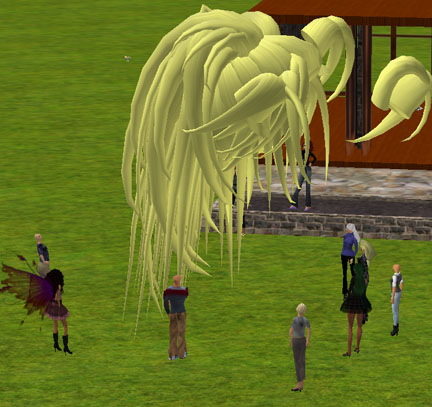
Avatars collaborating on making hair
Employers complain that the incoming workforce lacks what is needed. Are we preparing our students appropriately for their future? Tony Wagner in his book, The Global Achievement Gap discusses what he calls the 7 survival skills for the 21st century. According to him these skills are:
- Problem-solving and critical thinking;
- Collaboration across networks and leading by influence;
- Agility and adaptability;
- Initiative and entrepreneurship;
- Effective written and oral communication;
- Accessing and analyzing information; and
- Curiosity and imagination.
These are the kinds of things we discuss in our annual reviews with supervisors and we know these skills make us more productive and useful to the organization.
Most of these 7 skills are supported with project-based participant production in a virtual environment. Student production in virtual environments involves building, scripting and researching to develop content. This type of activity lends itself to a collaborative atmosphere and the ‘network’ across which students collaborate can extend across the globe. (Collaborative building in Second Life – Palo Alto Research Center). Problem solving takes place while planning and again while producing. Limitations must be considered and decisions about the best solution take place for effective results. Students must use mathematics and communication skills as they work together to complete their intended product. They may need to do some research and analyze information as they progress in their building. Discovery can take place and a plan may change or students may need to adapt a plan and influence colleagues toward a different approach. Of course, curiosity and imagination are always at play as students build what defies common perceptions and sometimes the laws of physics. It is the process that is most important here, what the students have to do to achieve their goal – not the final product.
Share this:

Black and White or Shades of Grey
In the WSJ article on June 5, 2010 Does The Internet Make You Smarter or Dumber?, Clay Shirkey author of Cognitive Surplus: Creativity and Generosity in a Connected Age and Nicholas Carr author of The Shallows: What the Internet is Doing to Our Brains describe opposing viewpoints – who is correct? As usual, they are both right and wrong. I happen to agree more with Shirkey’s perspective but I have to acknowledge the research described by Carr. The bottom line is that it is a revolutionary time, the digital world has arrived and it is what we do with it that matters. There are always negative byproducts – we can’t stop innovation because of those – we need to learn to mitigate the negative while moving ahead with new developments, we simply cannot go back to the way things were.
To apply the title to the use of Virtual Worlds – Do Virtual Worlds Make You Smarter or Dumber? Well, again – it’s what you do with it. Some of it will be inane and meaningless and even bizarre, there are also positive aspects like collaboration, experiential learning, engagement, constructivism, improved communication, and motivation. As educators we need to take advantage of innovations and learn to use them to benefit our students. That means as educators we will need to learn to do things differently, to use these technologies to instruct, assist and guide our students. There are examples of this being done effectively. Those who are at the forefront have intellectual curiosity, a sense of adventure, and the realization that it is a different world than the one we were students in.
Share this:
Consumer and Producer

This gallery contains 3 photos.
Frequent questions regarding Virtual environments in education are “So what does a student do in a virtual world? How/what does a student learn?”. What students can do falls into two categories, they can consume content and they can produce content. … Continue reading
Cultural Evolution
The sophistication of the modern world is a collective enterprise, according to Matt Ridley Humans: Why They Triumphed – WSJ Saturday May 22. This notion validates the collaboration those in virtual worlds often make reference to. I know that my learning has been positively impacted through the collaboration I have had with “friends” I have never met, friends who live in another time zone and in a different culture than mine. My “experience” is richer through my interaction with others who share my interests but not my geography. Trade, in ancient times, caused ideas to spread and cultures to evolve – today we can trade ideas and move the evolution of culture through online activities in virtual worlds. What are the implications for our students? The 21st century Pen-pal can be an avatar who works with someone from a different culture and solves problems in real-time. Am I being overly hopeful that this would bring greater understanding between people?
 Gridjumper's Blog