Teaching Math in The Virtual World

Mathematics may be one of the most obvious ways to use a virtual world for teaching and learning, particularly when students are in the building capacity.  Students can practice applying   mathematical concepts, while being creative and having fun.  Geometry comes alive as an avatar creates and moves 3D shapes around to construct a real or imagined structure, graphical representations are concrete rather than theoretical.
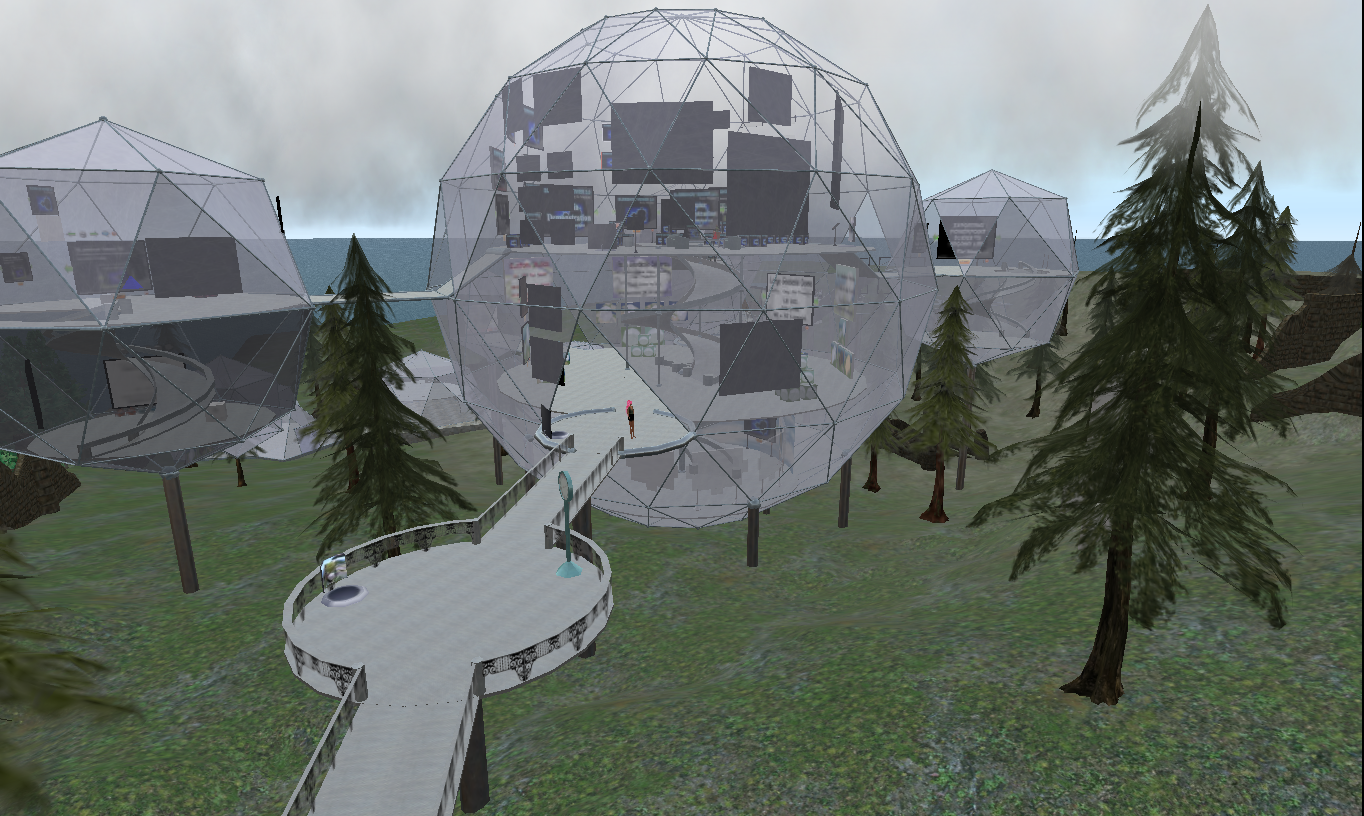
A geodesic structure in SL
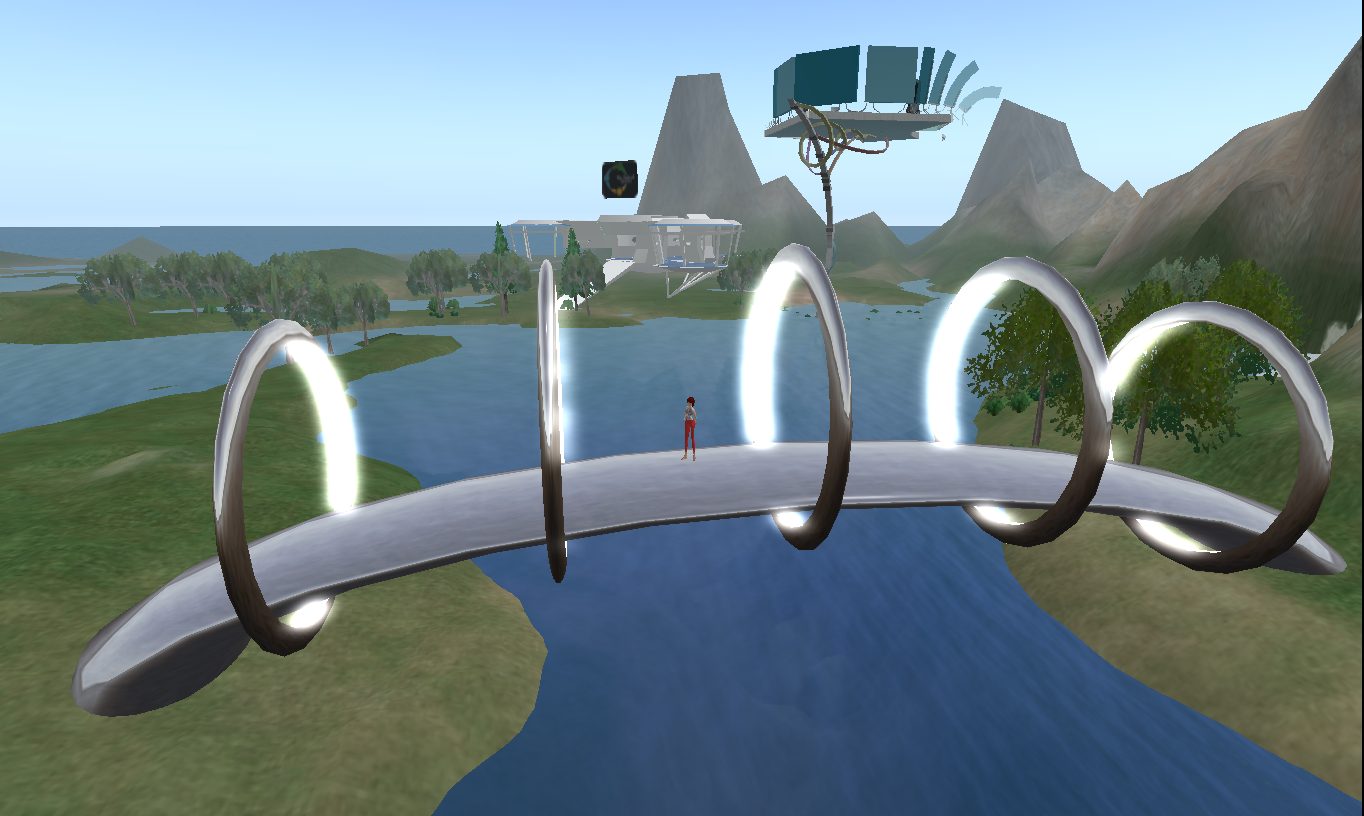
A bridge in Reaction Grid

The tools in the virtual world are simple enough that even elementary school children can use them.   Learning to use these tools may even provide some preliminary knowledge and skills for future use of  more complex engineering CAD tools. Once the students create the shapes (which takes seconds) the 3D polygons can be moved about, enlarged or reduced in size, stacked, linked, rotated, twisted, tapered, even suspended in the air at the click of a mouse.  Students can adjust shapes and angles to fit ‘building blocks’ more precisely, they have the use of coordinates and measuring tools to support their building and learning.  The most important part is the process, not the final product, though the final product may contribute to discussion regarding the feasibility of the structures in real  life.  The process of building and solving the problems of fitting virtual shapes together to construct a planned structure is what makes students think and apply the mathematical concepts.
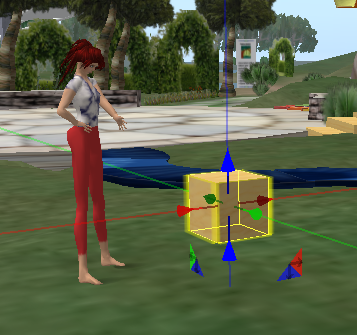
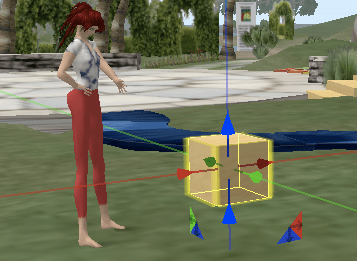
'Building' a block
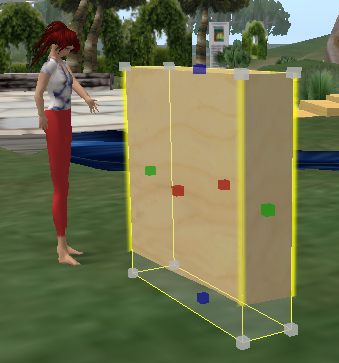
Adjusting dimensions of the cube.
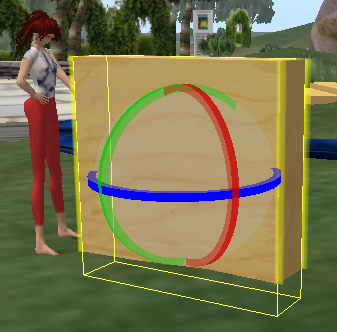
Rotating the adjusted cube.

Here an avatar creates a cube and then transforms it to a thinner taller rectangular shape, then rotates it to get it in the correct position.

The syllabus of an educational technology class at Boise State is an example of prospective teachers being provided an opportunity to learn  the skills necessary to use this medium for future instruction in K-12 classrooms.  There are multiple examples of K-12 teachers providing ‘building’ opportunities on the SL Teen Grid and on Reaction Grid  to their students. As these students apply mathematical concepts and address required standards they also practice some 21st Century skills such as innovation, collaboration and problem solving.


Gallery

Can a Paracosm in a Virtual World Contribute to Creativity?

This gallery contains 6 photos.

According to a recent Newsweek article, The Creativity crisis, the Creativity Quotient (CQ) among American children has been dropping steadily since 1990.   This drop in CQ correlates with the exclusive focus on the teaching of standards and the preponderance of television … Continue reading

NASA STEM Challenge for Grades 9-12 InWorld

A competition from NASA provides a challenge for High school students, in 2 phases. In phase 1 students have an opportunity to work cooperatively, in teams of three-to-five students, as engineers and scientists to solve real-world problems related to the James Webb Space Telescope. Final solutions from this first phase of the challenge are due on Dec. 15, 2010.

Teams who complete Phase 1 are then paired with participating college engineering students for Phase 2, the InWorld phase of the challenge. Each InWorld team will refine designs and create 3-D models of the Webb telescope.

For more information about the challenge, visit http://www.nasarealworldinworld.org/.

Culture and Foreign Language, Virtually

Learning of foreign languages can be somewhat of a challenge in the United States, partially due to proximity to countries where another language is spoken, yet global perspectives are essential and better  addressed through a multi-lingual  and multi-cultural citizenry.  “According to the American Council on the Teaching of Foreign Languages, a higher percentage of students are studying a foreign language than at any time in history.”  The Case for Foreign language Classes Education Week ( July 12, 2010).  Students need to become prepared to conduct business and compete in a global economy, our competitors across the globe are addressing it.

Foreign language instruction is an area that can be handled effectively through virtual environment experiences.  Foreign language teachers will tell you that practice in the native tongue with native speakers is a “best practice”.  In real life it often includes field trips, at the very least to a local restaurant or community,  students from affluent homes may participate in a trip abroad.

In a virtual environment, students can be placed in a variety of social situations, with native speakers, to practice newly acquired linguistic skills. There are instant translators available in virtual worlds that can translate written text to a limited degree, and/or students may turn on voice and actually practice speaking with individuals from another country.   Environments can be constructed to elicit the practice of particular vocabulary such as sporting, arts, cultural, or social events.  Students (through avatars) engaged in conversation and interaction will naturally acquire cultural lessons as well.

ESOL students could use the environment similarly.  A characteristic that encourages language practice for the second language learner is the ‘security’ of the avatar.  Students learning a foreign language may express a reluctance to speak, for fear of being made fun of.  An avatar representation offers some shielding from potential or perceived ridicule.

A virtual setting may very well be the most ‘natural’ setting we can provide, at a reasonable cost, for foreign language instruction.

Collaboration is a 21st Century Skill

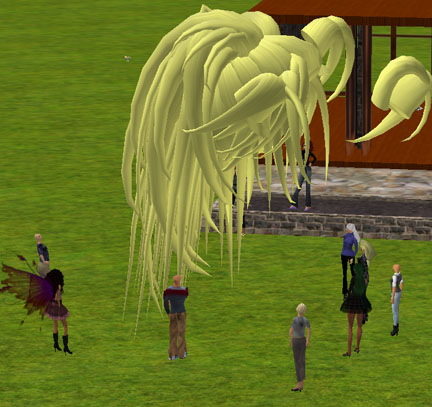
Avatars collaborating on making hair

Employers complain that the incoming workforce lacks what is needed.  Are we preparing our students appropriately for their future?   Tony Wagner in his book, The Global Achievement Gap discusses what he calls the 7 survival skills for the 21st century.  According to him these skills are:

  1. Problem-solving and critical thinking;
  2. Collaboration across networks and leading by influence;
  3. Agility and adaptability;
  4. Initiative and entrepreneurship;
  5. Effective written and oral communication;
  6. Accessing and analyzing information; and
  7. Curiosity and imagination.

These are the kinds of things we discuss in our annual reviews with supervisors and we know these skills make us more productive and useful to the organization.

Most of these 7 skills are supported with project-based  participant production in a virtual environment.  Student production in virtual environments involves building, scripting and researching to develop content.  This type of activity lends itself to a collaborative atmosphere and the ‘network’ across which students collaborate can extend across the globe. (Collaborative building in Second Life – Palo Alto Research Center). Problem solving takes place while planning and again while producing.  Limitations must be considered and decisions about the best solution take place for effective results.  Students must use mathematics and communication skills as they work together to complete their intended product.  They may need to do some research and analyze information as they progress in their building.  Discovery can take place and a plan may change or students may need to adapt a plan and influence colleagues toward a different approach.  Of course, curiosity and imagination are always at play as students build what defies common perceptions and sometimes the laws of physics.  It is the process that is most important here, what the students have to do to achieve their goal – not the final product.

Which Comes First – Problem Solving or Facts?

Perhaps they can be learned together in a more meaningful way. In a Frontline video James Paul Gee makes a case for using video games with students to teach 21st Century skills of problem solving and innovation.

We typically test students on the facts that they know but are less adept at assessing if they can use the facts to solve problems. We often attempt to ensure students know the vocabulary and facts before we give them experiences in which these words and facts are used. They are both important and require the other in order to be meaningful. You need facts to solve problems. A game or virtual environment has the quality of providing an experience in which a student can solve problems and learn facts and concepts simultaneously, they may even learn vocabulary after concepts are learned.

I watched a 7 year old playing a video game called Spore, the concepts were about evolution and biology and the game required manipulating an organism in varying stages of evolution. This little girl solved a variety of problems including avoiding predators, experimenting with mobility and communication and finding shelter and food. Among the concepts learned were the importance of a brain to a living organism, usefulness of camouflage, and the value of mobility types. She does not yet know all the vocabulary associated with these concepts but the frame of reference allows for a meaningful learning of facts and vocabulary. When told the word “predator” and “camouflage” in relation to the images on the screen that she had played with, it made perfect sense and the words were then used in conversation. Interestingly, none of this took place in a school classroom.

James Paul Gee describes games as being best for “preparation for future learning”, to give a foundation and background for learning that will take place later in another mode. What are the implications for children with limited experiences? Could a virtual environment provide that preparation for future learning effectively enough?