


Learning Spaces

Listening to A Lecture

I attended the Second Life ISTE speaker series June 1st, regarding learning spaces.  The speaker categorized learning spaces as formal, informal and virtual.  This would seem to indicate that Virtual World spaces are only virtual, but that is not the case.  The virtual environment contains formal and informal spaces within its’ ‘virtualness’.  Perhaps it is more what you do with the spaces than what they are or what they look like.

A traditional classroom is a formal space, yet teachers often manage those spaces in ways that engage students in untraditional ways.  A teacher in a classroom with desks, even desks in rows, can engage students in an informal, non-didactic way ( though a different setting may be more amenable to this).

During the ISTE Virtual session, the avatars all sat in an auditorium and the setting was certainly visually formal, yet it was virtual space.  The speaker did not talk-at, lecture non-stop or read from 30 powerpoint slides.  The speaker engaged the group by asking very pointed questions and then responded to the chatter in local chat.  Participants also “talked” among themselves without disturbing the group, so there was an informalness to the presentation despite the visually formal setting.  This strategy would not work as well in a face-to-face formal setting because of sound/noise. The ability to discern salient comments would be impossible.

Organization of visual space, virtual or real, certainly contributes to how the space is used, but it does not need to dictate the way the space is used.  A skilled teacher will be able to conduct learning experiences that are effective and can usually adjust in spite of the setting.   An exception would obviously be a lab or studio requiring specialized equipment.  In planning for the teaching and learning that will take place in any space the instructor must consider the content, objectives, target audience and learning styles.

Floating in space

Engagement and Immersion

On May 20 Iggyo wrote about Princeton’s abandoning Second Life “…replicating a campus and setting up lecture halls make little sense in a world where we can fly and where a lecture can be streamed to the flat Web. Virtual worlds are places for simulations and immersion, not recapitulation and passivity.”

It is interesting that so many universities “rebuild” their campuses on Second Life, the administration buildings, the student socializing areas and the classrooms.  When I ask, why? the response I get is something like “people need a frame of reference”.  Indeed, many of the builders I have met on SL do build structures they are familiar with or have at least visited.  The environments are true to the geography even with the flora and fauna – with an occasional fantasy figure thrown in ( a mermaid in Maine, or a Loch Ness Monster in Scotland) maybe not so true to scale, so some interpretive expression is taking place.   They take great pains to find just the right textures so the build is true to the real place.  Perhaps it is an evolutionary process – we build first what we are familiar with, we copy, replicate, duplicate, imitate.  We do what we have always done  but in a different place, in this case a virtual place.

The next step will be to do things differently and the virtual environment does encourage doing things differently.  Why talk at students about what happens when you mix certain chemicals instead of letting them do it safely and inexpensively?  Why lecture to students about a period in history instead of giving them the opportunity to experience it?  Why show pictures of an artist’s work instead of having students immerse themselves in that work?  Why describe how geometric forms fit together in building structures instead of providing opportunities for students to experiment with these structures?

Active engagement is something we say we strive for in classrooms yet we continue to tell, lecture, demonstrate, talk-at and describe.  We know that the ones doing the talking and the ones doing the doing are the ones doing the learning – perhaps the virtual environment can help to move us in that direction.  It does not make sense to gather students in a virtual room and talk at them – we have had mixed results doing it in the real world with this Talk-at-you strategy.  As Iggyo said “...Virtual worlds are places for simulations and immersion.”  Active learning produces better results in any world so perhaps taking advantage of the VW capabilities will provide what we have been unable to provide in the real world.

Student Management

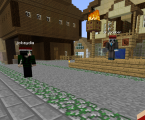
I’ve gathered some ideas, perhaps promising practices in managing students in a virtual world.  These ideas have come from educators who instruct in a virtual setting.  Naming of avatars is a great way to manage your students and keep track of what they do as well as ensuring you have the correct students in your virtual setting.

  • Having students use their first names and the last name of the school identifies the student and put them in the school “family” .  A teacher on RG uses this method and she can easily spot who is around and what they are doing.  She can also identify any intruders.
  • Another teacher of RG reports using Student1, Student2, and a last name associated with the school or geographic location of the school. This method works well for when you have to reuse avatars for different students.
  • A variation of  the above method would be to use a group tag.  So the student could have use an avatar names Student 1 or a first and last name they select but then use a group tag that identifies the school.
  • Another strategy used in the virtual setting has been to make t-shirts identifying the school and/or the student.  The Tshirt could display the first name of the student, thus identifying the student even though the avatar name is “Student One” or it could display the name of the school.
Gallery

Consumer and Producer

This gallery contains 3 photos.

Frequent questions regarding Virtual environments in education are “So what does a student do in a virtual world?  How/what does a student learn?”.   What students can do falls into two categories, they can consume content and they can produce content. … Continue reading

Cultural Evolution

The sophistication of the modern world is a collective enterprise, according to Matt Ridley Humans:  Why They Triumphed – WSJ Saturday May 22. This notion validates the collaboration those in virtual worlds often make reference to.  I know that my learning has been positively impacted through the collaboration I have had with “friends” I have never met, friends who live in another time zone and in a different culture than mine.  My “experience”  is richer through my interaction with others who share my interests but not my geography.  Trade, in ancient times, caused ideas to spread and cultures to evolve – today we can trade ideas and move the evolution of culture through online  activities in virtual worlds.  What are the implications for our students?  The 21st century Pen-pal can be an avatar who works with someone from a different culture and solves problems in real-time.  Am I being overly hopeful that this would bring greater understanding between people?

Virtual Environments and Education

In virtual environments students are able to experiment with identity and develop shared values. As they use and interact with the environment and objects, observe and interact with others, student participants can experientially develop a deeper understanding of a theme, topic, period of time, or concept. Since players are offered many options and the environment responds to their choices, student-players often feel as if they are in control of their learning and, as a result, own their learning process (Herz 2001).

Some students claim that they learn more through an online game than they would have if they had only read the text (Van 2007). Additionally, scaffolded activities are likely to create a safe environment with minimal risk of failure or embarrassment (Steinkuehler 2004).  Virtual environments enable students to practice skills vital to the world of work including but not limited to collaborating, communicating, critical thinking, navigating and evaluating resources. The power of play is motivating for some students ( Squire 2005), another feature available in virtual environments.

Hello Virtual World!

MultiUser Virtual Environments (MUVEs) designed for the educational community allow participants to engage in this environment.  Participants

• Interact with content (other participants, objects, activities)

  • Select a representation of themselves – an Avatar
  • Explore the environment
  • Communicate with other participants
  • Use and interact with objects
  • Analyze data

• Create content

  • Collaborate with others to accomplish a task
  • Gather information to perform tasks and solve problems
  • Plan and implement projects
  • Develop activites