Evidence vs Adult Intervention

Remember the clubhouse in the woods you built with your friends.  It was your clubhouse.  You and your friends thought of it, planned it, gathered materials, constructed it, fought about it, fought in it, plotted in it, pretended to be super-heros or knights in it, and then probably tore it down because it seemed like a good idea and it was yours to tear down.  Remember the playhouse that the little girl down the street had.  Her father built it for her.  It was a beauty; A door with hinges and a door knob, heart-shaped shutters, flower-boxes, shingles, matching curtains and furnishings.  She had a birthday party and everyone got to go into it but you couldn’t “mess it up”. Nobody really played there much, it collected spiderwebs.  It sat forever – a monument to adult intervention.

As I listened to the ISTE Speaker Series on SL Tuesday night, Knowclue’s message was most profound.  She said she is a stickler on students building and making their own environment in SL Teen Grid and now on Reaction Grid where she provides instruction.  I sat in the audience and asked “what evidence do you have of student achievement?”  My thoughts were focused on what so many educators are thinking about:  test scores, numbers, Adequate Yearly Progress, achievement data, standards.  Of course these are important quantifiable data points and so is the remarkable build that her students created.

A student build in a virtual world - minimal adult intervention.

The evidence is that children built a community based on a unit of study.  The student Build required the use of communication, collaboration and problem solving (those 21st Century Skills).  It required the use of mathematics and integration of an artistic sensibility.  The students had to read/research and take notes, write, and compute.  Knowclue has a clue and she also has evidence.  The student product is the evidence.  The students will be tested in the standards at the end of the year and those scores too will be reviewed – together they form the picture of evidence.  My hunch is the students who build will demonstrate more learning gains than the students who have it built for them,  look to the evidence.

A Metaphor for Teaching Those We Don’t Understand

As I attempted to help a newcomer to SL and kept getting the response “I don’t see that.”  “Not on my screen”.  “Not there” “Don’t have that”, it hit me that teachers who are well-meaning but unprepared reach a level of frustration because their students “Don’t see that”.

The issue here was that I was using the OLD viewer, the viewer I am comfortable with and the newcomer was using the NEW viewer, the viewer available to newcomers to SL.  I knew what this new av needed to do and gave very specific instructions. However, the newcomer, trying to follow every step, became increasingly frustrated at being given directions for a view she did not have.  Then I became frustrated and the result was a complete lack of progress until I re-logged with the new viewer and figured out where the buttons were and how to find the functions I had been describing.  It did take some time, I was out of my comfort level and went back to my old viewer immediately following the “lesson”.  I never did find the “stop all animations”.

When a teacher is trying to teach students with a different view on life, a different culture, a different language background, a different perspective, a different comfort level – the same thing happens.  The student gets frustrated and the teacher gets frustrated resulting in lack of progress.  The solution is that the teacher acquires the necessary knowledge and skill set to be able to help the students being taught.  A teacher needs to see what the student sees, even if it is a little uncomfortable at first, in order to effectively support learning.

Advisory Panel to Offer Obama Ideas for Advancing STEM Education

Advisory Panel to Offer Obama Ideas for Advancing STEM Education.

Gallery

Machinima in Education

Creating films for learning is not new in K-12 education nor has the strategy  been limited to magnet programs or exclusive schools that offer high-level technology classes and/or broadcasting.  Teachers have used filmmaking  as a way to help students learn … Continue reading

Federal Virtual Worlds Challenge

An open challenge to create the most innovative and interactive solutions in virtual environments.

http://www.fvwc.army.mil/

  • $25,000 in prizes
  • Focus on AI
  • Open to everyone
  • Submission due date Dec 6 2010

Social Learning in Immersive Environments

Much is discussed on the topic of Social Networking and the potential use of this technology in education.   Research indicates that individuals benefit from a social approach to learning.  L. Rendell et al. states that “Social learning (learning through observation or interactionwith other individuals) is widespread in nature and is centralto the remarkable success of humanity…” .  Immersive environments have gained acceptance in post-secondary education for the past several  years. VLearning: Is The Future Of Online Education A 3D Virtual Classroom? describes several studies that determined a positive correlation between the increased interaction among classmates and instructors in virtual classrooms and involvement in the course work and comprehension of material.  It states, “… this to be particularly true for students who have a difficult time engaging in face-to-face discussions, but who will ask questions freely and contribute to live debates in a virtual classroom.”

In their book The New Social Learning Bingham and Connor devote a chapter to the topic of social learning in immersive environments, describing the successful uses in multiple corporate training programs.  Social learning involves interaction, engagement and mutual exchange and benefit to participants.

The research on the  successful use of immersive environments in professional development and post-secondary education are certainly reason to consider exploring these strategies in the K-12 sector.

Architecture for the Virtual Environment

When people build in the virtual environment they create structures that resemble ones in the real world.  Buildings, offices, houses, castles and classrooms have standard walls, doors, windows, and furnishings that replicate the real world.  Perhaps it is because building what we are familiar with provides a frame of reference and feeling of comfort. In her blog,  Avril Korman refers to Virtual World architecture as virtuatecture and discusses this desire for a home that looks familiar.

Virtual world “physics”, almost limitless creative possibilities, and avatar abilities suggest a more innovative architectural approach.  Accommodating avatars who transport or fly in for a meeting requires a space that can be easily accessed with wide doorways, minimal walls or open rooftops.  You can still have the familiarity of RL spaces with the added benefit of virtuatecture to accommodate the unique qualities and possibilities of the virtual setting.

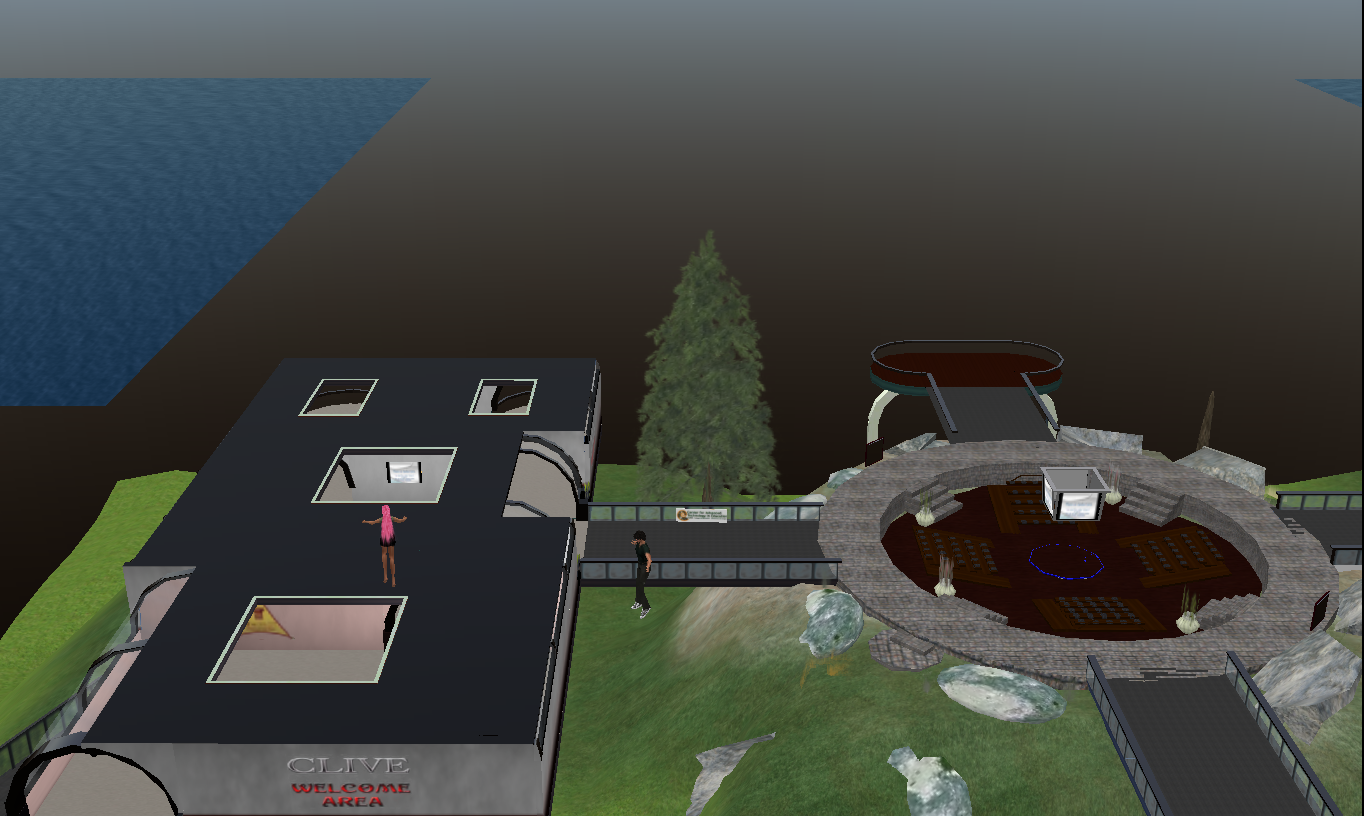
The rooftops at CLIVE in Second Life allow for easy access.

The buildings at CLIVE (Center for Learning in Virtual Environments) are generally standard looking buildings, with the exception of large openings in the rooftops for avatars to be able to fly in and exit easily.

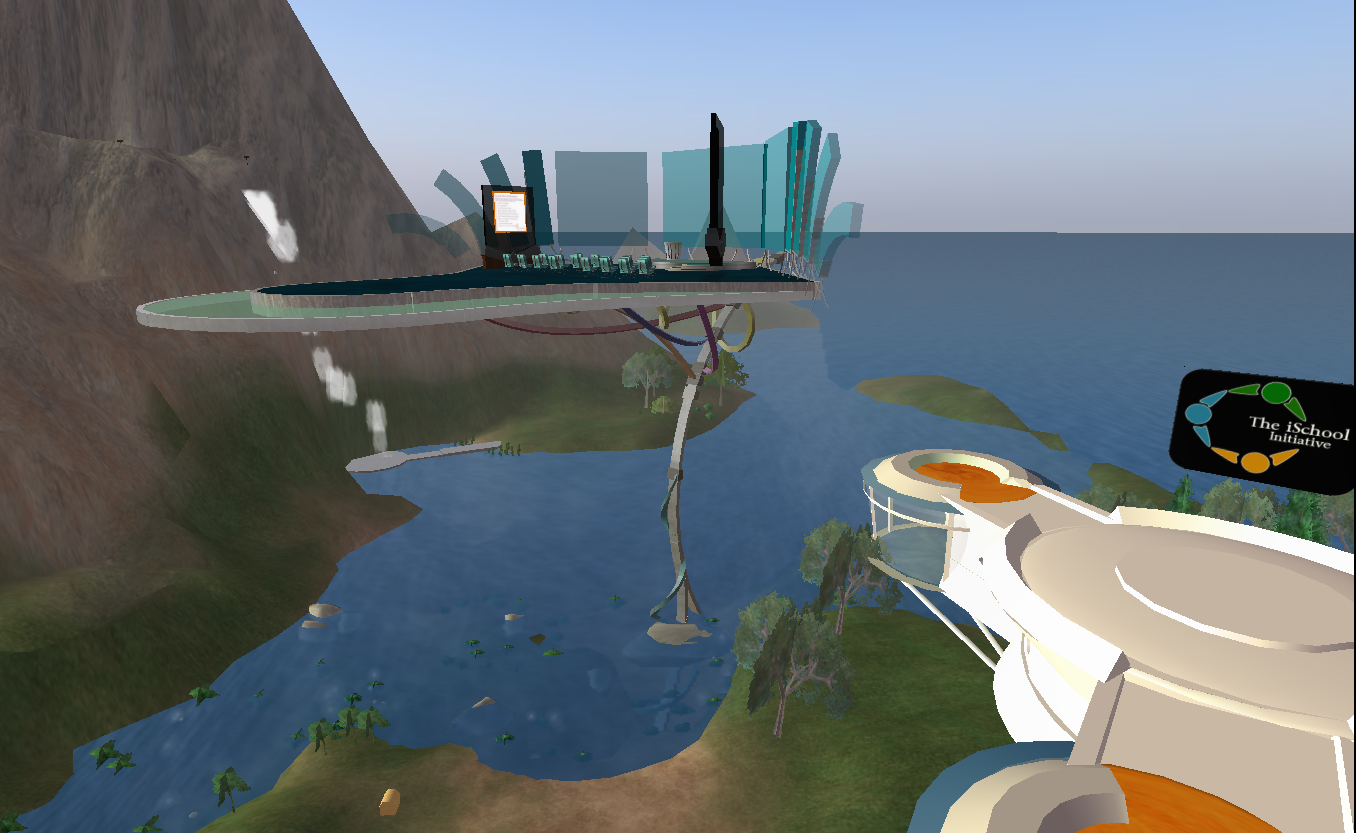
The iSchool classroom on Mellanium in Reaction Grid

The iSchool classroom on Reaction Grid is an open air classroom, easy to access via either a teleport or flying in, yet the space is somewhat traditional with the students desks in rows facing the instructor station and presentation area.

These two spaces illustrate the best of both worlds.

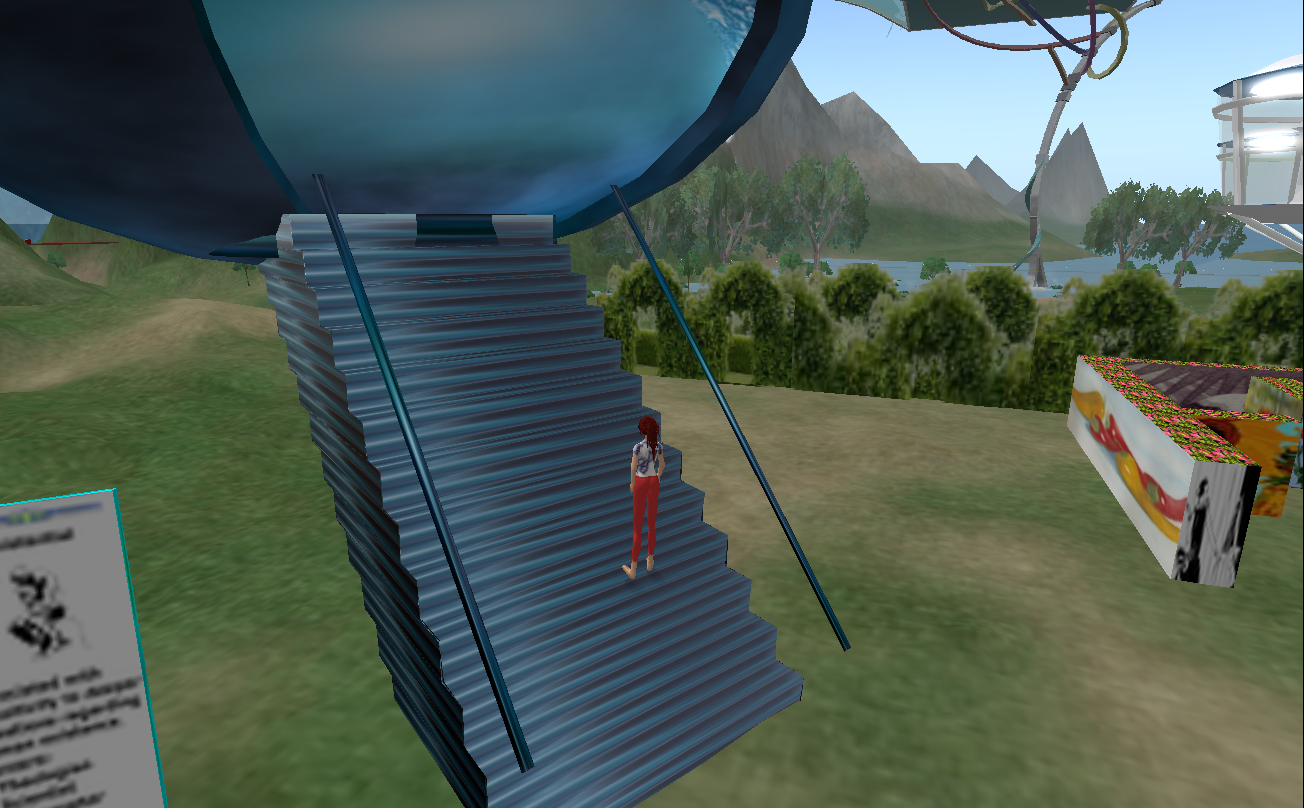
A wide ramp helps avatars to make their way into Gridizens market on Reaction Grid.

Rails keep an avatar from falling off a steep ramp.

Another feature to keep in mind is the ground  (stairs/ramp) access to a facility.  In real life we typically have stairs with a narrow ramp for wheelchair use.  In a virtual setting avatars generally do better with wide ramps or rails with narrower ramps so they don’t fall off.

XSS Bucky Fuller on Mellanium in Reaction Grid and Museum of the Globe are two builds that take full advantage of the attributes of virtual environments.  This virtuatecture looks unlike what we would encounter in the real world yet it works effectively in the virtual setting with large attractive spaces that can be reached via teleport and used in a variety of ways.

XSS Bucky Fuller in Reaction Grid

Museum of the Globe on Second Life

Teen Grid Gone. What’s next in Virtual Worlds for Teen Students?

The recent announcement of the discontinuing of the Teen Grid on Second Life and allowing 16 and 17 year olds to register on the Second Life Main grid has sparked much conversation regarding digital responsibility and safety on the Internet and Virtual Worlds.  In conversations with colleagues, educators using the Teen Grid, Second Life residents and students I have some thoughts about what could and maybe should happen.

Operating a secure closed grid was a complicated venture and educational organizations were not exactly flocking to take advantage, for several reasons.  Costly fingerprinting and background checks for people who already have fingerprints and background checks, a reputation for adult content (despite the security and separate grid), and a general lack of knowledge and understanding of VW among educators were all barriers to taking advantage of the the Teen Grid.

One possibility now is for companies who are developing on Opensim or who have already developed Virtual Worlds with a more educational/student focus could fill the void.  Reaction Grid and Kaneva are both viable possibilities.  A safe environment designed for students under the age of 18 where student participation is monitored.  Supervision is key, one educator told me that even on the Teen Grid students figured out how to smuggle in or create inappropriate content (just as they do in the real world).

The second possibility is to use the Main grid on second Life, not a possibility for my district.  Certainly individuals under the age of 18 will now be allowed to register but a school district will not likely be convinced that the SL main grid environment is safe for students and there would be no liability issues.  Students I have talked to about this tell me that “it is boring” and they would rather play World of Warcraft with a pre-defined objective, points and great graphics and action.  Sims devoted to this type of activity may indeed draw some gamer youth, but not for educational purposes.

An electronic border is used to prevent an avatar from entering a restricted area.

If an educational institution does decide to go this route they could develop filters and restrictions to keep students in appropriate locations and to keep intruders out.  Filters would need to be in place to prevent particular activity and content, possible but complicated.

It is a complex issue,  one widely publicized, inappropriate event involving an underage person could set the entire focus of using these environments for purposes of education into a tailspin, not to mention what it could do to the student.  Educators who are interested in and involved with using the virtual environment for education are clearly innovators and are working for the benefit of children.  In their enthusiasm they must not forget safety and security of the students they teach and should ensure the teaching of digital responsibility to their students.

Spatial Training in a Virtual World May Improve STEM Skills

Studies over the past 50 years indicate a significant, positive correlation between spatial thinking and STEM disciplines.  Project Talent is one of those studies to support spatial training among our students.  Findings indicate that thinking with images plays a central role in scientific creativity and communication.

Determining a path on Core1 in Reaction Grid

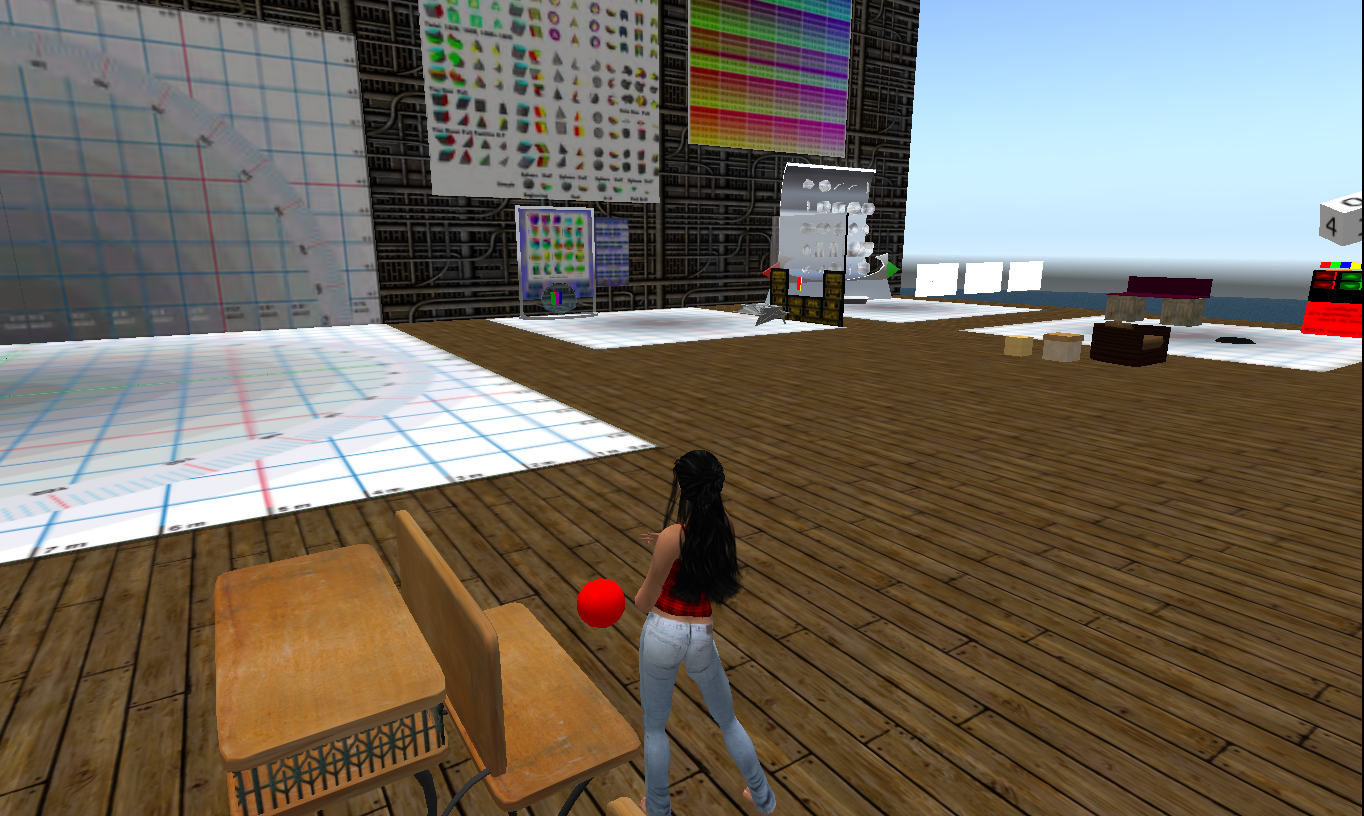
Participating in a virtual world incorporates spatial thinking on a variety of levels.  As consumers, participants in a virtual world deal with location, shapes,  object’s relationship to each other and verbal descriptions such as near, far, next to, on, and under.  In order to traverse the digital terrain they need to be able to move and to communicate spatial concepts.

On a more complex level participants may rearrange furniture, complete puzzles, move objects, and use maps, all contributing to spatial thinking.

Using a map to locate an event on Second Life

In a virtual world workshop

As producers in the virtual environment, participants build and script.  Building requires assembly, measurment, visualizing 3D models and reproducing them or creating new ones.  Producers can build real or imagined structures, vehicles, objects and clothing.

Virtual worlds could, used effectively, provide formal and informal learning models for STEM learning environments.  With the recent announcement of Race To The Top Winners, significant funding is allocated towards the STEM disciplines school districts may have an opportunity to expand and research this promising environment.