Gallery

Virtual Learning Communities Flourish

This gallery contains 4 photos.

Learning communities (LC) are active in the virtual environment,  consisting of like-minded individuals who have a  common interest and get together regularly over long periods of time  to both share and gain knowledge and skills.  Many of the learning communities … Continue reading

Gallery

It’s a Grid, It’s A Game …. It’s Learning

This gallery contains 3 photos.

When asked to describe virtual worlds to my colleagues I struggle in giving an adequate definition.  There is a game quality in virtual worlds, and we know that  game based learning is motivating and effective.  I run into newcomers “inworld” … Continue reading

Gallery

Machinima As An Artifact in A Virtual Portfolio

This gallery contains 1 photo.

Assessment is a necessary part of teaching and learning.   Although standardized testing is a piece of the evaluation picture, other evaluation strategies add to the data and provide a more comprehensive view of the success of teaching and learning. … Continue reading

Managing a Virtual Environment Classroom

The traditional physical classroom has not changed much in the past hundred years.  It contains desks and chairs for students, a teacher desk and chair, a board on which to write or project and wall space which is often decorated with appropriate curricular materials. The most important instructional resource in the classroom is the teacher. A skilled teacher manages the space, materials, furnishings, and students to ensure that students are engaged and learning.  A virtual learning space has less boundaries and limitations and a skilled teacher is again the most important resource.  The teacher must  manage the three-dimensional virtual space, guide students to navigate and interact with the environment and provide experiences to ensure that learning takes place.

Often virtual learning spaces are a replica of the traditional, providing a frame of reference for participants and taking advantage of the potential available in a virtual setting with ‘backchannel’ chat and follow-up assignments.  Teachers and students understand the traditional role of  “sage on the stage” and play the respective roles in the virtual setting, with the added benefits of a virtual setting.  Students can be physically in the same room using computers (a lab setting) requiring both real world and a virtual world classroom management strategies or in remote locations which would require more intensive virtual strategies to ensure engagement of students.  The teacher must :

  • Plan
  1. Design experiences which are interesting, relevant and aligned to curriculum objectives
  2. Plan appropriate amount of time for completing of tasks
  3. Provide direction and guidance so that students know expctations
  • Deliver and Guide
  1. Give clear directions
  2. Encourage questions and answer according to the protocol established
  3. Circulate (virtually and/or physically) among students to provide individual support and ensure engagement
  4. Institute a “buddy” policy for peer support
  5. Intervene when necessary

Norma Underwood uses both real-life and virtual world classroom management strategies to ensure learning for 5th - 8th grade art students on her sim in Reaction Grid.

Constructivist Learning, Virtual Worlds and Future Work Skills

Teachers know that differentiating instruction is most effective and that the more involved in the learning a student is, the more that student will learn.  Thus knowledge/concept retention from lecture is significantly less than from group discussion and actual practice by doing.  As educators we also know that when an individual “teaches” or provides instruction to another they learn it better themselves.  Using gaming in a constructivist teaching environment has merit. The theory of constructivist learning comes from the philosophy that people can understand only what they have personally constructed.  The nature of constructivism:

  • is interdisciplinary with the emphasis on the learner rather than the teacher
  • requires that the learner interacts with the environment and gains understanding
  • ensures the student making meaningful connections
  • requires problem solving
  • requires personal involvement
  • is based on the application of concepts to be learned

Constructivist teachers structure learning experiences that foster the creation of meaning,  building lessons around big ideas to foster learning.  Virtual worlds used in a way that students can build, collaborate, solve problems, and teach others certainly are aligned with the tenets of constructivist teaching.

According to Gartner information, the  World of Work in 10 Years will require a similar set of skills:

  • Work Swarms -problem solving with less structured  situations
  • Weak links – work with people you don’t know or barely know
  • Working With the Collective informal groups of people, outside the direct control of the organization
  • Spontaneous Work new opportunities and creating new designs and models.
  • Simulation and Experimentation active engagement with simulated environments
  • Hyperconnectedness – existing within networks of networks, unable to completely control any of them.
  • Virtual workplace – meetings occurring across time zones and organizations  increasingly happen 24 / 7

The alignment between  constructivist learning and skills for the future make teaching in a virtual world an obvious option.

VW – What’s the Point? Would a score help?

I have been in a cloud – in a trough of disillusionment.  As I encourage colleagues and superiors of the potential in using VW for teaching and learning – and actually get some to register and spend some (limited) time in a virtual world, I get the questions “So what is the point?”  or  “Ok I kinda get it – but is this the best way to…?”  Both are valid questions and questions like these require a thoughtful response.  Some people get it right away, others need guidance, support and demonstrations.  Many need proof – yes metrics.  A hunch is great, a description of happy children makes for good feelings but nothing works like data.

Rubrics are an effective way to capture observations and quantify what participants accomplish and the way in which they do so.  A simple rubric design may look something like this:

Communication Collaboration Problem Solving Use of Information Points
Objective: Participants will work together in teams of … to …..
Participant has minimal communication with other participants Participant works alone Participant has no unique contribution Participant includes only known information 1Points

each

Participant uses voice to effectively communicate with peers Participant demonstrates ability to work with 1 to 2 individuals primarily as a follower Participant participates in solving problems in a unique way Participant contributes to information by completing some research 2points

each

Participant uses both text and voice to collaborate with peers Participant collaborates with peers as a follower as well as a leader Participant provides unique contributions to solve problems Participant contributes with both known and newly researched information 3points

each

Participants would benefit knowing how well they are doing and the objective in the use of the environment needed to succeed. Success depends on the process. So points are awarded when students

  • work with others to accomplish a task
  • communicate effectively
  • locate and use information effectively

Virtual Literature Circles

Facilitating a literature circle takes skill and even the most practiced practitioners sometimes have challenges in encouraging the reticent to speak up.  In her article “The Virtual Circle” Stacy Kitsis describes how she used blogging to support student participation and thoughtful reflection. This English teacher describes a number of positive observations including increases in engagement and interaction, completion of homework, and active reading.  Ms. Kitsis described how the more reticent students chose to use pseudonyms for their blogs and were ‘not shy’ with their entries.

The success described could be taken a step further by conducting the literature circles in an immersive environment.  Positive aspects achieved in blogging could be even more enhanced as students use their avatars to reflect and discuss the selected literature.  The discussions could take place in voice or in text, the latter offers an archival benefit.

Evidence vs Adult Intervention

Remember the clubhouse in the woods you built with your friends.  It was your clubhouse.  You and your friends thought of it, planned it, gathered materials, constructed it, fought about it, fought in it, plotted in it, pretended to be super-heros or knights in it, and then probably tore it down because it seemed like a good idea and it was yours to tear down.  Remember the playhouse that the little girl down the street had.  Her father built it for her.  It was a beauty; A door with hinges and a door knob, heart-shaped shutters, flower-boxes, shingles, matching curtains and furnishings.  She had a birthday party and everyone got to go into it but you couldn’t “mess it up”. Nobody really played there much, it collected spiderwebs.  It sat forever – a monument to adult intervention.

As I listened to the ISTE Speaker Series on SL Tuesday night, Knowclue’s message was most profound.  She said she is a stickler on students building and making their own environment in SL Teen Grid and now on Reaction Grid where she provides instruction.  I sat in the audience and asked “what evidence do you have of student achievement?”  My thoughts were focused on what so many educators are thinking about:  test scores, numbers, Adequate Yearly Progress, achievement data, standards.  Of course these are important quantifiable data points and so is the remarkable build that her students created.
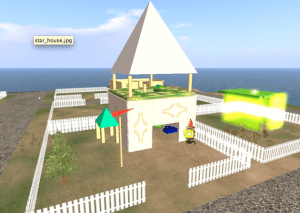
A student build in a virtual world - minimal adult intervention.

The evidence is that children built a community based on a unit of study.  The student Build required the use of communication, collaboration and problem solving (those 21st Century Skills).  It required the use of mathematics and integration of an artistic sensibility.  The students had to read/research and take notes, write, and compute.  Knowclue has a clue and she also has evidence.  The student product is the evidence.  The students will be tested in the standards at the end of the year and those scores too will be reviewed – together they form the picture of evidence.  My hunch is the students who build will demonstrate more learning gains than the students who have it built for them,  look to the evidence.

A Metaphor for Teaching Those We Don’t Understand

As I attempted to help a newcomer to SL and kept getting the response “I don’t see that.”  “Not on my screen”.  “Not there” “Don’t have that”, it hit me that teachers who are well-meaning but unprepared reach a level of frustration because their students “Don’t see that”.

The issue here was that I was using the OLD viewer, the viewer I am comfortable with and the newcomer was using the NEW viewer, the viewer available to newcomers to SL.  I knew what this new av needed to do and gave very specific instructions. However, the newcomer, trying to follow every step, became increasingly frustrated at being given directions for a view she did not have.  Then I became frustrated and the result was a complete lack of progress until I re-logged with the new viewer and figured out where the buttons were and how to find the functions I had been describing.  It did take some time, I was out of my comfort level and went back to my old viewer immediately following the “lesson”.  I never did find the “stop all animations”.

When a teacher is trying to teach students with a different view on life, a different culture, a different language background, a different perspective, a different comfort level – the same thing happens.  The student gets frustrated and the teacher gets frustrated resulting in lack of progress.  The solution is that the teacher acquires the necessary knowledge and skill set to be able to help the students being taught.  A teacher needs to see what the student sees, even if it is a little uncomfortable at first, in order to effectively support learning.

Advisory Panel to Offer Obama Ideas for Advancing STEM Education

Advisory Panel to Offer Obama Ideas for Advancing STEM Education.