Gallery

Machinima As An Artifact in A Virtual Portfolio

This gallery contains 1 photo.

Assessment is a necessary part of teaching and learning.   Although standardized testing is a piece of the evaluation picture, other evaluation strategies add to the data and provide a more comprehensive view of the success of teaching and learning. … Continue reading

Managing a Virtual Environment Classroom

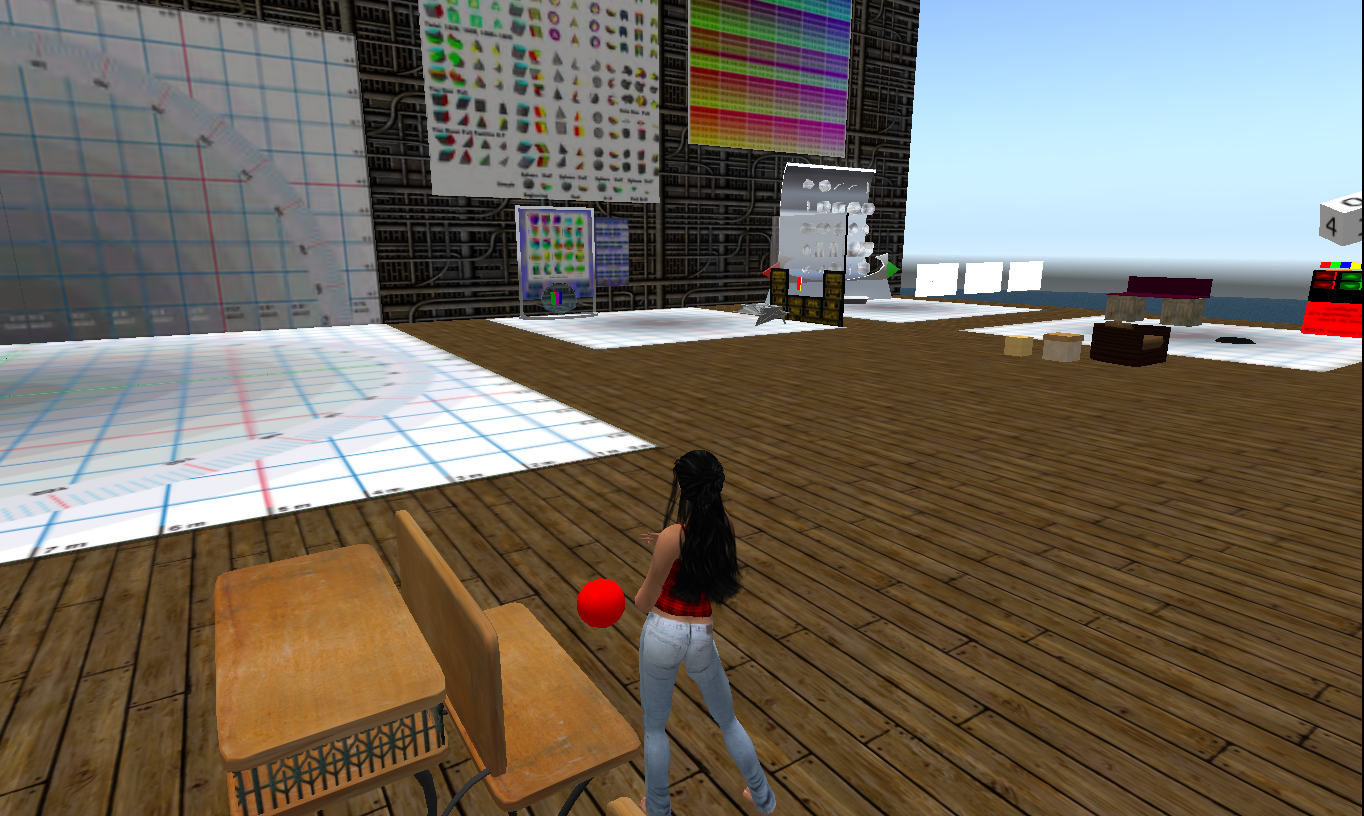
The traditional physical classroom has not changed much in the past hundred years.  It contains desks and chairs for students, a teacher desk and chair, a board on which to write or project and wall space which is often decorated with appropriate curricular materials. The most important instructional resource in the classroom is the teacher. A skilled teacher manages the space, materials, furnishings, and students to ensure that students are engaged and learning.  A virtual learning space has less boundaries and limitations and a skilled teacher is again the most important resource.  The teacher must  manage the three-dimensional virtual space, guide students to navigate and interact with the environment and provide experiences to ensure that learning takes place.

Often virtual learning spaces are a replica of the traditional, providing a frame of reference for participants and taking advantage of the potential available in a virtual setting with ‘backchannel’ chat and follow-up assignments.  Teachers and students understand the traditional role of  “sage on the stage” and play the respective roles in the virtual setting, with the added benefits of a virtual setting.  Students can be physically in the same room using computers (a lab setting) requiring both real world and a virtual world classroom management strategies or in remote locations which would require more intensive virtual strategies to ensure engagement of students.  The teacher must :

  • Plan
  1. Design experiences which are interesting, relevant and aligned to curriculum objectives
  2. Plan appropriate amount of time for completing of tasks
  3. Provide direction and guidance so that students know expctations
  • Deliver and Guide
  1. Give clear directions
  2. Encourage questions and answer according to the protocol established
  3. Circulate (virtually and/or physically) among students to provide individual support and ensure engagement
  4. Institute a “buddy” policy for peer support
  5. Intervene when necessary

Norma Underwood uses both real-life and virtual world classroom management strategies to ensure learning for 5th - 8th grade art students on her sim in Reaction Grid.

Constructivist Learning, Virtual Worlds and Future Work Skills

Teachers know that differentiating instruction is most effective and that the more involved in the learning a student is, the more that student will learn.  Thus knowledge/concept retention from lecture is significantly less than from group discussion and actual practice by doing.  As educators we also know that when an individual “teaches” or provides instruction to another they learn it better themselves.  Using gaming in a constructivist teaching environment has merit. The theory of constructivist learning comes from the philosophy that people can understand only what they have personally constructed.  The nature of constructivism:

  • is interdisciplinary with the emphasis on the learner rather than the teacher
  • requires that the learner interacts with the environment and gains understanding
  • ensures the student making meaningful connections
  • requires problem solving
  • requires personal involvement
  • is based on the application of concepts to be learned

Constructivist teachers structure learning experiences that foster the creation of meaning,  building lessons around big ideas to foster learning.  Virtual worlds used in a way that students can build, collaborate, solve problems, and teach others certainly are aligned with the tenets of constructivist teaching.

According to Gartner information, the  World of Work in 10 Years will require a similar set of skills:

  • Work Swarms -problem solving with less structured  situations
  • Weak links – work with people you don’t know or barely know
  • Working With the Collective informal groups of people, outside the direct control of the organization
  • Spontaneous Work new opportunities and creating new designs and models.
  • Simulation and Experimentation active engagement with simulated environments
  • Hyperconnectedness – existing within networks of networks, unable to completely control any of them.
  • Virtual workplace – meetings occurring across time zones and organizations  increasingly happen 24 / 7

The alignment between  constructivist learning and skills for the future make teaching in a virtual world an obvious option.

VW – What’s the Point? Would a score help?

I have been in a cloud – in a trough of disillusionment.  As I encourage colleagues and superiors of the potential in using VW for teaching and learning – and actually get some to register and spend some (limited) time in a virtual world, I get the questions “So what is the point?”  or  “Ok I kinda get it – but is this the best way to…?”  Both are valid questions and questions like these require a thoughtful response.  Some people get it right away, others need guidance, support and demonstrations.  Many need proof – yes metrics.  A hunch is great, a description of happy children makes for good feelings but nothing works like data.

Rubrics are an effective way to capture observations and quantify what participants accomplish and the way in which they do so.  A simple rubric design may look something like this:

Communication Collaboration Problem Solving Use of Information Points
Objective: Participants will work together in teams of … to …..
Participant has minimal communication with other participants Participant works alone Participant has no unique contribution Participant includes only known information 1Points

each

Participant uses voice to effectively communicate with peers Participant demonstrates ability to work with 1 to 2 individuals primarily as a follower Participant participates in solving problems in a unique way Participant contributes to information by completing some research 2points

each

Participant uses both text and voice to collaborate with peers Participant collaborates with peers as a follower as well as a leader Participant provides unique contributions to solve problems Participant contributes with both known and newly researched information 3points

each

Participants would benefit knowing how well they are doing and the objective in the use of the environment needed to succeed. Success depends on the process. So points are awarded when students

  • work with others to accomplish a task
  • communicate effectively
  • locate and use information effectively

Virtual Literature Circles

Facilitating a literature circle takes skill and even the most practiced practitioners sometimes have challenges in encouraging the reticent to speak up.  In her article “The Virtual Circle” Stacy Kitsis describes how she used blogging to support student participation and thoughtful reflection. This English teacher describes a number of positive observations including increases in engagement and interaction, completion of homework, and active reading.  Ms. Kitsis described how the more reticent students chose to use pseudonyms for their blogs and were ‘not shy’ with their entries.

The success described could be taken a step further by conducting the literature circles in an immersive environment.  Positive aspects achieved in blogging could be even more enhanced as students use their avatars to reflect and discuss the selected literature.  The discussions could take place in voice or in text, the latter offers an archival benefit.

Advisory Panel to Offer Obama Ideas for Advancing STEM Education

Advisory Panel to Offer Obama Ideas for Advancing STEM Education.

Gallery

Machinima in Education

Creating films for learning is not new in K-12 education nor has the strategy  been limited to magnet programs or exclusive schools that offer high-level technology classes and/or broadcasting.  Teachers have used filmmaking  as a way to help students learn … Continue reading

Spatial Training in a Virtual World May Improve STEM Skills

Studies over the past 50 years indicate a significant, positive correlation between spatial thinking and STEM disciplines.  Project Talent is one of those studies to support spatial training among our students.  Findings indicate that thinking with images plays a central role in scientific creativity and communication.

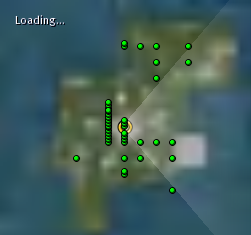
Determining a path on Core1 in Reaction Grid

Participating in a virtual world incorporates spatial thinking on a variety of levels.  As consumers, participants in a virtual world deal with location, shapes,  object’s relationship to each other and verbal descriptions such as near, far, next to, on, and under.  In order to traverse the digital terrain they need to be able to move and to communicate spatial concepts.

On a more complex level participants may rearrange furniture, complete puzzles, move objects, and use maps, all contributing to spatial thinking.

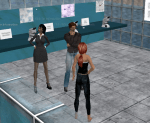
Using a map to locate an event on Second Life
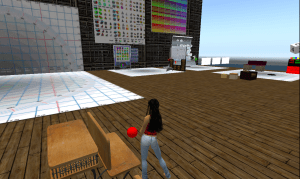
In a virtual world workshop

As producers in the virtual environment, participants build and script.  Building requires assembly, measurment, visualizing 3D models and reproducing them or creating new ones.  Producers can build real or imagined structures, vehicles, objects and clothing.

Virtual worlds could, used effectively, provide formal and informal learning models for STEM learning environments.  With the recent announcement of Race To The Top Winners, significant funding is allocated towards the STEM disciplines school districts may have an opportunity to expand and research this promising environment.

Gallery

The Value of Play

This gallery contains 4 photos.

Play connects us to others, fosters creativity, helps with social skills, motivates and increases cognitive growth, according to Vygotsky’s research on play.    We like to play and we learn from playing, so playing in a virtual setting seems to be logical enhancement … Continue reading

Teaching Math in The Virtual World

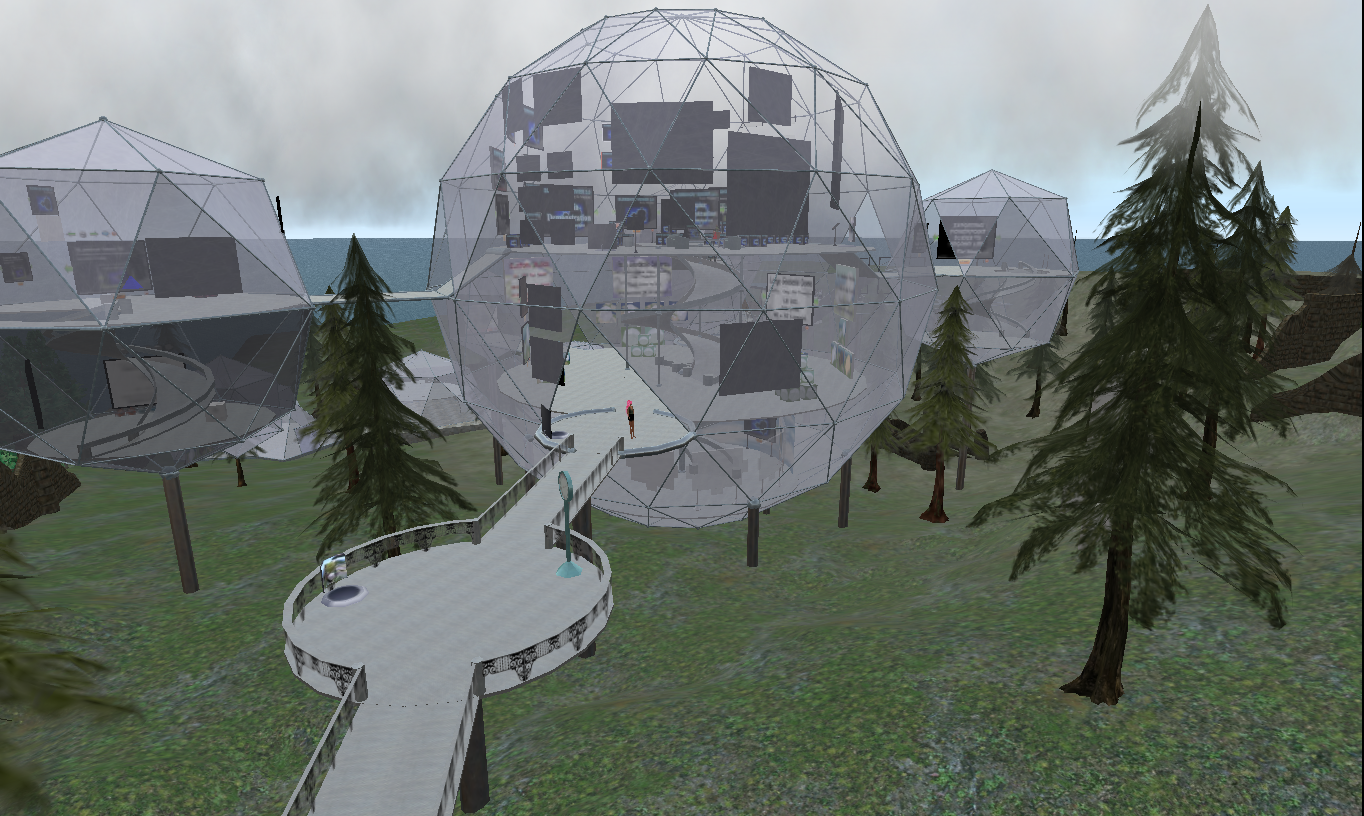
Mathematics may be one of the most obvious ways to use a virtual world for teaching and learning, particularly when students are in the building capacity.  Students can practice applying   mathematical concepts, while being creative and having fun.  Geometry comes alive as an avatar creates and moves 3D shapes around to construct a real or imagined structure, graphical representations are concrete rather than theoretical.

A geodesic structure in SL

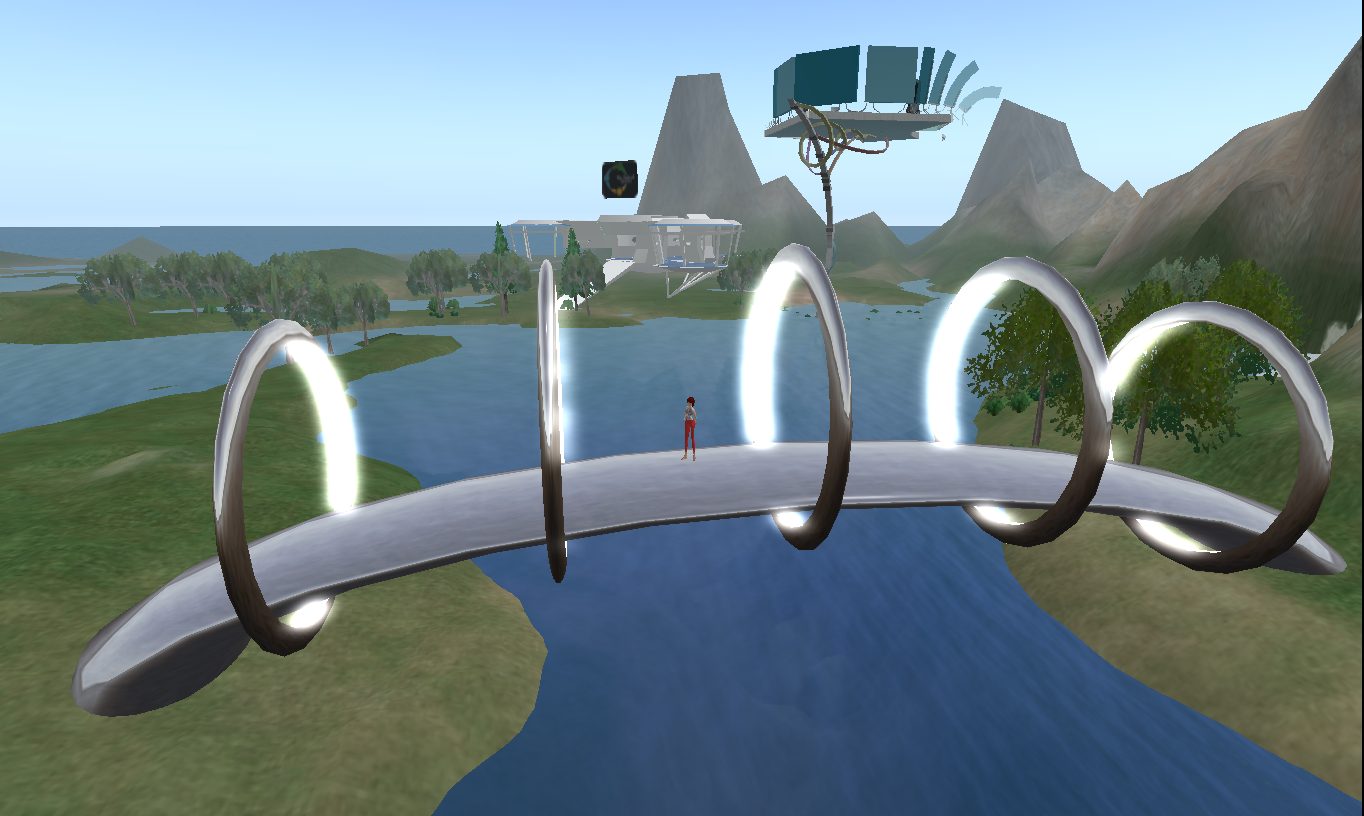
A bridge in Reaction Grid

The tools in the virtual world are simple enough that even elementary school children can use them.   Learning to use these tools may even provide some preliminary knowledge and skills for future use of  more complex engineering CAD tools. Once the students create the shapes (which takes seconds) the 3D polygons can be moved about, enlarged or reduced in size, stacked, linked, rotated, twisted, tapered, even suspended in the air at the click of a mouse.  Students can adjust shapes and angles to fit ‘building blocks’ more precisely, they have the use of coordinates and measuring tools to support their building and learning.  The most important part is the process, not the final product, though the final product may contribute to discussion regarding the feasibility of the structures in real  life.  The process of building and solving the problems of fitting virtual shapes together to construct a planned structure is what makes students think and apply the mathematical concepts.

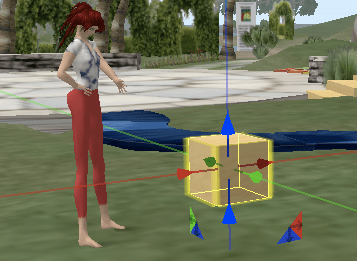
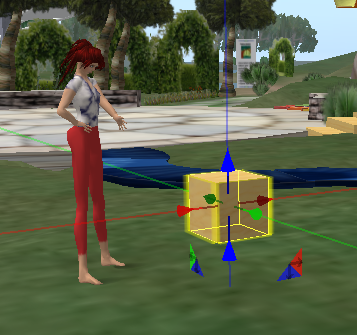
'Building' a block

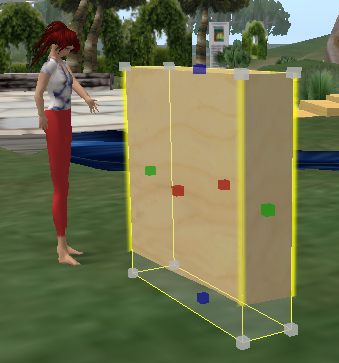
Adjusting dimensions of the cube.

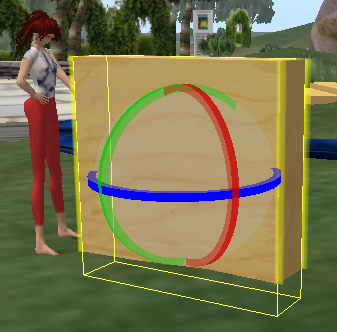
Rotating the adjusted cube.

Here an avatar creates a cube and then transforms it to a thinner taller rectangular shape, then rotates it to get it in the correct position.

The syllabus of an educational technology class at Boise State is an example of prospective teachers being provided an opportunity to learn  the skills necessary to use this medium for future instruction in K-12 classrooms.  There are multiple examples of K-12 teachers providing ‘building’ opportunities on the SL Teen Grid and on Reaction Grid  to their students. As these students apply mathematical concepts and address required standards they also practice some 21st Century skills such as innovation, collaboration and problem solving.