
The 3rd Tuesday of every month ISTE hosts a speaker at the ISTE Island Auditorium- Second Life. Speakers are educators and researchers from both the K-12 and higher education sector. The one-hour session uses a format of a typical talk-show, … Continue reading
Category Curricula
Book Clubbing, Virtually

This gallery contains 2 photos.
Belonging to a book club is like belonging to a gym, once you join there is fun and personal growth but you sometimes need to push yourself. The League of Extraordinary Dorks (LED) Book Club meets each month at the … Continue reading
Animations Make it Real…sort of
A virtual world avatar wielding a sword and dropping unconscious is not unusual, more subtle movements sometimes are. Standing at a podium and moving hands during a speech, nibbling on an apple or just sitting in a natural pose bring an avatar to life and make for a more engaging experience for participants. Virtual worlds supply your avatar with standard poses, these can be adjusted or you can make your own using Poser (for purchase) or Qavimator (PC) or (Mac) , a free animation creation software application. I highly recommend Danish Visions on Second Life classes at http://slurl.com/secondlife/Danish%20Visions/126/119/24). Tempest Jarman teaches the QAvimator class in voice in a patient, organized manner. She is clearly an expertise in the use of the QAvimator software.
I conducted a webinar in Adobe Connect recently and a participant gave me feedback saying that I “neglected to use the video capabilities and that would have provided some connection, audio is not enough”. In a virtual environment there is potential for auditory, textual, and visual cues to impart a message. Creating animations and then making them available provides natural movements for students and instructors on a virtual world. Adding the animations to a HUD gives the participant the ability to change an animation for emphasis and realism at a specific time. Subtle animations like raising a hand, applauding, leaning back in boredom or nodding can help to convey a message to others participating in an event. I am considering filming my virtual world avatar for the next webinar I facilitate, I figure it may help get their attention and it could be fun.
You can download the free QAvimator software at
(PC) http://www.qavimator.org/
(Mac) http://referencethis.com/QAvimator-osx-universal-svn-2008-12-06.zip
Share this:

Skilled Teaching Works in All Worlds
I was curious about sculpting 3D objects and figured “I am capable, I can do this”. I downloaded Blender, bought a book and made an attempt. The multiple tools and buttons in the software were overwhelming and The first chapter of the book discussed how difficult Blender was to learn. Time for Plan B. I turned to a RL friend who is not a teacher but user of multiple 3D programs and talented artist in multiple mediums. I sat with him for about an hour and watched in amazement as he transformed ordinary spheres and cubes into something more interesting and asymmetrical, still I had no idea how to do it myself. Fast-forward a few months when a friendly avatar invited me to come along to introductory sculpting class at the Danish Visions Class Group (http://slurl.com/secondlife/Danish%20Visions/126/119/24 ) in Second Life. We had to hurry as “the room is locked after the lesson begins”, I was told, “and you can’t get in late”.

The Danish Visions Classroom space on SL
What a difference quality instruction makes. Inge Qunhua, the Danish instructor provided the lesson in voice (in English), as well as in text for those who did not have audio capabilities. She began the lesson with a quick reminder of classroom norms and necessary materials with time to download Sculptypaint. She then provided the objectives of the lesson and explained that at the end of the hour we would all have an individually designed comfy chair with rounded edges and a pedestal table. “A lofty goal – I’m a beginner”, I was thinking, “how is this possible?”
With a minimized SL screen of Inge’s presentation and a working screen with Sculptypaint software I followed instructions, using a 15 inch laptop. Inge monitored the students, corrected and provided feedback, and evaluated results. At the end of the hour we had all met the objectives.

My newly constructed sculpty chair and table
Telling and showing is not teaching, though it’s part of the process. Good teaching must include
• planning meaningful activities to meet objectives • monitoring students as they practice until they reach a level of success • explaining expectations and what success looks like • evaluating results and providing feedback for improvementThe elements of this virtual world lesson included research-based effective teaching strategies and the results were evidence of capable instruction.
Share this:


Value of Voice: Language Instruction in Virtual Environments
Learning a language is facilitated in a virtual environment with opportunities to use audio in a non-threatening venue, quickly change settings to encourage use of diverse vocabulary, and practice with native speakers from different geographic locations and accents.


The particular English Language class I observed took advantage of a traditional lecture and presentation board, using both the native tongue of the learners as well as the target language, English.  Students responded to questions in local chat providing the instructor an easy way to ascertain grasp of the topic.
One strategy that Alfonso Perfferle uses in his English for Spanish Speakers class on Second Life is to pair students and assign one member of the pair a note-card with questions associated with the topic or grammatical focus of the day.  Pairs of students then conduct a private voice call and practice speaking, using the note-card as a guide.  Text is available, as needed, for clarification.  The paired chat does not disturb other students and can be practiced and repeated in a trusting environment.

Responses from students in local chat allows for quick formative evaluation.
In addition to the structured and more formal activity pictured here, this class of English Language learners logon from remote locations around the world to participate in "field trips" providing an opportunity to practice English in a variety of settings from shopping and restaurants to amusement parks and historic sites. Time zones and physical locations are secondary factors in this particular classroom, the instructor is physically located in Miami, Florida while the majority of students are located in Spain.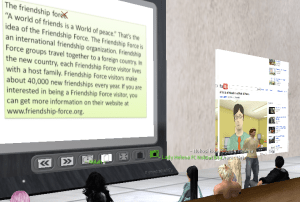

Share this:

Digitally Amplified Literature in the Virtual World

This gallery contains 5 photos.
Rod Humble of Linden Labs recently described the Virtual World as “creative space”. Jeddin’s Underground City sim on Second Life is a creative space melding the ideas of Descending Road author/creator with 3D artistry and SL scripting to make what the artist … Continue reading
Student Machinima at ISTE 2011
Almost half (17 out of 40) of the entries in the ISTE 2011 Machinima competition are student created and range from a 5-year-old working in Minecraft to university students working in Second Life to demonstrate their learning. Attendees in Philadelphia as well as those attending virtually can view the machinima at the iste Wikispaces . Machinima was created in a number of virtual worlds, including Second Life, Reaction Grid, MineCraft, World of Warcraft and WolfQuest and covered a variety of curriculum areas including history, social issues, creative writing and science.. Be sure to access the ballot at http://bit.ly/j8Amyj and vote for your favorite student created machinima.
Share this:
Living Literature in Virtual Worlds

This gallery contains 7 photos.
The use of Virtual Worlds to explore and enhance the literary experience is a useful activity for pre-reading, ongoing as a specific piece is read, and/or as reinforcement after the reading is complete. The value of a virtual world in … Continue reading
Genetic Study via Virtual Pets and Plants

This gallery contains 5 photos.
Can the virtual world SL breedable pets such as Meeroos and breedable plants such as Sibotanicals provide some opportunities to learn about biological and botanical genetics? The breedables are an amusing addition to the virtual setting, as the scripting progresses, the concepts of DNA and … Continue reading
Geography Standards via Terraforming and Virtual Mapping
Forming continents, islands, mountains, valleys and rivers works with mashed potatoes, beach sand, mud in the back yard and pixels in the virtual world. Terraforming physical landform characteristics including mountains, valleys, rivers, oceans, lakes and beaches is as easy as a click with a mouse on the correct tool and then sliding or moving the mouse in a circular motion to raise, lower, flatten, roughen and smooth the land.
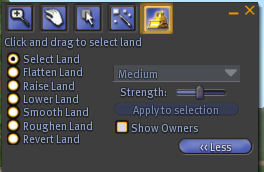
The terraforming tool options are basic and easy to understand
The size of the area as well as the strength of the tool is adjusted as desired. A little practice in an empty “sandbox” is typically enough to get the “feel” for pressure and size attributes. Adding Flora and fauna to the newly formed topography is an opportunity to learn about climate, elevations and ecosystems.

A map view of a sim on Reaction Grid
Geography standards include various elements of map reading. Reading the maps in a virtual world and being able to zoom in provides not only the opportunity for recognizing the use of a legend, direction, location and distance, but also the ability to see influences of hydrology and physical characteristics of a place.

 Gridjumper's Blog