Gallery

Build a Virtual Biome to Master Science Standards

This gallery contains 5 photos.

Environments in virtual worlds can be realistic or fantastical, each has benefits for students both as visitors and as creators.  National and state educational standards require that students can identify, describe and understand the differences in both land and water-related … Continue reading

Gallery

Virtual Learning Communities Flourish

This gallery contains 4 photos.

Learning communities (LC) are active in the virtual environment,  consisting of like-minded individuals who have a  common interest and get together regularly over long periods of time  to both share and gain knowledge and skills.  Many of the learning communities … Continue reading

Constructivist Learning, Virtual Worlds and Future Work Skills

Teachers know that differentiating instruction is most effective and that the more involved in the learning a student is, the more that student will learn.  Thus knowledge/concept retention from lecture is significantly less than from group discussion and actual practice by doing.  As educators we also know that when an individual “teaches” or provides instruction to another they learn it better themselves.  Using gaming in a constructivist teaching environment has merit. The theory of constructivist learning comes from the philosophy that people can understand only what they have personally constructed.  The nature of constructivism:

  • is interdisciplinary with the emphasis on the learner rather than the teacher
  • requires that the learner interacts with the environment and gains understanding
  • ensures the student making meaningful connections
  • requires problem solving
  • requires personal involvement
  • is based on the application of concepts to be learned

Constructivist teachers structure learning experiences that foster the creation of meaning,  building lessons around big ideas to foster learning.  Virtual worlds used in a way that students can build, collaborate, solve problems, and teach others certainly are aligned with the tenets of constructivist teaching.

According to Gartner information, the  World of Work in 10 Years will require a similar set of skills:

  • Work Swarms -problem solving with less structured  situations
  • Weak links – work with people you don’t know or barely know
  • Working With the Collective informal groups of people, outside the direct control of the organization
  • Spontaneous Work new opportunities and creating new designs and models.
  • Simulation and Experimentation active engagement with simulated environments
  • Hyperconnectedness – existing within networks of networks, unable to completely control any of them.
  • Virtual workplace – meetings occurring across time zones and organizations  increasingly happen 24 / 7

The alignment between  constructivist learning and skills for the future make teaching in a virtual world an obvious option.

Grid Hopping: One Av / Multiple Grids

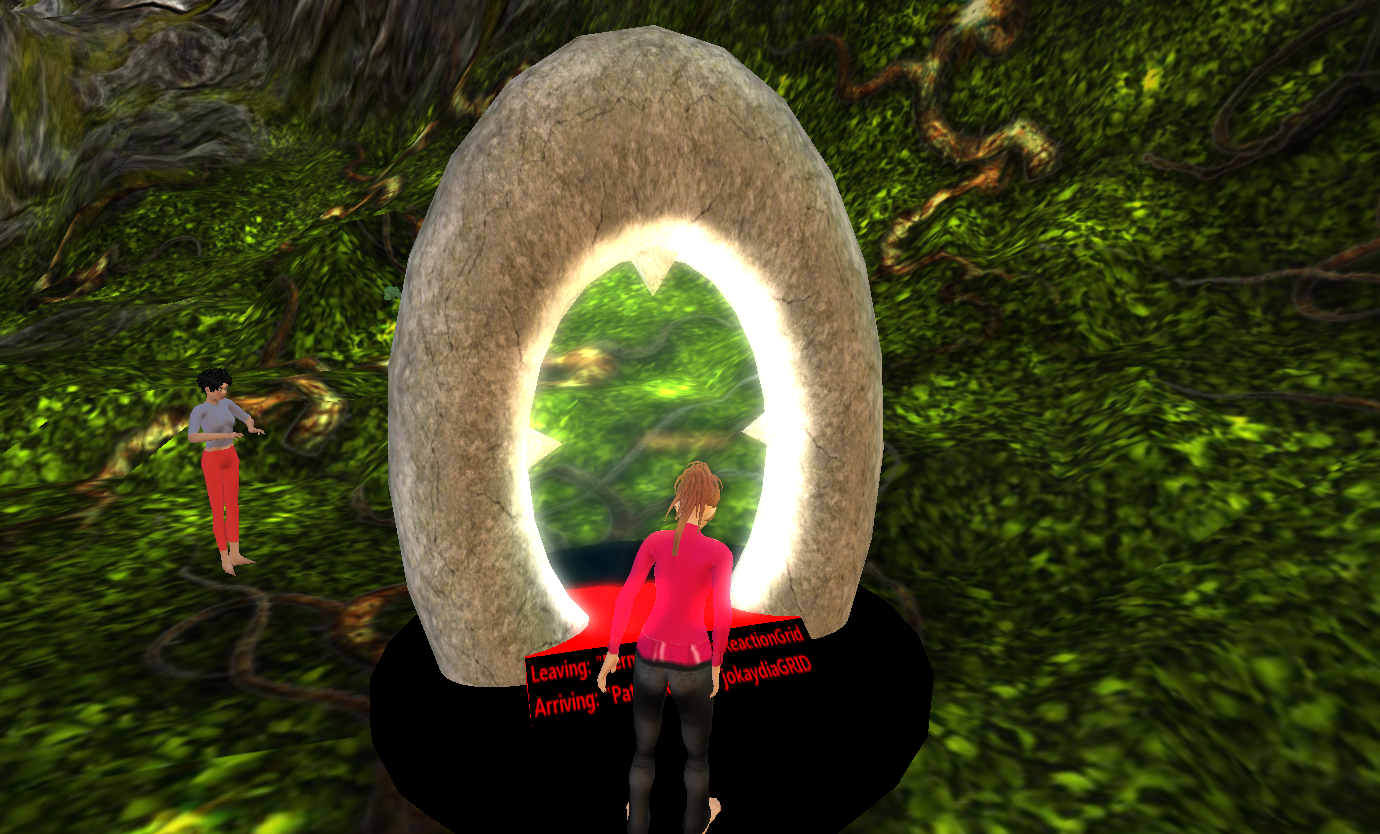
I joined an international group of “Gridizens” a couple of nights ago to experience a hypergrid.  Our Avatars teleported from one grid to another.  In this case we teleported from Reaction Grid to Jokaydia.  The technical aspects are explained on the Opensim wiki. Hopping from one grid to another – hypergridding –  is like linking from one website to another.  We do that everyday on the 2D web without really thinking too much about it, and many create those links in wikis, blogs, and in social networking and bookmarking pages.  A virtual world is a little more complicated because you have an agent or avatar that is entering the grid.  Typically, the user needs to register in each of the worlds and use a different avatar or agent, so the benefit of the hypergrid is that it allows you to use the same avatar in each of these worlds.

Entering the Hypergrid portal on Reaction Grid.

Implications for education and collaboration are significant.  Imagine being able to do extend what is now done in a flat environment like Facebook,  Google Docs, or Diigo in a 3D environment.  A single sign-on, a single username and password,  a single inventory repository simplifies entering the Virtual Universe and visiting the worlds within it.

On Jokaydia Grid with a member of the Jokaydia Grid - the tags indicate the Grid of origin for the visiting Avatars

Gallery

Gartner Hype Wave

This gallery contains 1 photo.

Always good to triangulate your data – 1.  The Gartner  Hype Cycle/Wave indicates that “Virtual Assistants & Public Virtual Worlds are nearly through the Trough of Disillusionment, about to enter mainstream in 5-10 years” 2.  Recent Grant activity encouraging the use … Continue reading

Advisory Panel to Offer Obama Ideas for Advancing STEM Education

Advisory Panel to Offer Obama Ideas for Advancing STEM Education.

Gallery

Machinima in Education

Creating films for learning is not new in K-12 education nor has the strategy  been limited to magnet programs or exclusive schools that offer high-level technology classes and/or broadcasting.  Teachers have used filmmaking  as a way to help students learn … Continue reading

Spatial Training in a Virtual World May Improve STEM Skills

Studies over the past 50 years indicate a significant, positive correlation between spatial thinking and STEM disciplines.  Project Talent is one of those studies to support spatial training among our students.  Findings indicate that thinking with images plays a central role in scientific creativity and communication.

Determining a path on Core1 in Reaction Grid

Participating in a virtual world incorporates spatial thinking on a variety of levels.  As consumers, participants in a virtual world deal with location, shapes,  object’s relationship to each other and verbal descriptions such as near, far, next to, on, and under.  In order to traverse the digital terrain they need to be able to move and to communicate spatial concepts.

On a more complex level participants may rearrange furniture, complete puzzles, move objects, and use maps, all contributing to spatial thinking.

Using a map to locate an event on Second Life
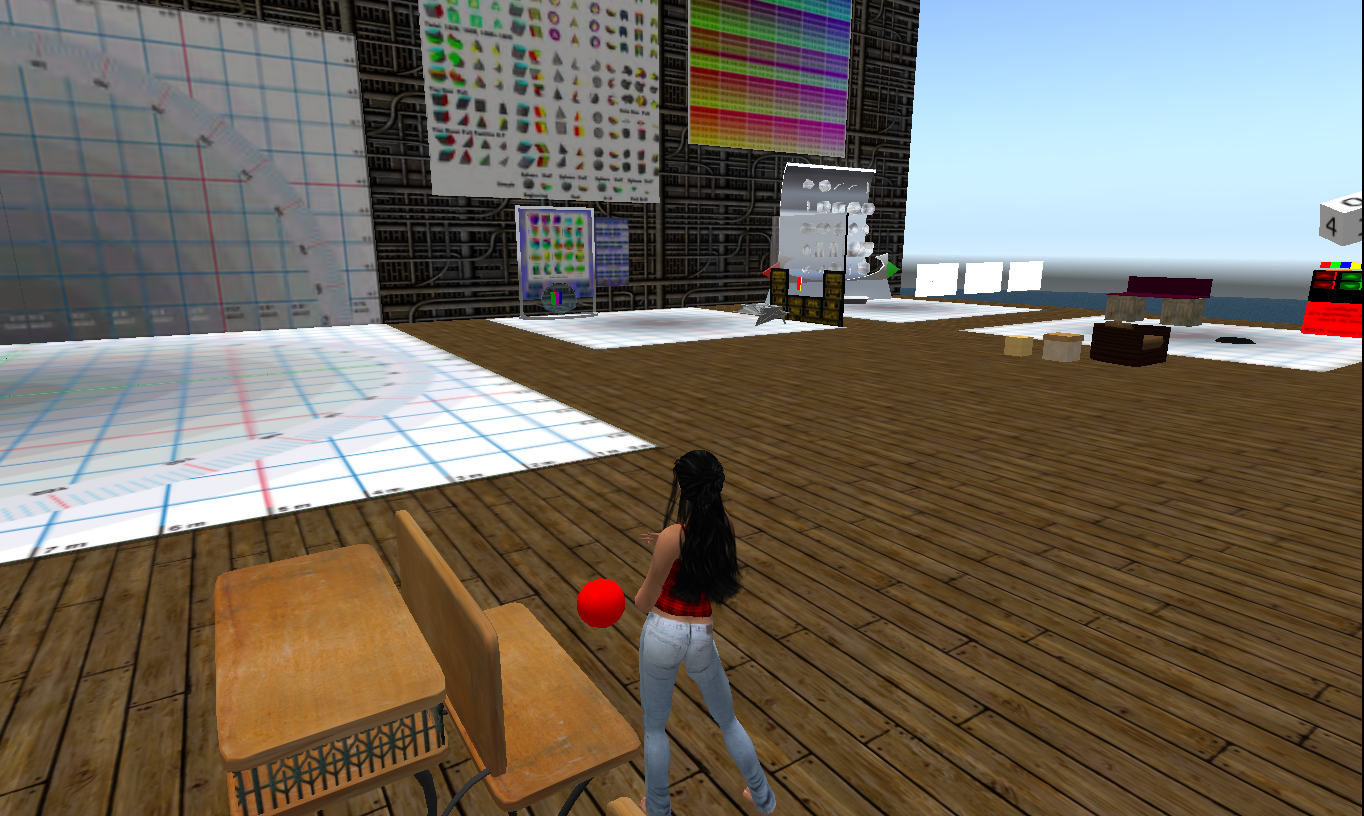
In a virtual world workshop

As producers in the virtual environment, participants build and script.  Building requires assembly, measurment, visualizing 3D models and reproducing them or creating new ones.  Producers can build real or imagined structures, vehicles, objects and clothing.

Virtual worlds could, used effectively, provide formal and informal learning models for STEM learning environments.  With the recent announcement of Race To The Top Winners, significant funding is allocated towards the STEM disciplines school districts may have an opportunity to expand and research this promising environment.

21st Century Teacher Preparation Using VW

Prospective and veteran teachers have an opportunity to participate in a teacher preparation/training model using the virtual world of Second Life at West Virginia University.  The program at West Virginia University has found it to be particularly useful for math and physics training, an area of concern for schools across the US.

Universities in general seem to have explored VW technology more readily than the K-12 sector, perhaps the safety/security/liability concerns have something to do with it.  Their incoming students are over 18, certainly more tech-savvy than their predecessors, and professors are quickly becoming more digitally literate to support the student population they serve.  It seems that a pre-requisite for attending college today is a computer.  How this translates to the more cautious K-12 sector is still up to policy makers.  At the very least, the new teaching force will have a digital comfort and will use the digital environment to enhance their own content knowledge via learning strategies that seem to translate theory into application effectively.   The VW teacher preparation can also provide opportunities to learn teaching strategies that do not require digital methods.   Role playing in a “traditional classroom setting” can take place more frequently and without disrupting learning in an actual classroom.  Prospective teachers can pre-practice with avatars before actually practicing in an actual classroom with real children, thus honing skills and building confidence.

Change is not easy. Although K-12  teachers are currently using VW with their students for standards-based learning and 21st Century skill acquisition, the numbers are comparatively low.   Perhaps new teachers coming out of universities that use the technologies will help us to make some changes in the K-12 sector to update and benefit teaching and learning.

What’s the distinction between Protection from and Prevention of the Net?

The topic of safety on the Internet and protecting children from the perils of the Internet, as well as protecting organizations from possible lawsuits, have been coming up more and more frequently. A few years ago I would encounter the “ACCESS DENIED” screen not more than once every couple of months.  I would even have participants in a training purposely type in a URL that would produce that same screen, to demonstrate the effectiveness of the system keeping children secure and I would also report a site for needed blocking, if I stumbled upon something that was clearly inappropriate.   When encountering ‘the screen‘, I would continue with my work  and possibly check the source I was looking for after hours from my home computer.

Today I encounter the “ACCESS DENIED” screen several times a day and my colleagues report a similar experience.  The firewall is becoming a barrier to research, learning, collaboration and  innovation.  Now I contact the appropriate department requesting adjustment of the site I am trying to get to and  inevitably get the answer that “there is nothing that we can do – the School Board will not allow this site as it is classified as______”.  Are there more inappropriate sites than there used to be?  Are we blocking more than we used to?  Are we screening effectively?  Are we effectively teaching the appropriate use of the Internet?  Has the firewall become a replacement for teacher monitoring and supervision?  Is there a difference between social networking and professional networking?  How are social networking and social bookmarking the same/different?

The advent of social networking and virtual worlds used by the working world have caused me to ponder these questions and push back a little at our well-meaning and disciplined “Internet Police”.  I wonder if the fear of what students MAY encounter has caused us to prevent encounters that could be useful and educational.  Can social networking sites and working in virtual worlds positively impact collaboration and learning?
A government site, http://www.onguardonline.gov/, provides information for parents to know what to look for and to discuss with children regarding safety on the Internet, including social networking and virtual worlds.  Could this be curriculum material for educators to use?   In an ISTE 2010 address Mario Armstrong referred  to school districts blocking of the Internet as the  Locked Net Monster.  Check out the learning today blog for some ideas on teaching digital safety in a k-12 school setting.

I am not suggesting we unlock the firewall to all that is available, just a more thoughtful approach to what could be useful.  An approach that includes academic review, intellectual curiosity and alignment with 21st century skills.  The approach would require diligent supervision by teachers and appropriate preparation for use of the tool that has become ubiquitous, except in the classroom.  In the meantime I’ll do like the kids – use my smartphone, call a friend or wait until I get home to look it up.