Managing a Virtual Environment Classroom

The traditional physical classroom has not changed much in the past hundred years.  It contains desks and chairs for students, a teacher desk and chair, a board on which to write or project and wall space which is often decorated with appropriate curricular materials. The most important instructional resource in the classroom is the teacher. A skilled teacher manages the space, materials, furnishings, and students to ensure that students are engaged and learning.  A virtual learning space has less boundaries and limitations and a skilled teacher is again the most important resource.  The teacher must  manage the three-dimensional virtual space, guide students to navigate and interact with the environment and provide experiences to ensure that learning takes place.

Often virtual learning spaces are a replica of the traditional, providing a frame of reference for participants and taking advantage of the potential available in a virtual setting with ‘backchannel’ chat and follow-up assignments.  Teachers and students understand the traditional role of  “sage on the stage” and play the respective roles in the virtual setting, with the added benefits of a virtual setting.  Students can be physically in the same room using computers (a lab setting) requiring both real world and a virtual world classroom management strategies or in remote locations which would require more intensive virtual strategies to ensure engagement of students.  The teacher must :

  • Plan
  1. Design experiences which are interesting, relevant and aligned to curriculum objectives
  2. Plan appropriate amount of time for completing of tasks
  3. Provide direction and guidance so that students know expctations
  • Deliver and Guide
  1. Give clear directions
  2. Encourage questions and answer according to the protocol established
  3. Circulate (virtually and/or physically) among students to provide individual support and ensure engagement
  4. Institute a “buddy” policy for peer support
  5. Intervene when necessary

Norma Underwood uses both real-life and virtual world classroom management strategies to ensure learning for 5th - 8th grade art students on her sim in Reaction Grid.

Constructivist Learning, Virtual Worlds and Future Work Skills

Teachers know that differentiating instruction is most effective and that the more involved in the learning a student is, the more that student will learn.  Thus knowledge/concept retention from lecture is significantly less than from group discussion and actual practice by doing.  As educators we also know that when an individual “teaches” or provides instruction to another they learn it better themselves.  Using gaming in a constructivist teaching environment has merit. The theory of constructivist learning comes from the philosophy that people can understand only what they have personally constructed.  The nature of constructivism:

  • is interdisciplinary with the emphasis on the learner rather than the teacher
  • requires that the learner interacts with the environment and gains understanding
  • ensures the student making meaningful connections
  • requires problem solving
  • requires personal involvement
  • is based on the application of concepts to be learned

Constructivist teachers structure learning experiences that foster the creation of meaning,  building lessons around big ideas to foster learning.  Virtual worlds used in a way that students can build, collaborate, solve problems, and teach others certainly are aligned with the tenets of constructivist teaching.

According to Gartner information, the  World of Work in 10 Years will require a similar set of skills:

  • Work Swarms -problem solving with less structured  situations
  • Weak links – work with people you don’t know or barely know
  • Working With the Collective informal groups of people, outside the direct control of the organization
  • Spontaneous Work new opportunities and creating new designs and models.
  • Simulation and Experimentation active engagement with simulated environments
  • Hyperconnectedness – existing within networks of networks, unable to completely control any of them.
  • Virtual workplace – meetings occurring across time zones and organizations  increasingly happen 24 / 7

The alignment between  constructivist learning and skills for the future make teaching in a virtual world an obvious option.

Grid Hopping: One Av / Multiple Grids

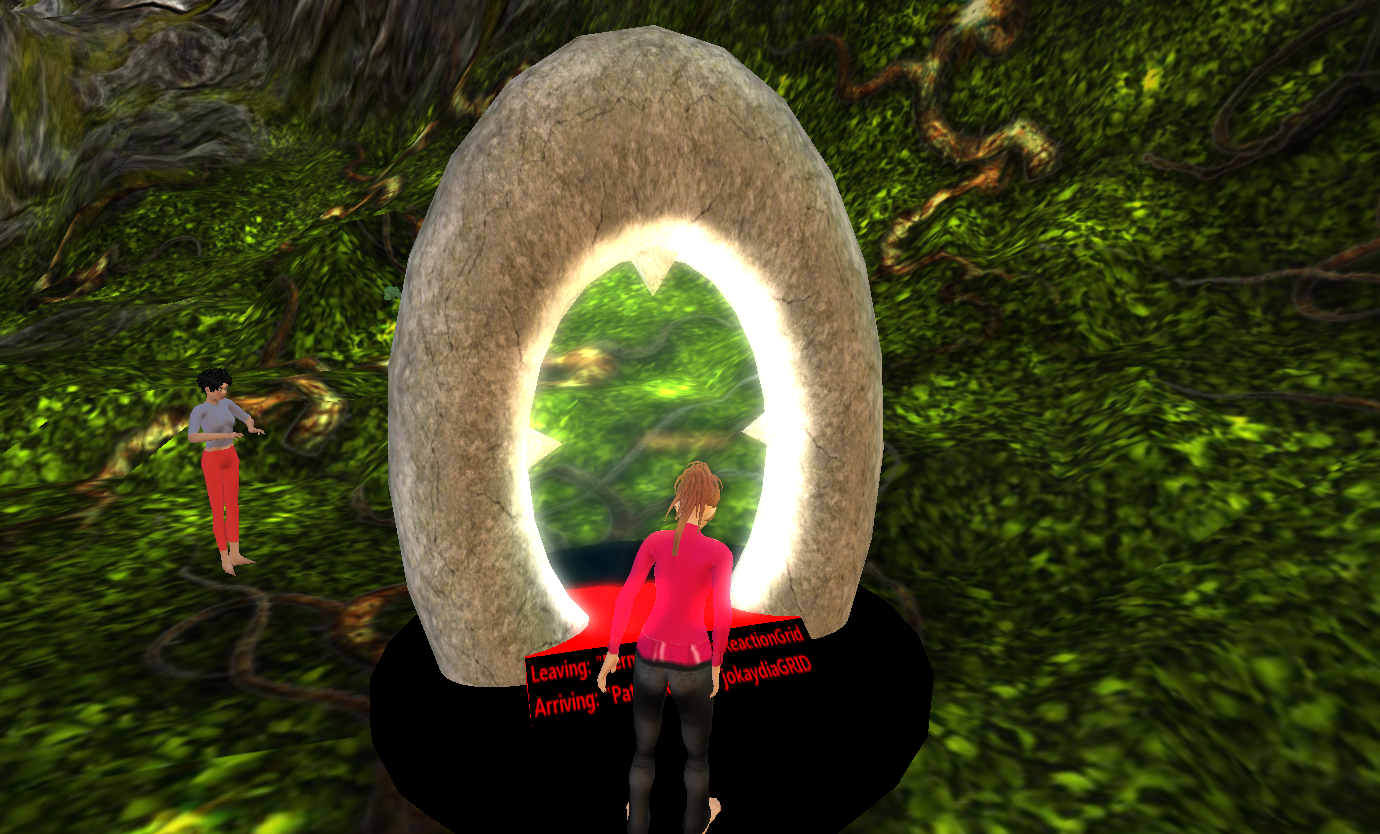
I joined an international group of “Gridizens” a couple of nights ago to experience a hypergrid.  Our Avatars teleported from one grid to another.  In this case we teleported from Reaction Grid to Jokaydia.  The technical aspects are explained on the Opensim wiki. Hopping from one grid to another – hypergridding –  is like linking from one website to another.  We do that everyday on the 2D web without really thinking too much about it, and many create those links in wikis, blogs, and in social networking and bookmarking pages.  A virtual world is a little more complicated because you have an agent or avatar that is entering the grid.  Typically, the user needs to register in each of the worlds and use a different avatar or agent, so the benefit of the hypergrid is that it allows you to use the same avatar in each of these worlds.

Entering the Hypergrid portal on Reaction Grid.

Implications for education and collaboration are significant.  Imagine being able to do extend what is now done in a flat environment like Facebook,  Google Docs, or Diigo in a 3D environment.  A single sign-on, a single username and password,  a single inventory repository simplifies entering the Virtual Universe and visiting the worlds within it.

On Jokaydia Grid with a member of the Jokaydia Grid - the tags indicate the Grid of origin for the visiting Avatars

VW – What’s the Point? Would a score help?

I have been in a cloud – in a trough of disillusionment.  As I encourage colleagues and superiors of the potential in using VW for teaching and learning – and actually get some to register and spend some (limited) time in a virtual world, I get the questions “So what is the point?”  or  “Ok I kinda get it – but is this the best way to…?”  Both are valid questions and questions like these require a thoughtful response.  Some people get it right away, others need guidance, support and demonstrations.  Many need proof – yes metrics.  A hunch is great, a description of happy children makes for good feelings but nothing works like data.

Rubrics are an effective way to capture observations and quantify what participants accomplish and the way in which they do so.  A simple rubric design may look something like this:

Communication Collaboration Problem Solving Use of Information Points
Objective: Participants will work together in teams of … to …..
Participant has minimal communication with other participants Participant works alone Participant has no unique contribution Participant includes only known information 1Points

each

Participant uses voice to effectively communicate with peers Participant demonstrates ability to work with 1 to 2 individuals primarily as a follower Participant participates in solving problems in a unique way Participant contributes to information by completing some research 2points

each

Participant uses both text and voice to collaborate with peers Participant collaborates with peers as a follower as well as a leader Participant provides unique contributions to solve problems Participant contributes with both known and newly researched information 3points

each

Participants would benefit knowing how well they are doing and the objective in the use of the environment needed to succeed. Success depends on the process. So points are awarded when students

  • work with others to accomplish a task
  • communicate effectively
  • locate and use information effectively
Gallery

Gartner Hype Wave

This gallery contains 1 photo.

Always good to triangulate your data – 1.  The Gartner  Hype Cycle/Wave indicates that “Virtual Assistants & Public Virtual Worlds are nearly through the Trough of Disillusionment, about to enter mainstream in 5-10 years” 2.  Recent Grant activity encouraging the use … Continue reading

Firewall Content or Teach Digital Citizenship

So I tried to check out a couple of educational sites that would give me information about educational use of virtual worlds and this is what I got.  I made the mistake of doing this from my workplace, an educational facility.

Virtual Pioneers, a site for collaborating educators, is classified as “dating, computing, social networking” and the URL is blocked by my school district.

Jokadia, a site to document the educational uses of a range of virtual worlds and games was classified as “games, reference material” and is also blocked.

This is what educators deal with daily in an attempt to be innovative and meaningful with the students they teach.  The challenge of preparing students with 21st Century skills is daunting enough and made more difficult with the constant battle over what can be accessed.

On June 4, the Online Safety & Technology Working Group sent its 150-page report to Congress. Anne Collier co-chaired the committee and discussed the recommendations at the most recent ISTE Speaker Series on another blocked site, Second Life – I watched it from my home at 8PM.  Anne discussed  “a more intelligent approach”.  She suggested an approach  in which children are given opportunities to practice with social media under adult supervision.  The participants at the ISTE event were educators from around the world and it was obvious that the ones from the United States were having the biggest struggles with the issue of filtering and blocking.  We all agreed that privacy and safety features were essential but that teaching students about good citizenship in an environment where behavior occurs is essential for their futures.  According to Ms. Collier the educational systems in Australia and in the United Kingdom promote helping students to use appropriate filters rather than enforcing strict filtering polices as we do in the United States.  Teaching children to filter prepares them to deal with Internet safety and appropriate behavior,  implementing  a strict filtering policy does not.

There are some school districts who are more progressive and forward thinking, less fearful.  A high school in New Jersey is taking advantage of social networking and using the technology to help students.  A school in Oregon has documented improved student achievement after social networking was embraced.  Teachers do get tired of “the fight” and just go back to an old-fashioned way of doing things.  My suggestion is to keep doing what you know is right to help our students be prepared for a future we are uncertain of.

Evidence vs Adult Intervention

Remember the clubhouse in the woods you built with your friends.  It was your clubhouse.  You and your friends thought of it, planned it, gathered materials, constructed it, fought about it, fought in it, plotted in it, pretended to be super-heros or knights in it, and then probably tore it down because it seemed like a good idea and it was yours to tear down.  Remember the playhouse that the little girl down the street had.  Her father built it for her.  It was a beauty; A door with hinges and a door knob, heart-shaped shutters, flower-boxes, shingles, matching curtains and furnishings.  She had a birthday party and everyone got to go into it but you couldn’t “mess it up”. Nobody really played there much, it collected spiderwebs.  It sat forever – a monument to adult intervention.

As I listened to the ISTE Speaker Series on SL Tuesday night, Knowclue’s message was most profound.  She said she is a stickler on students building and making their own environment in SL Teen Grid and now on Reaction Grid where she provides instruction.  I sat in the audience and asked “what evidence do you have of student achievement?”  My thoughts were focused on what so many educators are thinking about:  test scores, numbers, Adequate Yearly Progress, achievement data, standards.  Of course these are important quantifiable data points and so is the remarkable build that her students created.

A student build in a virtual world - minimal adult intervention.

The evidence is that children built a community based on a unit of study.  The student Build required the use of communication, collaboration and problem solving (those 21st Century Skills).  It required the use of mathematics and integration of an artistic sensibility.  The students had to read/research and take notes, write, and compute.  Knowclue has a clue and she also has evidence.  The student product is the evidence.  The students will be tested in the standards at the end of the year and those scores too will be reviewed – together they form the picture of evidence.  My hunch is the students who build will demonstrate more learning gains than the students who have it built for them,  look to the evidence.

Advisory Panel to Offer Obama Ideas for Advancing STEM Education

Advisory Panel to Offer Obama Ideas for Advancing STEM Education.

Gallery

Machinima in Education

Creating films for learning is not new in K-12 education nor has the strategy  been limited to magnet programs or exclusive schools that offer high-level technology classes and/or broadcasting.  Teachers have used filmmaking  as a way to help students learn … Continue reading

Federal Virtual Worlds Challenge

An open challenge to create the most innovative and interactive solutions in virtual environments.

http://www.fvwc.army.mil/

  • $25,000 in prizes
  • Focus on AI
  • Open to everyone
  • Submission due date Dec 6 2010