What’s the distinction between Protection from and Prevention of the Net?

The topic of safety on the Internet and protecting children from the perils of the Internet, as well as protecting organizations from possible lawsuits, have been coming up more and more frequently. A few years ago I would encounter the “ACCESS DENIED” screen not more than once every couple of months.  I would even have participants in a training purposely type in a URL that would produce that same screen, to demonstrate the effectiveness of the system keeping children secure and I would also report a site for needed blocking, if I stumbled upon something that was clearly inappropriate.   When encountering ‘the screen‘, I would continue with my work  and possibly check the source I was looking for after hours from my home computer.

Today I encounter the “ACCESS DENIED” screen several times a day and my colleagues report a similar experience.  The firewall is becoming a barrier to research, learning, collaboration and  innovation.  Now I contact the appropriate department requesting adjustment of the site I am trying to get to and  inevitably get the answer that “there is nothing that we can do – the School Board will not allow this site as it is classified as______”.  Are there more inappropriate sites than there used to be?  Are we blocking more than we used to?  Are we screening effectively?  Are we effectively teaching the appropriate use of the Internet?  Has the firewall become a replacement for teacher monitoring and supervision?  Is there a difference between social networking and professional networking?  How are social networking and social bookmarking the same/different?

The advent of social networking and virtual worlds used by the working world have caused me to ponder these questions and push back a little at our well-meaning and disciplined “Internet Police”.  I wonder if the fear of what students MAY encounter has caused us to prevent encounters that could be useful and educational.  Can social networking sites and working in virtual worlds positively impact collaboration and learning?
A government site, http://www.onguardonline.gov/, provides information for parents to know what to look for and to discuss with children regarding safety on the Internet, including social networking and virtual worlds.  Could this be curriculum material for educators to use?   In an ISTE 2010 address Mario Armstrong referred  to school districts blocking of the Internet as the  Locked Net Monster.  Check out the learning today blog for some ideas on teaching digital safety in a k-12 school setting.

I am not suggesting we unlock the firewall to all that is available, just a more thoughtful approach to what could be useful.  An approach that includes academic review, intellectual curiosity and alignment with 21st century skills.  The approach would require diligent supervision by teachers and appropriate preparation for use of the tool that has become ubiquitous, except in the classroom.  In the meantime I’ll do like the kids – use my smartphone, call a friend or wait until I get home to look it up.


From Virtual to Real- Second Life Community Convention Aug 13-15, 2010

Great to see that education and work with non-profits included in this real convention about the virtual world.  There are simultaneous RL and in-world meetings as well as great keynote speakers and SL musicians performing live – in RL.  I am hoping to be able to see recordings since Boston is not on my travel list this year.

Virtual Visuals add to Authentic Engagement

The difference between participating in a cyber educational event via a webinar and one via a virtual world  is dramatic.  When I first started to explore the use of virtual worlds to determine potential use in education I asked, “why not just use an online meeting software package? A webinar allows voice, is in real-time, allows sharing and collaborating, includes chat and sidebar conversations as well as the benefits of not having to waste time in travel and logistics of a F-t-F event”.  The use of an avatar and mechanics of having to find the right outfit for her to wear, to have her transport, walk and sit in a virtual auditorium seemed a little silly.

Avatars attending a building Class at NCI on SL. Snoopy was a classmate.

Having participated in both types of events I can now say that, for me, the Virtual World experience is much more connected.  Even a ‘talking head’ presentation with a Powerpoint is more active in the 3D virtual world than participating in a 2D webinar.  I have observed that in a 3D environment the audience seems more likely to ask questions and provide commentary which adds to the information and addresses adult learning principles.  The chat texts I have saved from regular ISTE sessions are much longer and more interesting than the ones I have from Elluminate and Meeting-Place sessions I have attended.  They are also less formal, more natural.

When I attend a “flat” webinar I have a tendency to multi-task, to have the webinar on in the background while I do some other work at my desk.  Conversely, when sitting in an audience of avatars there is a feeling of presence.  I look around and see who else is there, I may chat with someone I know, introduce myself to someone I don’t know and contribute to the conversation in local chat for everyone’s benefit or chat privately on the issues being discussed.  I rarely do other work and concentrate on the topic at hand.   I am more engaged.

Virtual events that incorporate instructional strategies such as grouping participants, taking “field trips”, and interacting with content in the environment are even more engaging and push participants to participate.

A class getting ready to go on a field trip

The use of the virtual world medium is still evolving and it seems the majority of decision makers have yet to be convinced of potential educational merits.   I was not convinced until I had mastered some basic avatar communication and mobility skills and had participated several times in sessions that were of particular interest with skilled presenters.  I have paid more attention to the cartoons in virtual worlds than to an unattached voice and a whiteboard on my computer desktop.

Culture and Foreign Language, Virtually

Learning of foreign languages can be somewhat of a challenge in the United States, partially due to proximity to countries where another language is spoken, yet global perspectives are essential and better  addressed through a multi-lingual  and multi-cultural citizenry.  “According to the American Council on the Teaching of Foreign Languages, a higher percentage of students are studying a foreign language than at any time in history.”  The Case for Foreign language Classes Education Week ( July 12, 2010).  Students need to become prepared to conduct business and compete in a global economy, our competitors across the globe are addressing it.

Foreign language instruction is an area that can be handled effectively through virtual environment experiences.  Foreign language teachers will tell you that practice in the native tongue with native speakers is a “best practice”.  In real life it often includes field trips, at the very least to a local restaurant or community,  students from affluent homes may participate in a trip abroad.

In a virtual environment, students can be placed in a variety of social situations, with native speakers, to practice newly acquired linguistic skills. There are instant translators available in virtual worlds that can translate written text to a limited degree, and/or students may turn on voice and actually practice speaking with individuals from another country.   Environments can be constructed to elicit the practice of particular vocabulary such as sporting, arts, cultural, or social events.  Students (through avatars) engaged in conversation and interaction will naturally acquire cultural lessons as well.

ESOL students could use the environment similarly.  A characteristic that encourages language practice for the second language learner is the ‘security’ of the avatar.  Students learning a foreign language may express a reluctance to speak, for fear of being made fun of.  An avatar representation offers some shielding from potential or perceived ridicule.

A virtual setting may very well be the most ‘natural’ setting we can provide, at a reasonable cost, for foreign language instruction.

Collaboration is a 21st Century Skill

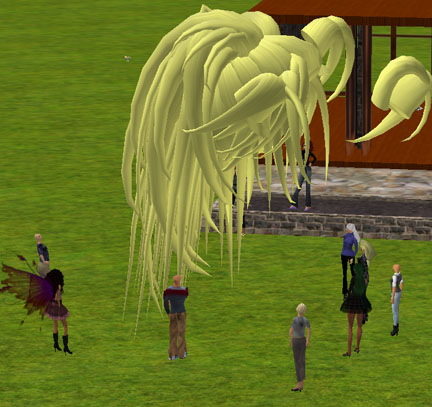
Avatars collaborating on making hair

Employers complain that the incoming workforce lacks what is needed.  Are we preparing our students appropriately for their future?   Tony Wagner in his book, The Global Achievement Gap discusses what he calls the 7 survival skills for the 21st century.  According to him these skills are:

  1. Problem-solving and critical thinking;
  2. Collaboration across networks and leading by influence;
  3. Agility and adaptability;
  4. Initiative and entrepreneurship;
  5. Effective written and oral communication;
  6. Accessing and analyzing information; and
  7. Curiosity and imagination.

These are the kinds of things we discuss in our annual reviews with supervisors and we know these skills make us more productive and useful to the organization.

Most of these 7 skills are supported with project-based  participant production in a virtual environment.  Student production in virtual environments involves building, scripting and researching to develop content.  This type of activity lends itself to a collaborative atmosphere and the ‘network’ across which students collaborate can extend across the globe. (Collaborative building in Second Life – Palo Alto Research Center). Problem solving takes place while planning and again while producing.  Limitations must be considered and decisions about the best solution take place for effective results.  Students must use mathematics and communication skills as they work together to complete their intended product.  They may need to do some research and analyze information as they progress in their building.  Discovery can take place and a plan may change or students may need to adapt a plan and influence colleagues toward a different approach.  Of course, curiosity and imagination are always at play as students build what defies common perceptions and sometimes the laws of physics.  It is the process that is most important here, what the students have to do to achieve their goal – not the final product.